
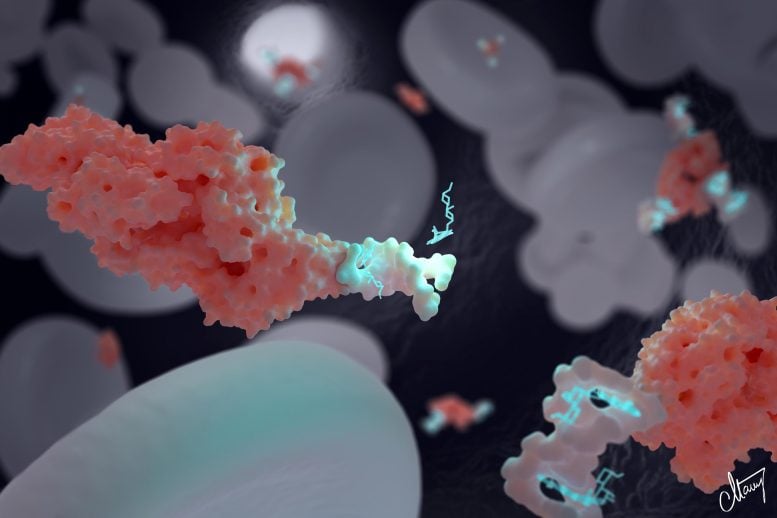
A new class of drug transporters made of DNA that are 20,000 times smaller than a human hair and that could improve how cancers and other diseases are treated has been designed and validated.
These molecular transporters can be chemically programmed to deliver an optimal concentration of drugs, making them more efficient than current methods. A team of Canadian researchers from the University of Montreal, (UdeM) report the details in a new study that will be published today (November 2) in the journal Nature Communications.
Optimal Dosing at All Times: A Medical Challenge
Providing and maintaining a therapeutic drug dosage throughout treatment is one of the key ways to successfully treat disease. Overexposure to treatments increases side effects. On the other hand, sub-optimal therapeutic exposure reduces efficiency and typically leads to drug resistance.
A major challenge in modern medicine is maintaining an optimal concentration of drugs in the blood. Since most drugs undergo rapid degradation, patients are forced to take multiple doses at regular intervals. Many patients often forget to take medications on time, leading to lower-than-optimal dosing. And because each patient has a distinct pharmacokinetic profile, the concentration of the drug in their blood varies significantly.
Observing that only about 50 percent of cancer patients get an optimal drug dosage during certain chemotherapy, UdeM Chemistry associate professor Alexis Vallée-Bélisle, an expert in bio-inspired nanotechnologies, started to explore how biological systems control and maintain the concentration of biomolecules.
“We have found that living organisms employ protein transporters that are programmed to maintain precise concentration of key molecules such as thyroid hormones, and that the strength of the interaction between these transporters and their molecules dictates the precise concentration of the free molecule,” he said.
This simple idea led Valléé-Belisle – who holds a Canada Research Chair in bioengineering and bionanotechnology — and his research team to start developing artificial drug transporters that mimic the natural effect of maintaining a precise concentration of a drug during treatment.
UdeM PhD student Arnaud Desrosiers, the first author of the study, initially identified and developed two DNA transporters: one for quinine, an antimalarial, and the other for doxorubicin, a commonly used drug for treating breast cancer and leukemia.
He then demonstrated that these artificial transporters could be readily programmed to deliver and maintain any specific concentration of drug.
“More interestingly, we also found that these nanotransporters could also be employed as a drug reservoir to prolong the effect of the drug and minimize its dosage during treatment,” said Desrosiers.
“Another impressive feature of these nanotransporters,” he added, “is that they can be directed to specific parts of the body where the drug is most needed – and that, in principle, should reduce most side effects.”
Nanotreated Mice: Reduced Cardiotoxicity
To demonstrate the effectiveness of these nanotransporters, the researchers teamed up with Jeanne Leblond-Chain, a pharmacist at Université de Bordeaux, in France; Luc DesGroseillers, a biochemist at UdeM; Jérémie Berdugo, a pathologist at UdeM; Céline Fiset, a pharmacist at the Montreal Heart Institute; and Vincent De Guire, a clinical biochemist at the UdeM-affiliated Maisonneuve-Rosemont Hospital.
Using the new drug transporter developed for doxorubicin, the team demonstrated that a specific drug-transporter formulation allows doxorubicin to be maintained in the blood and drastically reduces its diffusion toward key organs such as the heart, lungs, and pancreas.
In mice treated with this formulation, doxorubicin was maintained 18 times longer in the blood and cardiotoxicity was reduced as well, keeping the mice more healthy as evidenced by their normal weight gain.
“Another great property of our nanotransporters is their high versatility,” said Vallée-Bélisle.
“For now, we have demonstrated the working principle of these nanotransporters for two different drugs. But thanks to the high programmability of DNA and protein chemistries, one can now design these transporters to precisely deliver a wide range of threrapeutic molecules.”
And, he added, “additionally, these transporters could also be combined with human-designed liposomic transporters that are now being employed to deliver drugs at various rates.”
A Clinical Study for Blood Cancers?
The researchers are now eager to validate the clinical efficiency of their discovery. Since
their doxorubicin nanotransporter is programmed to optimally maintain the drug in blood circulation, it could be deal to treat blood cancers, they believe.
“We envision that similar nanotransporters may also be developed to deliver drugs to other specific locations in the body and maximize the presence of the drug at tumor sites,” said Vallée-Bélisle. “This would drastically improve the efficiency of drugs as well as decrease their side effects.”
Reference: “Programmable self-regulated molecular buffers for precise sustained drug delivery” by Arnaud Desrosiers, Rabeb Mouna Derbali, Sami Hassine, Jérémie Berdugo, Valérie Long, Dominic Lauzon, Vincent De Guire, Céline Fiset, Luc DesGroseillers, Jeanne Leblond Chain and Alexis Vallée-Bélisle, 2 November 2022, Nature Communications.
DOI: 10.1038/s41467-022-33491-7
Never miss a breakthrough: Join the SciTechDaily newsletter.
Follow us on Google and Google News.
1 Comment
I got shouted at by my consultant about myLymphoma”What have you been doing there’s a marker where you had it now we can’t find it anywhere”