
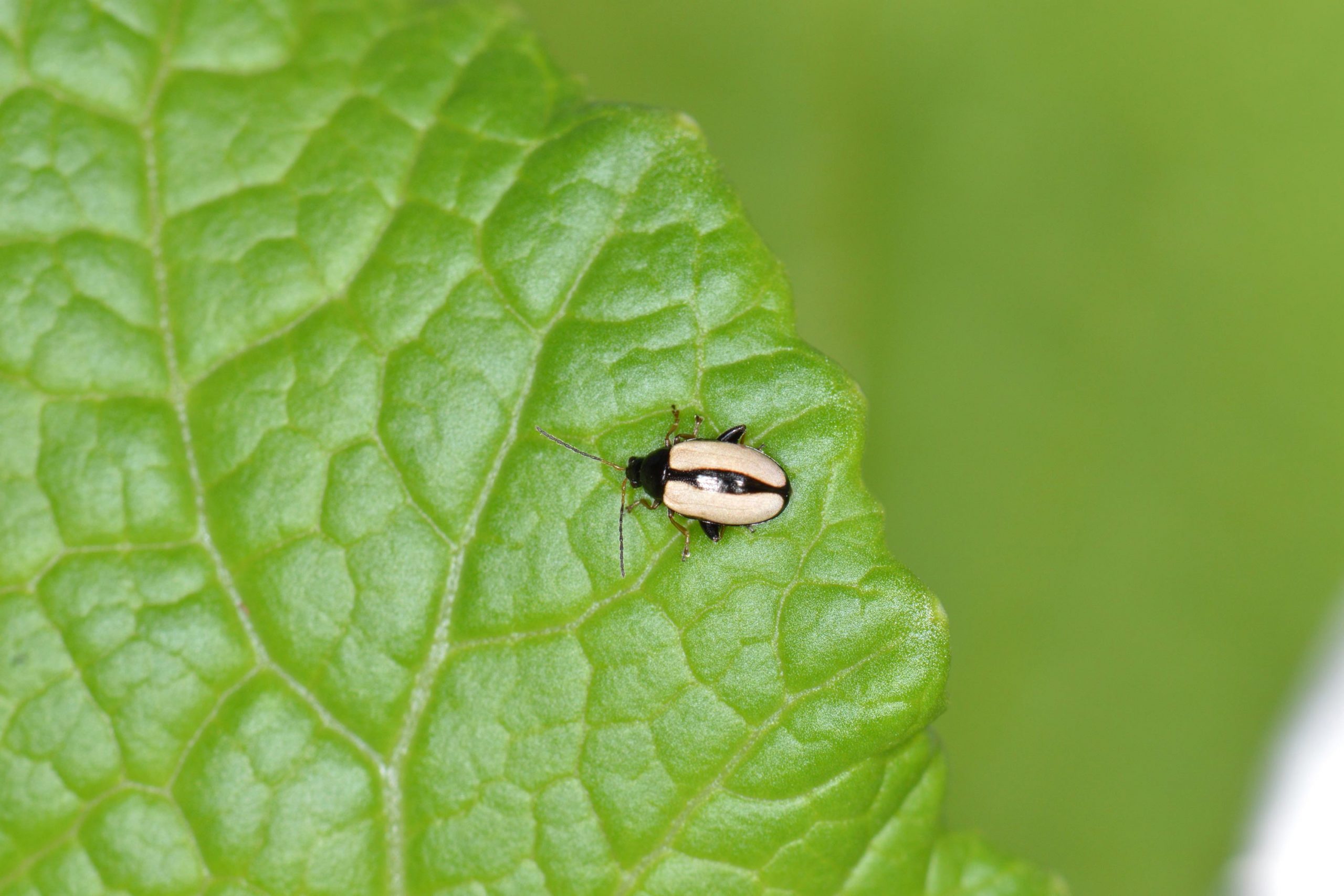
Researchers elucidate how the insect regulates the accumulation of plant toxins via special transporters.
When horseradish flea beetles feed on their host plants, they take up not only nutrients but also mustard oil glucosides, the characteristic defense compounds of horseradish and other brassicaceous plants. Using these mustard oil glucosides, the beetles turn themselves into a “mustard oil bomb” and so deter predators. A team of researchers from the Max Planck Institute for Chemical Ecology in Jena, Germany, has now been able to demonstrate how the beetle regulates the accumulation of mustard oil glucosides in its body. The beetles have special transporters in the excretory system that prevent the excretion of mustard oil glucosides. This mechanism enables the horseradish flea beetle to accumulate high amounts of the plant toxins in its body, which it uses for its own defense. (Study published today, May 11, 2021, in the journal Nature Communications.)
Sequestration: Well-Armed With the Weapons of Others
Many animals use chemical defense compounds to deter predators. These defense compounds are either produced by the animal itself or by symbionts of the animal, or they are acquired from the diet. The ability to acquire defense compounds from the diet is particularly widespread in insects that feed on toxic plants. One example is the horseradish flea beetle (Phyllotreta armoraciae), which can sequester mustard oil glucosides, also known as glucosinolates, in its body.
“The horseradish flea beetle belongs to an economically important group of insects, because several Phyllotreta species are crop pests. This beetle, which can accumulate vast amounts of host plant glucosinolates, regulates the levels and composition of glucosinolates in the body at least partially by excretion. This suggested that Phyllotreta armoraciae possesses very efficient transport and storage mechanisms, which we wanted to uncover,” says first author Zhi-Ling Yang, explaining the goal of the new study.
The team led by Franziska Beran, head of the Sequestration and Detoxification in Insects Research Group at the Max Planck Institute, has already been able to demonstrate how the horseradish flea beetle effectively uses glucosinolates from its host plant to defend itself against a predatory ladybug (see press release, “Whether horseradish flea beetles can deter predators depends on their food plant and their life stage,” March 2, 2020).
Special Transporters for Plant Toxins in the Excretory System of the Beetles
Although it has long been known that horseradish flea beetles and related species can accumulate glucosinolates, how the beetle absorb and store high amounts of these substances in the body was unknown. The research team’s goal, therefore, was to identify glucosinolate transporters in this insect. “The search for these transporters was literally like looking for a needle in a haystack,” recalls Beran, “We found 1401 putative membrane transporters in the gut and excretory system of this beetle. Narrowing down our search to transporters that are specific for the horseradish flea beetle helped us to identify a group of glucosinolate-specific transporters.”
These glucosinolate transporters are located in the excretory system, the so-called Malpighian tubules. The function of the Malpighian tubules in insects is similar to the function of the kidneys in vertebrates. The scientists determined the function of the identified transporters by using RNA interference, an approach in which the expression of a gene of interest is reduced in order to determine its function in the organism: “We silenced the expression of several transporter genes that are localized in the Malpighian tubules and found that the beetles excreted more glucosinolates than a control group of beetles with normal gene expression. Because of the higher excretion rate, the levels of defense compounds in the beetle body went down. Our study is the first to identify transporters in the Malpighian tubules that enable an insect to accumulate plant defense compounds,” Yang summarizes.
With their study, the researchers show that sequestration is a complex process and much more than just the uptake of plant metabolites into the animal’s body. The sequestering insect must adapt its entire physiology to use plant defense compounds for its own defense. These adaptations are driven by challenges in its environment: predators, parasites, and pathogens. “Sequestration is probably one of the most complex adaptations that herbivorous insects have evolved. It most certainly also contributes to the evolutionary success of insects that specialize in certain host plants, such as the horseradish flea beetle,” says Beran.
Beran’s team now wants to identify other transporters involved in sequestration. The scientists also want to know which natural enemies of the horseradish flea beetle the glucosinolates are providing protection from. Increased knowledge of how the horseradish flea beetle sequesters toxins and the effects on its ecological interactions with other organisms in the environment, will improve understanding of this pest and may lead eventually to better strategies for its control.
Reference: “Sugar transporters enable a leaf beetle to accumulate plant defense compounds” by Zhi-Ling Yang, Hussam Hassan Nour-Eldin, Sabine Hänniger, Michael Reichelt, Christoph Crocoll, Fabian Seitz, Heiko Vogel and Franziska Beran, 11 May 2021, Nature Communications.
DOI: 10.1038/s41467-021-22982-8
Funding: Max Planck Society, Danish National Research Foundation
Never miss a breakthrough: Join the SciTechDaily newsletter.
Follow us on Google and Google News.