
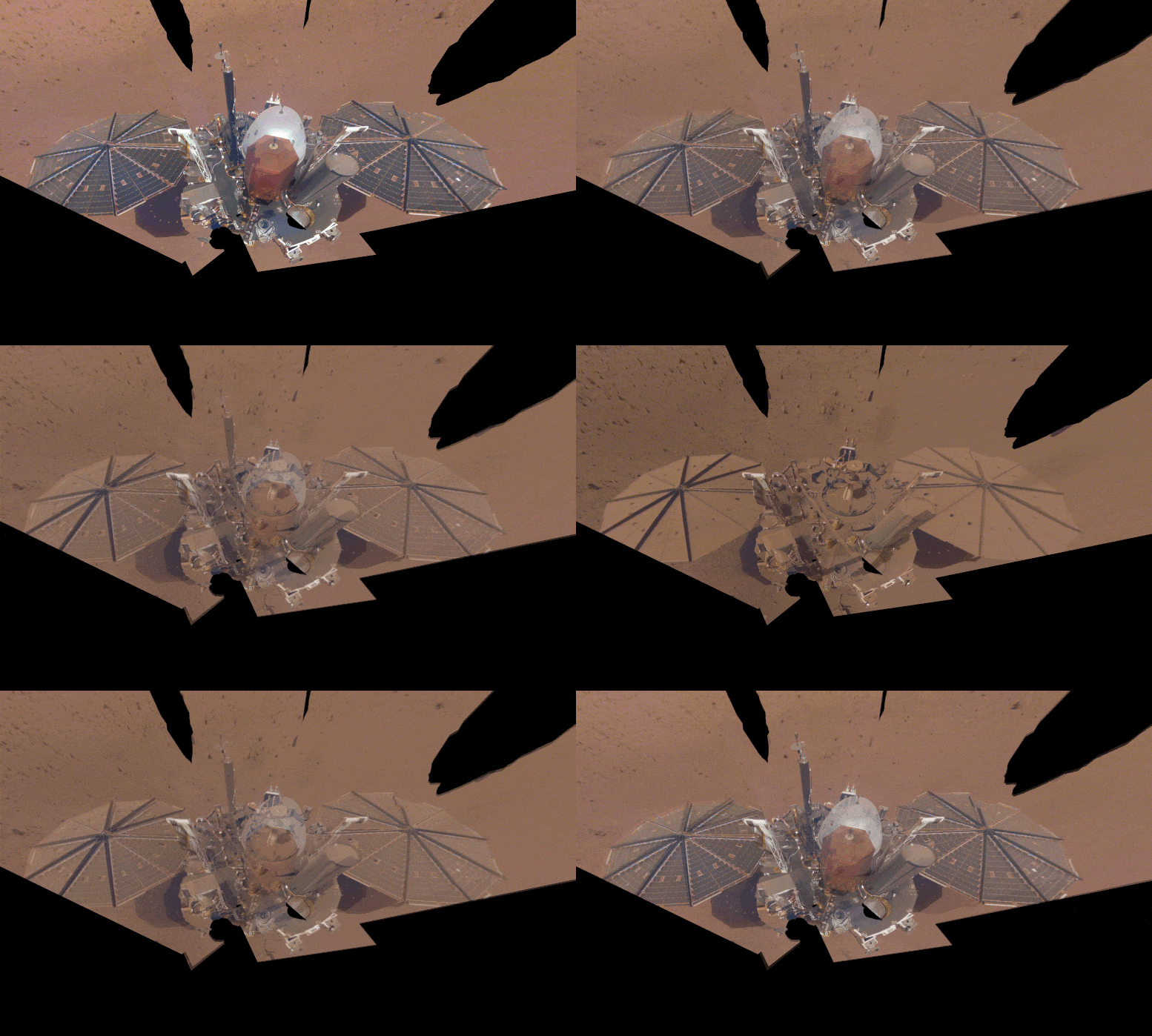
A closer look at what goes into wrapping up the mission as the InSight spacecraft’s power supply continues to dwindle.
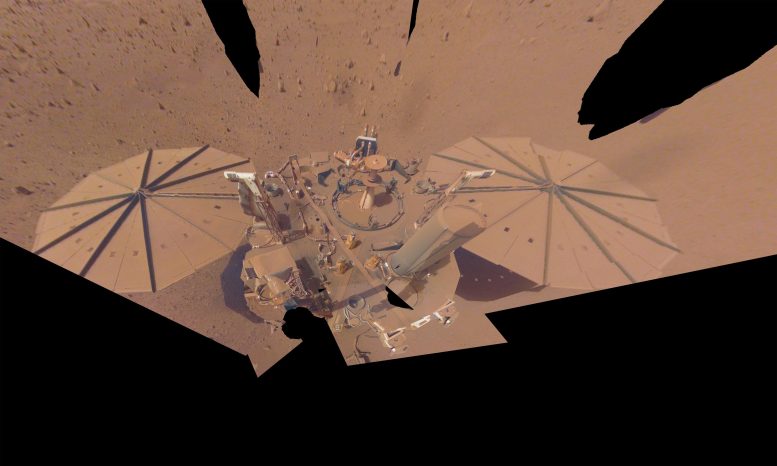
The end is nigh for NASA’s Mars InSight lander. The day is fast approaching when the spacecraft will fall silent, ending its history-making mission to reveal secrets of the Red Planet’s interior. Since the spacecraft’s power generation continues to decline as windblown dust on its solar panels thickens, the engineering team has already taken steps to continue as long as possible with what power remains. Despite these efforts, it won’t be long now, as the end is expected to come in the next few weeks.
Although InSight’s tightknit 25-to-30-member operations team – a small group compared to other Mars missions – continues to squeeze the most they can out of InSight, they’ve also begun taking steps to wind down the mission.
Here’s a glimpse of what that looks like.
Preserving Data
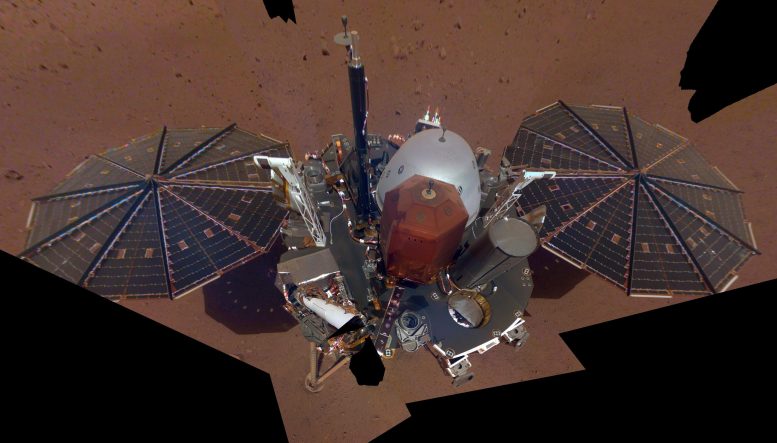
With InSight (short for Interior Exploration using Seismic Investigations, Geodesy and Heat Transport), the most important of the final steps of the mission is storing its trove of data and making it accessible to researchers around the world. Already, the data from the lander has yielded details about Mars’ interior layers, its liquid core, the surprisingly variable remnants beneath the surface of its mostly extinct magnetic field, weather on this part of Mars, and lots of quake activity. More insights are sure to follow, as scientists continue to sift through the data.
InSight’s seismometer, provided by France’s Centre National d’Études Spatiales (CNES), has detected more than 1,300 marsquakes since the lander touched down in November 2018. The largest quake it detected measured a magnitude 5. It even recorded quakes from meteoroid impacts. Observing how the seismic waves from those quakes change as they travel through the planet offers an invaluable glimpse into Mars’ interior. Beyond that, these observations also provide a better understanding of how all rocky worlds form, including Earth and its Moon.
“Finally, we can see Mars as a planet with layers, with different thicknesses, compositions,” said Bruce Banerdt of NASA’s Jet Propulsion Laboratory (JPL) in Southern California, the mission’s principal investigator. “We’re starting to really tease out the details. Now it’s not just this enigma; it’s actually a living, breathing planet.”
The seismometer readings will join the only other set of extraterrestrial seismic data, from the Apollo lunar missions, in NASA’s Planetary Data System. They will also go into an international archive run by the Incorporated Research Institutions for Seismology, which houses “all the terrestrial seismic network data locations,” said JPL’s Sue Smrekar, InSight’s deputy principal investigator. “Now, we also have one on Mars.”
Smrekar said the data is expected to continue yielding discoveries for decades.
Managing Power
Earlier this summer, the lander had so little power remaining that the mission turned off all of InSight’s other science instruments in order to keep the seismometer running. They even turned off the fault protection system that would otherwise automatically shut down the seismometer if the system detects that the lander’s power generation is dangerously low.
“We were down to less than 20% of the original generating capacity,” said Banerdt. “That means we can’t afford to run the instruments around the clock.”
Recently, after a regional dust storm added to the lander’s dust-covered solar panels, the team decided to turn off the seismometer altogether in order to save power. Now that the storm is over, the seismometer is collecting data again. However, the mission expects the lander only has enough power for a few more weeks.
Of the seismometer’s array of sensors, only the most sensitive were still operating, said Liz Barrett, who leads science and instrument operations for the team at JPL, adding, “We’re pushing it to the very end.”
Packing Up Twin
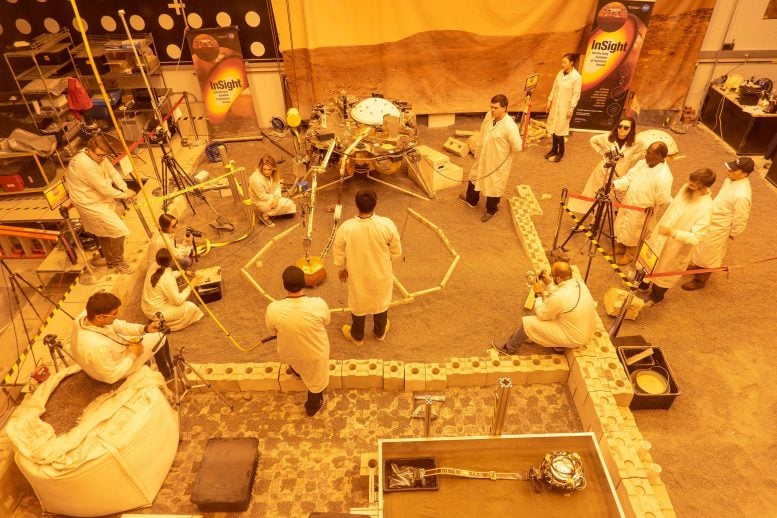
A silent member of the team is ForeSight, the full-size engineering model of InSight in JPL’s In-Situ Instrument Laboratory. Engineers used ForeSight to practice how InSight would place science instruments on the Martian surface with the lander’s robotic arm, test techniques to get the lander’s heat probe into the sticky Martian soil, and develop ways to reduce noise picked up by the seismometer.
ForeSight will be crated and placed in storage. “We’ll be packing it up with loving care,” Banerdt said. “It’s been a great tool, a great companion for us this whole mission.”
Declaring Mission End
When InSight misses two consecutive communication sessions with the spacecraft orbiting Mars, part of the Mars Relay Network, NASA will declare the mission over. However, this rule only applies if the cause of the missed communication is the lander itself, said network manager Roy Gladden of JPL. After that, NASA’s Deep Space Network will still listen for a while, just in case.
However, there will be no heroic measures to re-establish contact with InSight. Although a mission-saving event, such as a strong gust of wind that cleans the panels off, isn’t impossible, it is considered quite unlikely.
In the meantime, as long as InSight remains in contact, the team will continue gathering data. “We’ll keep making science measurements as long as we can,” Banerdt said. “We’re at Mars’ mercy. Weather on Mars is not rain and snow; weather on Mars is dust and wind.”
More About the Mission
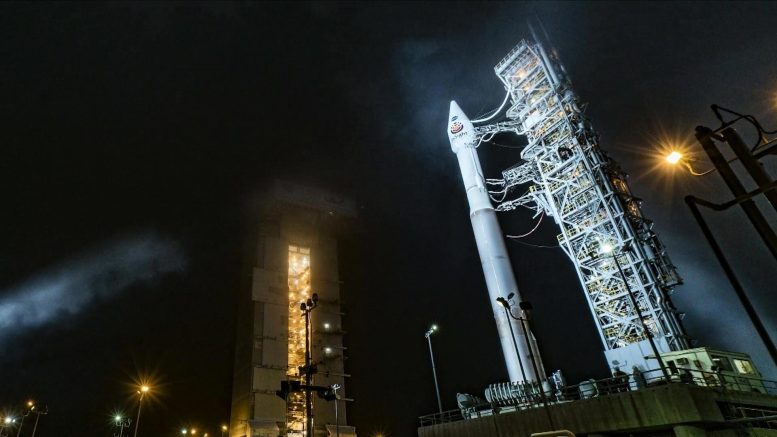
NASA’s Jet Propulsion Laboratory (JPL) manages InSight for NASA’s Science Mission Directorate. InSight is part of NASA’s Discovery Program, managed by the agency’s Marshall Space Flight Center in Huntsville, Alabama. Lockheed Martin Space in Denver built the InSight spacecraft, including its cruise stage and lander, and supports spacecraft operations for the mission.
A number of European partners, including France’s Centre National d’Études Spatiales (CNES) and the German Aerospace Center (DLR), are supporting the InSight mission. CNES provided the Seismic Experiment for Interior Structure (SEIS) instrument to NASA, with the principal investigator at IPGP (Institut de Physique du Globe de Paris). Significant contributions for SEIS came from IPGP; the Max Planck Institute for Solar System Research (MPS) in Germany; the Swiss Federal Institute of Technology (ETH Zurich) in Switzerland; Imperial College London and Oxford University in the United Kingdom; and JPL. DLR provided the Heat Flow and Physical Properties Package (HP3) instrument, with significant contributions from the Space Research Center (CBK) of the Polish Academy of Sciences and Astronika in Poland. Spain’s Centro de Astrobiología (CAB) supplied the temperature and wind sensors, and the Italian Space Agency (ASI) supplied a passive laser retroreflector.
Never miss a breakthrough: Join the SciTechDaily newsletter.
Follow us on Google and Google News.
11 Comments
I may not make a big difference (every little it helps), but, is there an option to close and reopen the solar panels? This may either shake loose some of the dust or shut it down completely. It might be worth a try. Could give the lander a little more time.
Cant, the designs’ a geared motor on a tape system. Doesn’t allow the wings to furl/unfurl once the hinges deploy and the latches lock.
Why not fly over it with the helicopter?
Our team was in charge of the PV aspect of this build. It hinged on our success to scale up LUCY. It boggles my mind they don’t get the chopper to clear the dust. Such a shame its dying. Musk, walk over there and fix it!
Why don’t they try using the helicopter to blow air on the solar panels?
WHY CAN THEY PUT A AIR BLAST OR SOMETHING TO CLEAN THE SOLAR PANALS? IT WOULD BE SO SIMPLE. WHAT IS WRONG WITH A LITTLE COMMON SENSE?
Air blast is a good idea, But I was thinkin somthin stupid like…a windshield wiper..ta da!
Winshield wiper with a simple air blast from time to time problem solved send all proseeds to me and Johm
I realy don’t understand they spend billions to get the thing there and no one thinks oh, no power the stupid thing won’t work, this is not the first time to smart for their own good I guess.
I see a lot of misplaced anger in these comments. People, the original mission was supposed to last 2 years. It has made it more than 3. The mission has been a success, and this is the best of all possible planned outcomes. Any ‘blast of air’ or ‘wiper’ would have been added weight and complexity. Believe me, these engineers thought about every gram and the impact it would have on the success or failure.
Oh… and the helicopter? It is half a planet away from this lander.
If they had a way to create vibratory oscillations. I think that would either cause the dust to collect in small clumps or slide off exposing some of the panels.