
NASA’s InSight “Hears” Its First Meteoroid Impacts on Mars
SEIS, the Mars lander’s seismometer, has picked up vibrations from four separate impacts in the past two years.
NASA’s InSight lander has detected seismic waves from four space rocks that crashed on Mars in 2020 and 2021. These represent the first impacts detected by the spacecraft’s seismometer since InSight touched down on the Red Planet in 2018. In fact, it also marks the first time seismic and acoustic waves from an impact have been detected on Mars.
A new scientific paper details the impacts, which ranged between 53 and 180 miles (85 and 290 kilometers) from InSight’s location, a region of Mars called Elysium Planitia. It was published on September 19 in the journal Nature Geoscience.
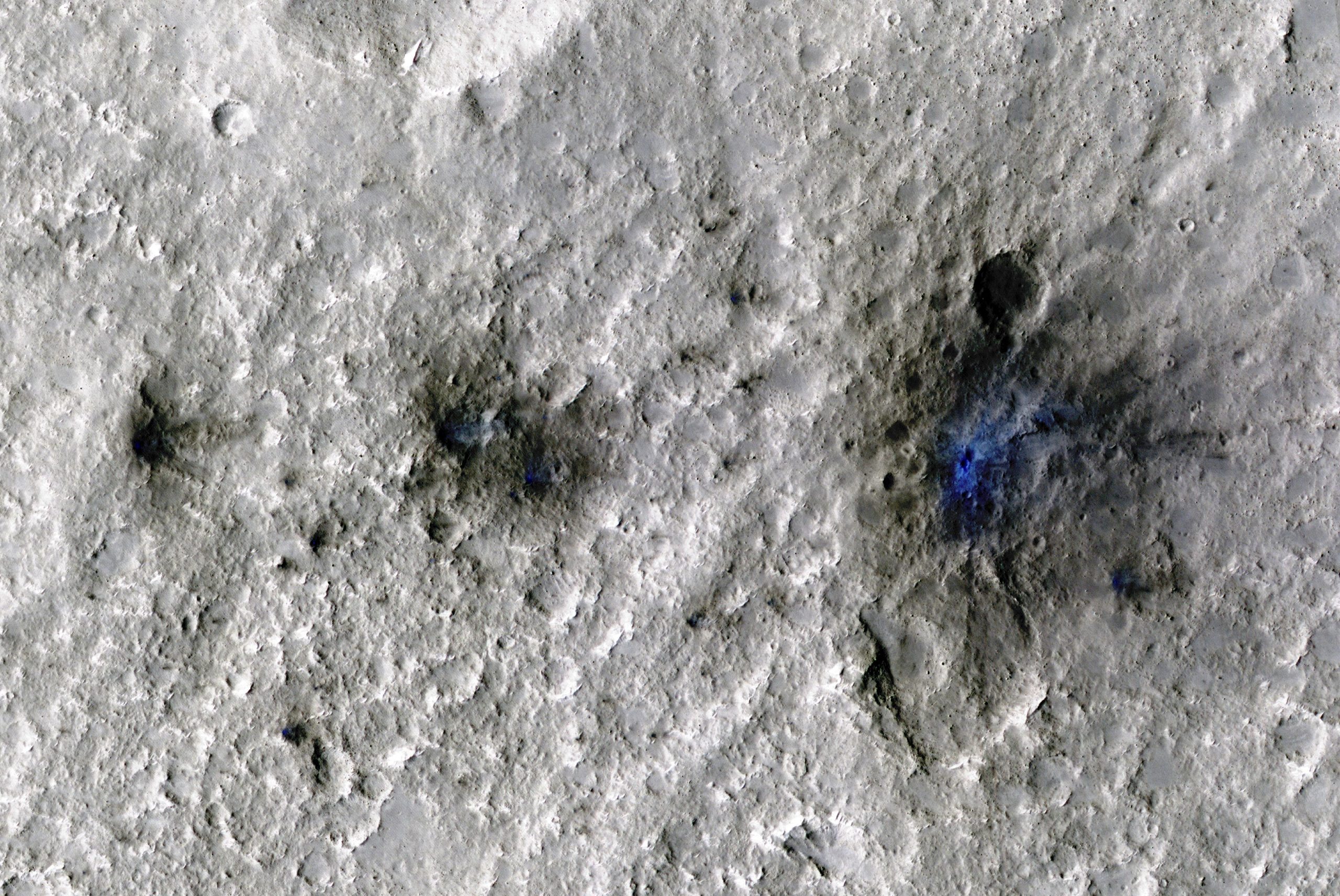
A “meteoroid” is the term used for space rocks before they hit the ground. The first of the four confirmed meteoroids made the most dramatic entrance: It exploded into at least three shards that each left a crater behind after entering Mars’ atmosphere on September 5, 2021.
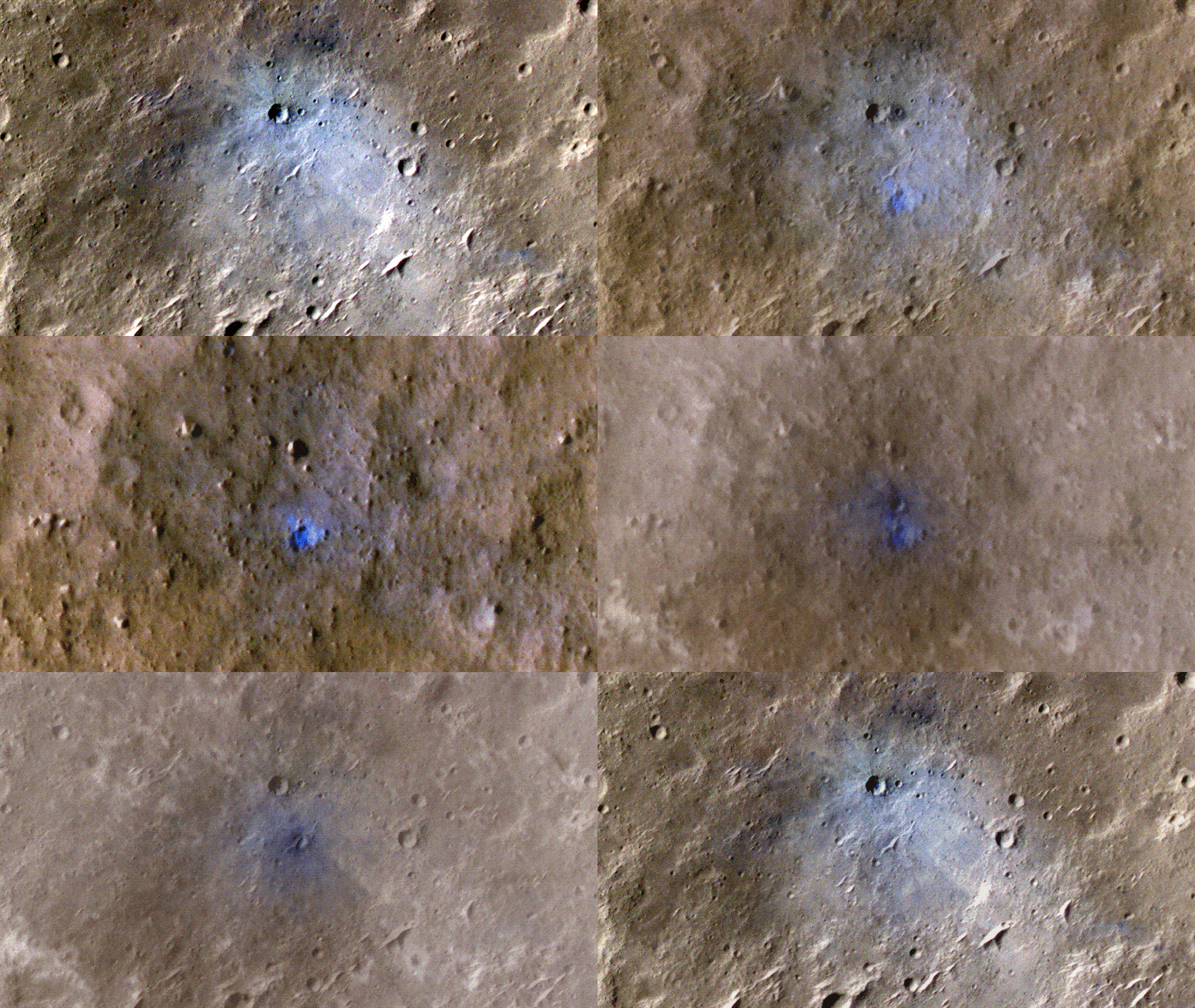
NASA’s Mars Reconnaissance Orbiter then flew over the estimated impact site to confirm the location. The orbiter used its black-and-white Context Camera to reveal three darkened spots on the surface. After locating these spots, the orbiter’s team used the High-Resolution Imaging Science Experiment camera, or HiRISE, to get a color close-up of the craters (the meteoroid could have left additional craters on the surface, but they would be too small to see in HiRISE’s images). See the images in the “Mars Crater Collage” below.
Learn more about the first meteoroid impact NASA’s InSight lander detected on Mars in this video. Credit: NASA/JPL-Caltech
“After three years of InSight waiting to detect an impact, those craters looked beautiful,” said Ingrid Daubar of Brown University. She is a co-author of the paper and a specialist in Mars impacts.
After combing through earlier data, researchers confirmed three other impacts had occurred on May 27, 2020; February 18, 2021; and August 31, 2021.
Scientists are perplexed as to why they haven’t detected more meteoroid impacts on Mars. The Red Planet is located next to the solar system’s main asteroid belt, which should provide an ample supply of space rocks to scar the planet’s surface. Additionally, far more meteoroids pass through Mars’ atmosphere without disintegrating because it is just 1% as thick as Earth’s.
The sound of a meteoroid striking Mars – created from data recorded by NASA’s InSight lander – is like a “bloop” due to a peculiar atmospheric effect. In this audio clip, the sound can be heard three times: when the meteoroid enters the Martian atmosphere, explodes into pieces, and impacts the surface. Credit: NASA/JPL-Caltech/CNES/IPGP
SEIS, InSight’s seismometer, has detected over 1,300 marsquakes. Provided by France’s space agency, the Centre National d’Études Spatiales, the instrument is so sensitive that it can detect seismic waves from thousands of miles away. However, the September 5, 2021, event marks the first time an impact was confirmed as the cause of such waves.
InSight’s team suspects that noise from wind or seasonal changes in the atmosphere may have obscured other impacts. But now that the distinctive seismic signature of an impact on Mars has been discovered, researchers expect to discover more hiding within InSight’s nearly four years of data.
Science Behind the Strikes
Seismic data offer various clues that will help scientists better understand the Red Planet. Most marsquakes are caused by subsurface rocks cracking from heat and pressure. Studying how the resulting seismic waves change as they move through different materials provides scientists a way to study Mars’ crust, mantle, and core.
The four meteoroid impacts confirmed so far produced small quakes with a magnitude of no more than 2.0. Those smaller quakes provide investigators with only a glimpse into the Martian crust, while seismic signals from larger quakes, like the magnitude 5 event that occurred in May 2022, can also reveal details about the planet’s mantle and core.

However, the impacts will be critical to refining Mars’ timeline. “Impacts are the clocks of the solar system,” said the paper’s lead author, Raphael Garcia of Institut Supérieur de l’Aéronautique et de l’Espace in Toulouse, France. “We need to know the impact rate today to estimate the age of different surfaces.”
Scientists can calculate the approximate age of a planet’s surface by counting its impact craters: The more they see, the older the surface. By calibrating their statistical models based on how often they see impacts occurring now, researchers can then estimate how many more impacts happened earlier in the solar system’s history.
InSight’s data, in combination with orbital images, can be used to rebuild a meteoroid’s trajectory and the size of its shock wave. Every meteoroid creates a shock wave as it hits the atmosphere and an explosion as it hits the ground. These events send sound waves through the atmosphere. The bigger the explosion, the more this sound wave tilts the ground when it reaches InSight. The lander’s seismometer is sensitive enough to measure how much the ground tilts from such an event and in what direction.
“We’re learning more about the impact process itself,” Garcia said. “We can match different sizes of craters to specific seismic and acoustic waves now.”

The lander still has some time to study Mars. Dust buildup on the lander’s solar panels is reducing its power and will eventually lead to the spacecraft shutting down. Predicting precisely when is difficult, but based on the latest power readings, engineers now believe the lander could shut down between October of this year and January 2023.
Reference: “Newly formed craters on Mars located using seismic and acoustic wave data from InSight” by Raphael F. Garcia, Ingrid J. Daubar, Éric Beucler, Liliya V. Posiolova, Gareth S. Collins, Philippe Lognonné, Lucie Rolland, Zongbo Xu, Natalia Wójcicka, Aymeric Spiga, Benjamin Fernando, Gunnar Speth, Léo Martire, Andrea Rajšić, Katarina Miljković, Eleanor K. Sansom, Constantinos Charalambous, Savas Ceylan, Sabrina Menina, Ludovic Margerin, Rémi Lapeyre, Tanja Neidhart, Nicholas A. Teanby, Nicholas C. Schmerr, Mickaël Bonnin, Marouchka Froment, John F. Clinton, Ozgur Karatekin, Simon C. Stähler, Nikolaj L. Dahmen, Cecilia Durán, Anna Horleston, Taichi Kawamura, Matthieu Plasman, Géraldine Zenhäusern, Domenico Giardini, Mark Panning, Mike Malin and William Bruce Banerdt, 19 September 2022, Nature Geoscience.
DOI: 10.1038/s41561-022-01014-0
More About the Mission
NASA’s Jet Propulsion Laboratory (JPL), a division of Caltech in Pasadena, California, manages InSight for the agency’s Science Mission Directorate in Washington. InSight is part of NASA’s Discovery Program, managed by the agency’s Marshall Space Flight Center in Huntsville, Alabama. Lockheed Martin Space in Denver built the InSight spacecraft, including its cruise stage and lander, and supports spacecraft operations for the mission.
A number of European partners, including France’s Centre National d’Études Spatiales (CNES) and the German Aerospace Center (DLR), are supporting the InSight mission. CNES provided the Seismic Experiment for Interior Structure (SEIS) instrument to NASA, with the principal investigator at IPGP (Institut de Physique du Globe de Paris). Significant contributions for SEIS came from IPGP; the Max Planck Institute for Solar System Research (MPS) in Germany; the Swiss Federal Institute of Technology (ETH Zurich) in Switzerland; Imperial College London and Oxford University in the United Kingdom; and JPL. DLR provided the Heat Flow and Physical Properties Package (HP3) instrument, with significant contributions from the Space Research Center (CBK) of the Polish Academy of Sciences and Astronika in Poland. Spain’s Centro de Astrobiología (CAB) supplied the temperature and wind sensors.
Never miss a breakthrough: Join the SciTechDaily newsletter.
Follow us on Google and Google News.
2 Comments
Impressive! Never knew a meteorite can make such long lasting percussion music 😃 NASA is master of manipulation of images and now sound too, not mention the fake supermassive ‘black hole’ of M87 (https://t.co/8fPoWp3XcL).
Amen!