
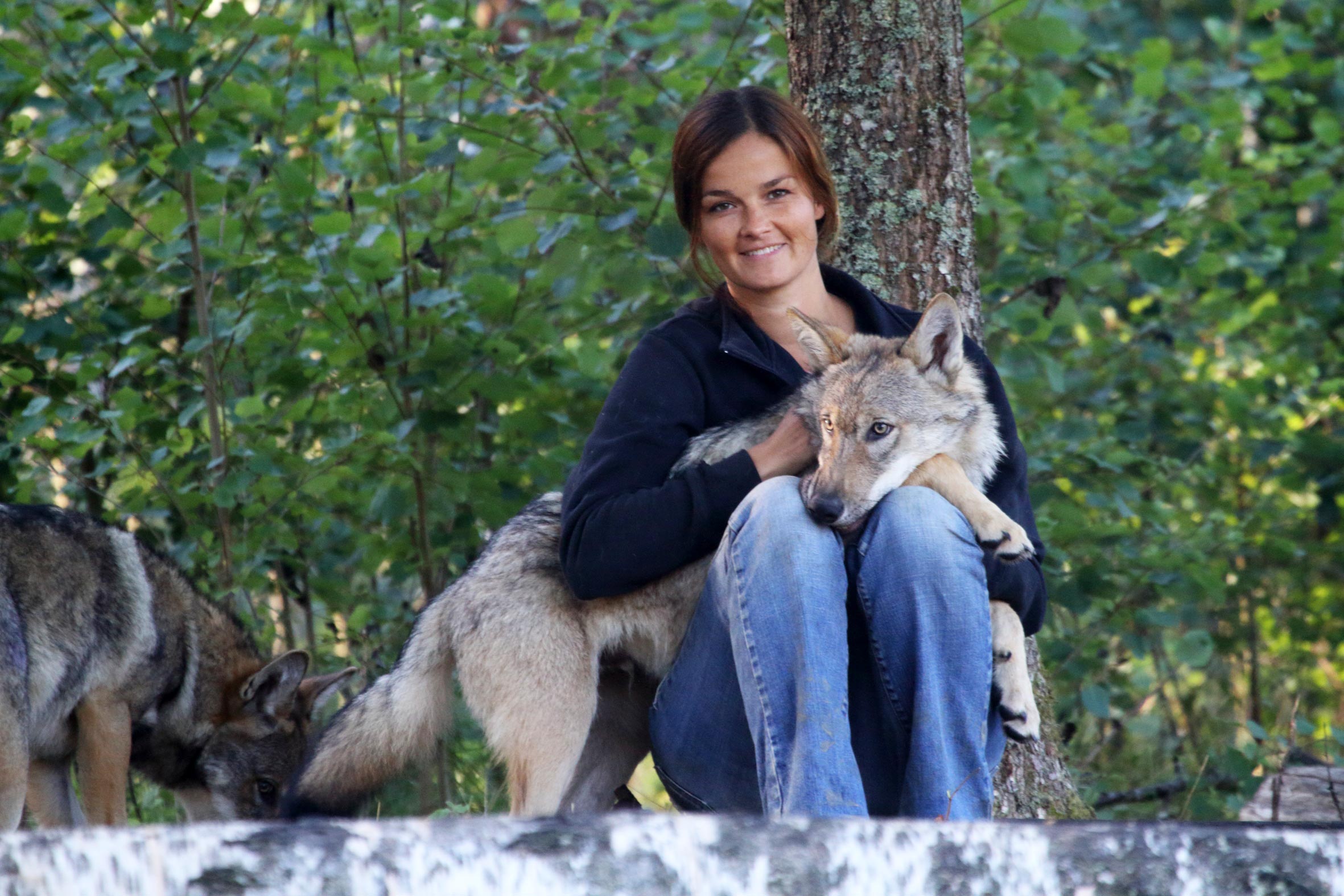
When it comes to showing affection towards people, many dogs are naturals. Now a report in the journal Ecology and Evolution reveals that the remarkable ability to show attachment behavior toward human caregivers also exists in wolves.
The findings were made when scientists at Stockholm University, Sweden, tested 10 wolves and 12 dogs in a behavioral test specifically designed to quantify attachment behaviors in canids. (Canids are members of the Canidae family of carnivorous animats, which includes domestic dogs, wolves, coyotes, foxes, jackals, dingoes, and many other extant and extinct dog-like mammals.)
During this test 23-week-old wolves spontaneously discriminated between a familiar person and a stranger just as well as dogs did, and showed more proximity seeking and affiliative behaviors towards the familiar person. Additionally, the presence of the familiar person acted as a social stress buffer for the wolves calming them in a stressful situation.
These discoveries build on a slowly accumulating body of evidence contradicting the hypothesis that the abilities necessary to form attachment with humans, arose in dogs only after humans domesticated them at least 15,000 years ago.
Investigating Attachment in Canids
“We felt that there was a need to thoroughly test this,” says Dr. Christina Hansen Wheat, PhD in Ethology from Stockholm University, Sweden. “Together with earlier studies making important contributions to this question, I think it is now appropriate to entertain the idea that if variation in human-directed attachment behavior exists in wolves, this behavior could have been a potential target for early selective pressures exerted during dog domestication.”
Dr. Hansen Wheat is interested in understanding how domestication affects behavior. To study this, she and her team raised wolf and dog puppies from the age of 10 days and put them through various behavioral tests. In one of those tests, a familiar person and a stranger take turns in coming in and out of a test room to create a somewhat strange and stressful situation for the animal. The theory behind the test, originally developed to assess attachment in human infants, is that by creating this unstable environment attachment behaviors, such as proximity seeking, will be stimulated.
In essence, what the researchers were looking for in this Strange Situation Test was if the wolves and dogs could discriminate between the familiar person and the stranger. That is, did they show more affection, and spend more time greeting and in physical contact with the familiar person than the stranger? If wolves and dogs would do so equally it would point towards this ability not being unique to dogs, i.e. it has not evolved specifically in dogs.
Wolves Show Human-Directed Attachment
“That was exactly what we saw,” says Dr. Hansen Wheat. “It was very clear that the wolves, as the dogs, preferred the familiar person over the stranger. But what was perhaps even more interesting was that while the dogs were not particularly affected by the test situation, the wolves were. They were pacing the test room. However, the remarkable thing was that when the familiar person, a hand-raiser who had been with the wolves all their lives, re-entered the test room the pacing behavior stopped, indicating that the familiar person acted as a social stress buffer for the wolves. I do not believe that this has ever been shown to be the case for wolves before and this also complements the existence of a strong bond between the animals and the familiar person.”
Dr. Hansen Wheat adds that similarities between dogs and wolves can tell us something about where the behavior we see in our dogs comes from. And, while it may be a surprise to some that wolves can connect with a person in this way, she says in retrospect it also makes sense.
“Wolves showing human-directed attachment could have had a selective advantage in early stages of dog domestication,” she says.
Dr. Hansen Wheat will now continue to work with the data she and her team have collected over the course of three years hand-raising wolves and dogs under identical conditions to learn even more about their behavioral differences and similarities.
Reference: “Human-directed attachment behaviour in wolves suggests standing ancestral variation for human-dog attachment bonds” by Christina Hansen Wheat, Linn Larsson, Patricia Berner and Hans Temrin, 20 September 2022, Ecology and Evolution.
DOI: 10.1002/ece3.9299
This research did not receive any specific grants from funding agencies in the public, commercial, or not-for-profit sectors.
Never miss a breakthrough: Join the SciTechDaily newsletter.
Follow us on Google and Google News.
11 Comments
My “dog” is primarily of a wolf lineage. I have had a lot of dogs in my life. I see little, if any, difference in the way my wolf relates to me and the way most, not all, of my dogs have related to me.
An earlier study showed that wolves have the capacity to effect a change in human behavior which generates trust – then the human gets eaten. viz, the Brothers Grim
As wolves and coyotes can interbreed with dogs they are not separate species but subspecies of a single complex species. There has been much resistance to this reality including attempts to redefine the definition of species. The discovery of attachment similar to dogs in wolves further shows that the reality is real and needs to be accepted as such. If science can get its collective head around this then our own equally complex species formed from the merger of subspecies will begin to be understood.
I hope the scientists know we already know that, like we have dogs now but in the beginning they where once wolfs, so thanks for the check I guess
Yes. Wolves may attach to humans in the same way a shark may attach to a cod fish.
Uh No
In the pictures I only see coyotes big difference real wolves might take a lot longer to gain their trust if you do you’ll have a friend for life speaking from experience
I had the pleasure of working with four wolves for a couple of years. I spent many hundreds of days with them. I have never experienced such unconditional love anywhere else in y life. They would here my car door at 100 meters and start to howl a greeting. They understood my moods and requests almost instantaneously and were able quite clearly able to express their feelings and needs to me. As for identifying people they could identify some one whow they had only meet once months before. When greeting new people they seemed to show a preference to people i personally liked and would greet them instantaneously witout hesitation. A much as there was an unbreakable bond between they also recognized they differences between us. If there was an injury they ce to me. If there was a fight i would literally step between the wolves and they would continue the fight between my legs ever so carefull to not even touch me and after a few minutes they would seperate and come to me individually for attention and comfort.
All four had a sense of humor. While i was giving programs the but only programs, the male would grab a shoelace or a belt or occasionaly a piece of clothing and then growl at me interupting the program. No matter how much he growled it was absolutely no issue to put my hand on his nose or playfully scrath his ears. Occasionaly i would sit on a rock while talking and he would sneak up behind me and open his jaws and basically put my whole head in his mouth. I would laugh and reach up and scratch his neck and he would give a quiet semi growl of pleasure.
You are definately on the right track but still have a long way to go.
While dingos and dogs are subspecies of the same species, humans should not attach their own values to that of any canid. Or for that matter any hominid. A Papuan bushman is not a New York businessman is not a Kalihari bushman. Canids like hominids will individually do what they feel they must to survive and pass on their genes. Or to put it simply, dogs are people too!
That is how, and where, it all went wrong for the wolves. They attached themselves to humans, thinking “What can possibly go wrong?” Ten thousand years later – poodles.
… Very strange, who would say that!