
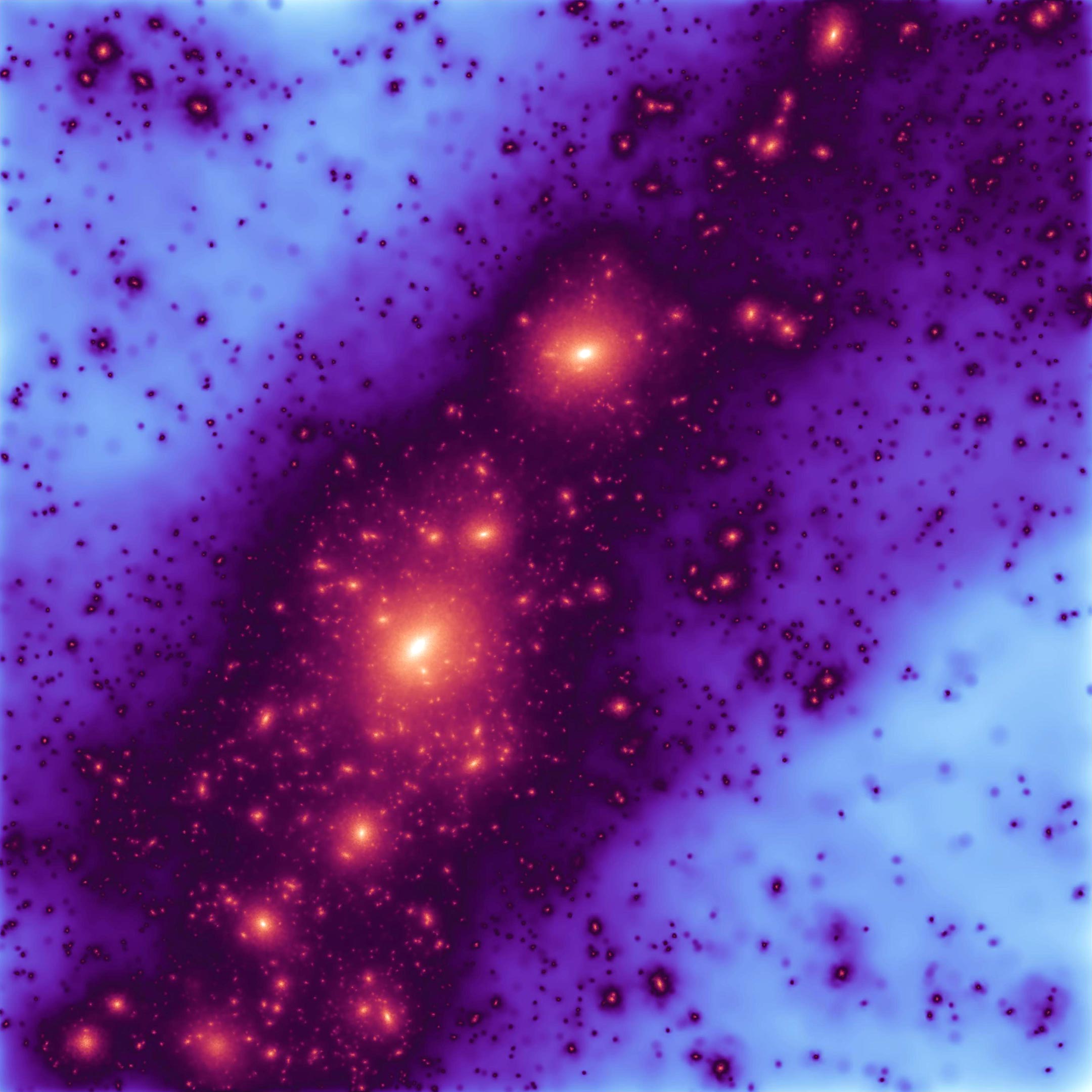
Mystery of the Milky Way’s Plane of Satellites
Astronomers say they have solved an outstanding problem that challenged our understanding of how the Universe evolved – the spatial distribution of faint satellite galaxies orbiting the Milky Way.
These satellite galaxies exhibit a bizarre alignment – they seem to lie on an enormous thin rotating plane – called the “plane of satellites”
This seemingly unlikely arrangement had puzzled astronomers for over 50 years, leading many to question the validity of the standard cosmological model that seeks to explain how the Universe came to look as it does today.
Dissolving Planes: A Matter of Cosmic Time
Now, new research jointly led by the Universities of Durham, UK, and Helsinki, Finland, has found that the plane of satellites is a cosmological quirk that will dissolve over time in the same way that star constellations also change.
Their research removes the challenge posed by the plane of satellites to the standard model of cosmology.
This model explains the formation of the Universe and how the galaxies we see now formed gradually within clumps of cold dark matter – a mysterious substance that makes up about 27 percent of the Universe.
The findings were published on December 19 in the journal Nature Astronomy.
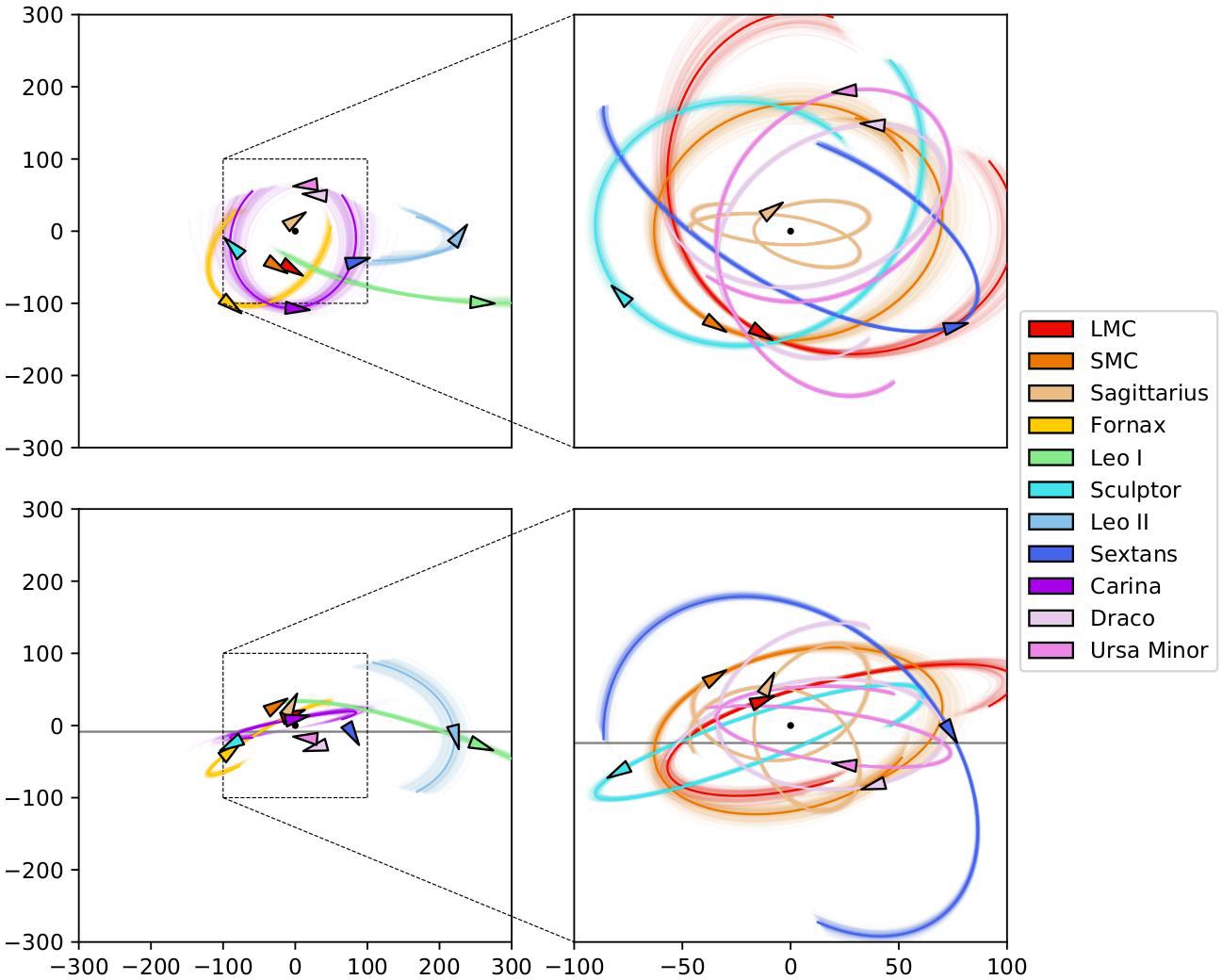
The Milky Way’s satellites seem to be arranged in an implausibly thin plane piercing through the galaxy and, oddly, they are also circling in a coherent and long-lived disk.
There is no known physical mechanism that would make satellites planes. Instead, it was thought that satellite galaxies should be arranged in a roughly round configuration tracing the dark matter.
Since the plane of satellites was discovered in the 1970s, astronomers have tried without success to find similar structures in realistic supercomputer simulations that track the evolution of the Universe from the Big Bang to the present day.
The fact that the arrangement of satellites could not be explained led researchers to think that the cold dark matter theory of galaxy formation might be wrong.
Data from the GAIA Observatory
However, this latest research saw astronomers use new data from the European Space Agency’s GAIA space observatory. GAIA is charting a six-dimensional map of the Milky Way, providing precise positions and motion measurements for about one billion stars in our galaxy (about one percent of the total), and its companion systems.
These data allowed scientists to project the orbits of the satellite galaxies into the past and future and see the plane form and dissolve in a few hundred million years – a mere blink of an eye in cosmic time.
The researchers also searched new, tailor-made cosmological simulations for evidence of planes of satellites.
They realized that previous studies based on simulations had been misled by failing to consider the distances of satellites from the center of the Galaxy, which made the virtual satellite systems appear much rounder than the real one.
Taking this into account, they found several virtual Milky Ways which boast a plane of satellite galaxies very similar to the one seen through telescopes.
Affirming the Standard Model
The researchers say this removes one of the main objections to the validity of the standard model of cosmology and means that the concept of dark matter remains the cornerstone of our understanding of the Universe.
Study co-author Professor Carlos Frenk, Ogden Professor of Fundamental Physics in the Institute for Computational Cosmology, at Durham University, UK, said: “The strange alignment of the Milky Way’s satellite galaxies in the sky had perplexed astronomers for decades, so much so that it was deemed to pose a profound challenge to cosmological orthodoxy.
“But thanks to the amazing data from the GAIA satellite and the laws of Physics, we now know that the plane is just a chance alignment, a matter of being in the right place at the right time, just as the constellations of stars in the sky.
“Come back in a billion years, and the plane will have disintegrated, as will today’s constellations.
“We have been able to remove one of the main outstanding challenges to the cold dark matter theory. It continues to provide a remarkably faithful description of the evolution of our Universe.”
Study lead author Dr. Till Sawala, of the University of Helsinki, said: “The plane of satellites was truly mind-boggling.
“It is perhaps unsurprising that a puzzle which has endured for almost fifty years required a combination of methods to solve it – and an international team to come together.”
Reference: “The Milky Way’s plane of satellites is consistent with ΛCDM” by Till Sawala, Marius Cautun, Carlos Frenk, John Helly, Jens Jasche, Adrian Jenkins, Peter H. Johansson, Guilhem Lavaux, Stuart McAlpine and Matthieu Schaller, 19 December 2022, Nature Astronomy.
DOI: 10.1038/s41550-022-01856-z
The research was funded by the European Research Council, the UK Science and Technology Facilities Council and made extensive use of the Cosmology Machine (COSMA) supercomputer at Durham University. COSMA is hosted by Durham as part of the Science and Technology Facilities Council-funded DiRAC High-Performance Computing facility to support researchers across the UK.
Never miss a breakthrough: Join the SciTechDaily newsletter.
Follow us on Google and Google News.
8 Comments
Dark matter is indeed mysterious – because it does not exist. When will scientists drop this fudge factor?
The mystery of the dark matter was discovered by me and proved by the formula of physics. University of Wareham, please reply
Oh, Dark Matter exists, just not in the way that’s generally discussed. Go to YouTube and search for “Dark Matter – A String Theory Way” for another view.
Satellite galaxies are always dwarfs. Because they’re so small, for now we can only see them in the Milky Way and Andromeda, but they should exist with all galaxies. Many dwarf galaxies lie in a very thin plane extending from the poles of their parent in direct contradiction to the accepted idea that a halo of Dark Matter surrounds the parent and that dwarfs should be formed all over. But also reports that many dwarf galaxies without obvious Dark Matter have stars that orbit their cores much faster than expected suggest that a significant modification of the Cold Dark Matter paradigm or new mass profiles may be needed. NAOC research suggests that unusual kinds of Dark Matter (warm, fuzzy) creates those dwarfs. There are also reports that very unexpected supermassive Black Holes have been found in some of these tiny dwarfs. What’s going on?
Specifics on this can be found by searching YouTube for “Dwarf Galaxies – A String Theory Way”
Materia întunecată este o materie virtuală existentă doar acolo unde lipsește lumina . Teoria Big-Bang este o teorie falsă , din punct de vedere logic ea nu poate fi explicată , așa cum nu poate fi explicată existența Divinității , de oricare fel .
Perhaps a thread of dark ‘matter’ is a string or strength of quantum entanglement that seems to alter space between, or perhaps among the nodes.
People will insist that imaginary Dark Matter exists until the day when they are forced to bow and acknowledge that Jesus Christ is Lord and Creator.
Jesus was a prophet, nothing more nothing less God is your lord and savior
Are you an idiot. If Jesus is creator, then where did all the people come from for the 10k years before Jesus christ? Maybe you should be asking questions about the books that were removed from the Bible in order to keep the populations attention and get more people, and their “offerings”(money), in the church.