
‘Groupie’ galaxies orbiting Milky Way tell us about dark matter, how galaxy formed.
We live in a big-city galaxy. The Milky Way is so big it has satellite galaxies that orbit it, just as the Moon orbits the Earth. These arrangements tell us a great deal about the secrets of the universe—from how galaxies form to the mysterious nature of dark matter.
Two new studies have revealed more and more about these ‘groupie’ galaxies around the Milky Way, including evidence that large satellite galaxies can bring their own small satellites with them when they are sucked into orbit around the Milky Way. Scientists have also extracted information about the halos of dark matter that surround these galaxies, as well as a prediction that our home galaxy should host an additional 100 or so very faint satellite galaxies awaiting discovery.
The research, co-led by University of Chicago Asst. Prof. Alex Drlica-Wagner in collaboration with scientists from SLAC National Accelerator Laboratory and the University of Wisconsin-Madison, was published in the April edition of the The Astrophysical Journal. It relies heavily on data from the Dark Energy Survey, a groundbreaking effort to map the skies led by Fermi National Accelerator Laboratory and the University of Chicago.
“The Dark Energy Survey data gives us unprecedented sensitivity for the smallest, oldest, and most dark-matter-dominated galaxies,” said Drlica-Wagner. “These faint galaxies can teach us a lot about how stars and galaxies form.”
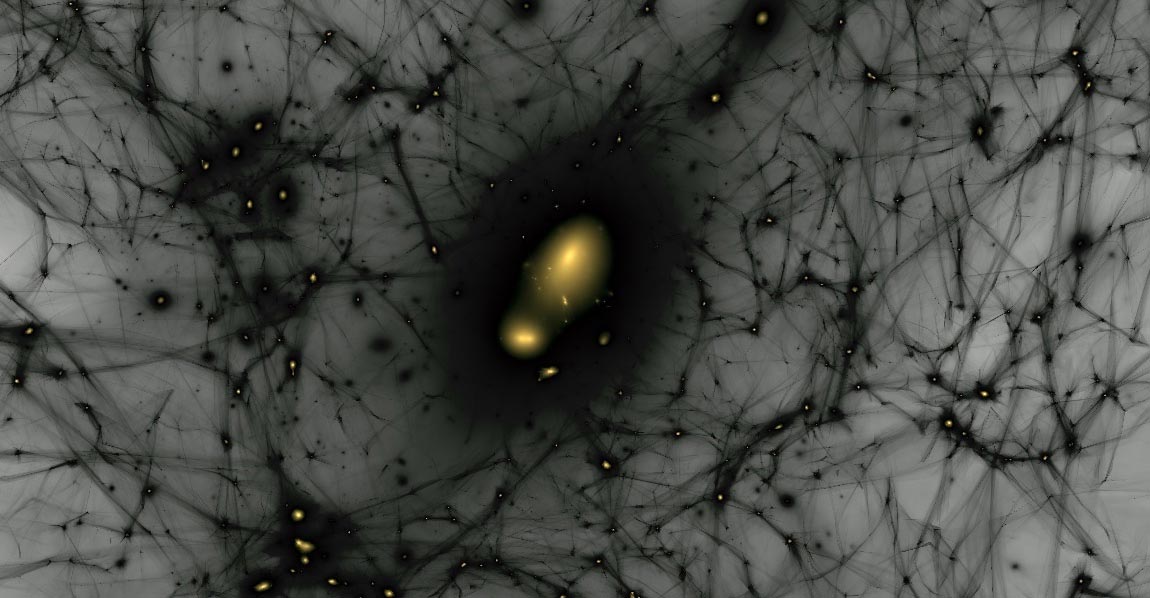
A simulation of the formation of dark matter structures from the early universe until today. Gravity makes dark matter clump into dense halos, indicated by bright patches, where galaxies form. At about 18 seconds into this simulation, a halo like the one that hosts the Milky Way begins to form near the center top of the frame. Shortly afterward, a smaller halo begins to take shape at the top center of the screen. This halo falls into the first, larger halo by about 35 seconds, mimicking the Large Magellanic Cloud’s fall into the Milky Way. SLAC and Stanford researchers, working with collaborators from the Dark Energy Survey, have used simulations like these to better understand the connection between dark matter and galaxy formation. Credit: Ralf Kaehler/SLAC National Accelerator Laboratory
Shining galaxies’ light on dark matter
Astronomers have long known the Milky Way has satellite galaxies—including the notable Large Magellanic Cloud, which can be observed with the naked eye in the southern hemisphere—but thanks to surveys with large telescopes, the list of known satellites has increased to about 60 over the last two decades.
These galaxies tell us much about the cosmos, including how much dark matter it takes to form a galaxy, how many satellite galaxies we should expect to find around the Milky Way, and whether galaxies can bring their own satellites into orbit around our own—a key prediction of the most popular model of dark matter. (The answer to that last question appears to be a resounding “yes.”)
“We wanted to rigorously answer the question: What is the faintest galaxy that our telescopes can detect?” Drlica-Wagner said.
To answer this question, they simulated over a million small satellite galaxies, embedded them into large astronomical data sets, and used their search algorithms to try to re-extract them. This allowed them to determine which galaxies could be detected and which were too faint for current telescopes. They then combined this information with large numerical simulations of dark matter clustering to predict the total population of satellites around the Milky Way (including both those that we can see, and those that we cannot).
The result was a prediction that about 100 more galaxies remain to be discovered orbiting the Milky Way. If the “missing” 100 galaxies are discovered, this would help confirm the researchers’ model linking dark matter and galaxy formation.
“One of the most exciting things about this work is that we will be able to use our measurements of satellite galaxies to understand microscopic properties of dark matter,” Drlica-Wagner said.
The leading model for dark matter is that it’s a subatomic particle, like an electron or a proton, that was formed in the early universe. If these particles of dark matter were very light, they could have had very high velocity, which would make it hard for dark matter to clump and form the galaxies that we see today. Thus, by observing a large number of small galaxies, it is possible to put a lower limit on how much mass a dark matter particle could have, the scientists said.
“The particle nature of dark matter can have observable consequences for the galaxies that we see,” said Drlica-Wagner.
Read Link Between Dark Matter Halos and Galaxy Formation Revealed With Help From the Milky Way’s Satellites for more about this research.
References:
“Milky Way Satellite Census. I. The Observational Selection Function for Milky Way Satellites in DES Y3 and Pan-STARRS DR1” by A. Drlica-Wagner, K. Bechtol, S. Mau, M. McNanna, E. O. Nadler, A. B. Pace, T. S. Li, A. Pieres, E. Rozo, J. D. Simon, A. R. Walker, R. H. Wechsler, T. M. C. Abbott, S. Allam1, J. Annis, E. Bertin, D. Brooks, D. L. Burke, A. Carnero Rosell, M. Carrasco Kind, J. Carretero, M. Costanzi, L. N. da Costa, J. De Vicente, S. Desai, H. T. Diehl, P. Doel, T. F. Eifler, S. Everett, B. Flaugher, J. Frieman, J. García-Bellido, E. Gaztanaga, D. Gruen, R. A. Gruendl, J. Gschwend, G. Gutierrez, K. Honscheid, D. J. James, E. Krause, K. Kuehn, N. Kuropatkin, O. Lahav, M. A. G. Maia, J. L. Marshall, P. Melchior, F. Menanteau, R. Miquel, A. Palmese, A. A. Plazas, E. Sanchez, V. Scarpine, M. Schubnell, S. Serrano, I. Sevilla-Noarbe, M. Smith, E. Suchyta, G. Tarle and (DES Collaboration), 15 April 2020, The Astrophysical Journal.
DOI: 10.3847/1538-4357/ab7eb9
“Milky Way Satellite Census. II. Galaxy–Halo Connection Constraints Including the Impact of the Large Magellanic Cloud” by E. O. Nadler, R. H. Wechsler, K. Bechtol, Y.-Y. Mao, G. Greeng, A. Drlica-Wagner, M. McNanna, S. Mau, A. B. Pace, J. D. Simon, A. Kravtsov, S. Dodelson, T. S. Li,,, A. H. Riley, M. Y. Wang, T. M. C. Abbott, M. Aguena, S. Allam, J. Annis, S. Avila, G. M. Bernstein, E. Bertin, D. Brooks, D. L. Burke, A. Carnero Rosell, M. Carrasco Kind, J. Carretero, M. Costanzi, L. N. da Costa, J. De Vicente, S. Desai, A. E. Evrard, B. Flaugher, P. Fosalba, J. Frieman, J. García-Bellido, E. Gaztanaga, D. W. Gerdes, D. Gruen,, J. Gschwend, G. Gutierrez, W. G. Hartley, S. R. Hinton, K. Honscheid, E. Krause, K. Kuehn, N. Kuropatkin, O. Lahav, M. A. G. Maia, J. L. Marshall, F. Menanteau, R. Miquel, A. Palmese, F. Paz-Chinchón, A. A. Plazas, A. K. Romer, E. Sanchez, B. Santiago, V. Scarpine, S. Serrano, M. Smith, M. Soares-Santos, E. Suchyta, G. Tarle, D. Thomas, T. N. Varga, A. R. Walker and (DES Collaboration), 15 April 2020, The Astrophysical Journal.
DOI: 10.3847/1538-4357/ab846a
The research was a collaborative effort within the Dark Energy Survey, led by the Milky Way Working Group, with substantial contributions from junior members including Sidney Mau, an undergraduate at UChicago; and Mitch McNanna, a graduate student at UW-Madison.
Never miss a breakthrough: Join the SciTechDaily newsletter.
Follow us on Google and Google News.
8 Comments
Galaxies don’t form! All that constitutes Galaxies now was all part of what existed, ‘Before the, Bang’. (In my, (Not so, Humble view, of course.)
Actually; If ‘Our’, ‘Big Bang occurred within, ‘Infinity’ (As I have proposed within the format of a number of ‘Scientific Papers’ that are spread around our world,)It is quite possible that lots of, ‘Multi-Verses’ exist.
There are two parts to this article – satellite galaxies (often called dwarf galaxies) and Dark Matter.
Many dwarf galaxies lie in a very thin plane extending from the poles of their parent (such as the Andromeda galaxy) in direct contradiction to the accepted idea that a halo of Dark Matter surrounds the parent and that dwarfs should be formed all over. Concepts in String Theory suggest a novel possibility for this occurring in all large galaxies, including the Milky Way. See https://www.youtube.com/watch?v=uuG4yy-vW84
Regarding Dark Matter, there may also be a String Theory explanation. As you may know, quantum mechanics requires that strings must be formed as pairs in the quantum foam – a string and an anti-string – that immediately annihilate each other. Quantum mechanics also requires both the string and anti-string to be surrounded by “jitters” that reduce their monstrous vibrating energies. What if this jitter remains for a fraction of an instant after their string/anti-string annihilations? This temporary jitter would be seen by us as matter for that instant before it too returns to the foam. That’s why we never see it – the “mass” lasts only for that instant but is repeated over and over and over, all over. Specifics on this can be found in my YouTube at https://www.youtube.com/watch?v=24WyRKT8t4w
I thought dark matter was recently debunked forever and explained as clouds of particles, baryons.
No, Dark Matter is still in the light, so to speak. Some baryon clouds have been found but nothing like what’s needed to hold galaxies together, so either there’s an awful lot of undiscovered material out there or we need another explanation.
Perhaps somebody got it backwards as far as (darkmatter)go’s. If there is such a thing then it’s created like everything else and blacksphere’s are most likely the things doing the making.
Blacksphere’s hold their galaxies together nothing else as a matter of opinion the star that creates the sphere is the size of the observed galaxies. And in saying that the bubble that surrounds each galaxie will in be the same size as the star that created said galaxie. Everything is relative to itself in outer space it would appear. I believe once the right evidence is found it will change everything as far as our understanding of the universe and everything in it.
If you had a pic of the CMB we could have a look and see if their are patterns. I believe we will see patterns that will start to explain itself. I was watching coxy in one of his early videos lastnite and I thought I noticed something in one of his pics of the CMB. We should look for circles to start. And poof patterns will appear.Everything in the uni is circular or is moving in that kind of pattern. Planets circular pattern around star. Galaxies circular around blacksphere’s and so on. You don’t see squares or triangles always circular or round there’s a reason and that reason is universal in nature.