
Close Menu
    Facebook X (Twitter) Instagram
    SciTechDaily
    • Biology
    • Chemistry
    • Earth
    • Health
    • Physics
    • Science
    • Space
    • Technology
    Facebook X (Twitter) Pinterest YouTube RSS
    SciTechDaily
    Home»Space»Interactions between Cold Dark Matter and Radiation Leads to a Dramatic Reduction in Satellite Galaxies
    Space

    Interactions between Cold Dark Matter and Radiation Leads to a Dramatic Reduction in Satellite Galaxies

    By Royal Astronomical SocietySeptember 9, 2014No Comments4 Mins Read
    Facebook Twitter Pinterest Telegram LinkedIn WhatsApp Email Reddit
    Share
    Facebook Twitter LinkedIn Pinterest Telegram Email Reddit
    Dark Matter Could Help Explain Milky Ways Missing Satellite Galaxies
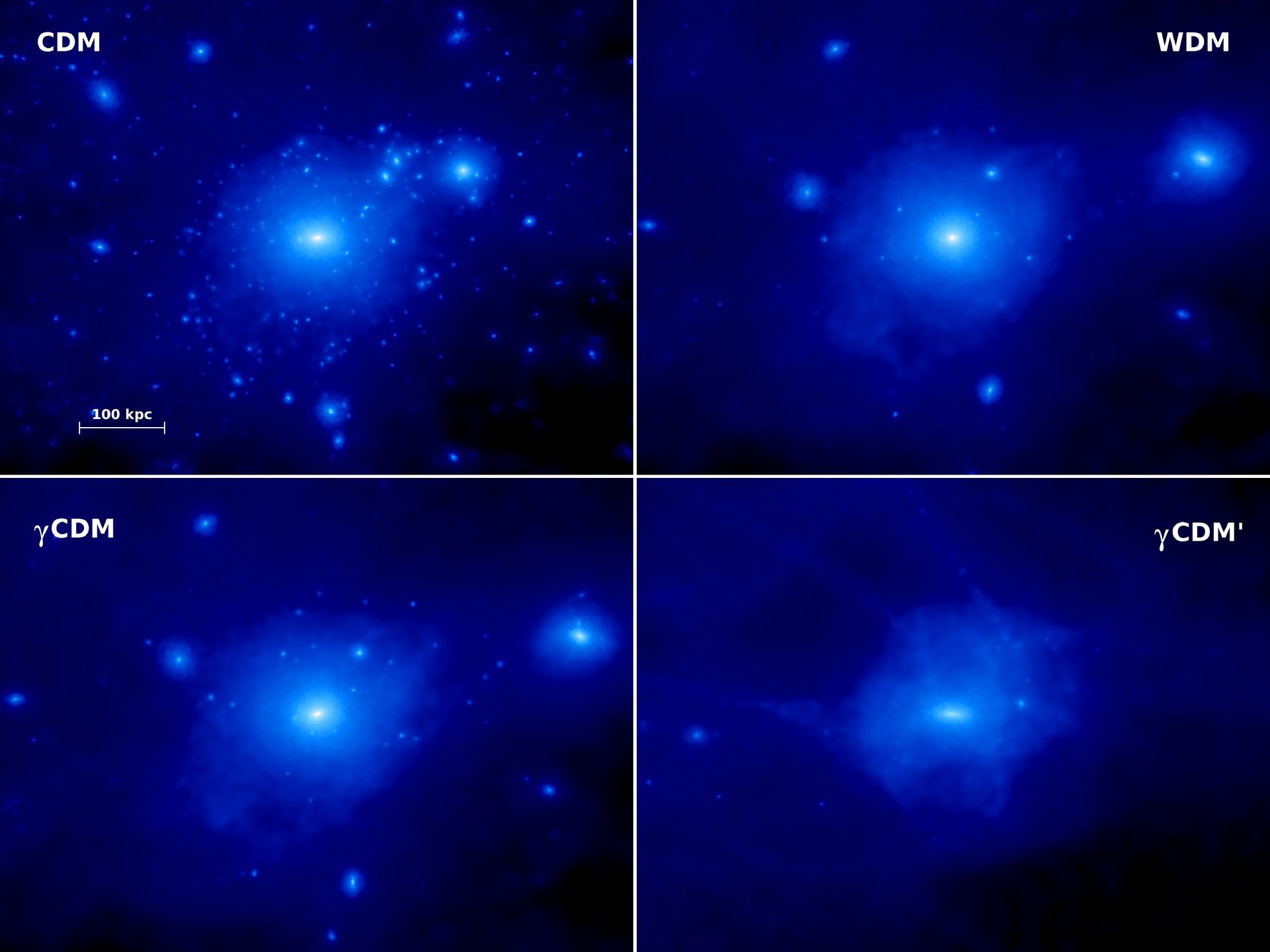
    The simulated distribution of dark matter in a Milky Way-like galaxy for standard, non-interacting dark matter (top left), warm dark matter (top right) and the new dark matter model that interacts with the photon background (bottom). Smaller structures are erased up to the point where, in the most extreme model (bottom right), the galaxy is completely sterilized. Credit: Durham University

    A newly published study from Durham University shows that interactions between cold dark matter and radiation lead to a dramatic reduction in the number of satellite galaxies, alleviating the Milky Way’s missing satellite galaxies problem and indicating that physics beyond gravity may be essential to making accurate predictions of structure formation on small scales.

    Scientists believe they have found a way to explain why there are not as many galaxies orbiting the Milky Way as expected. Computer simulations of the formation of our galaxy suggest that there should be many more small galaxies around the Milky Way than are observed through telescopes.

    This has thrown doubt on the generally accepted theory of cold dark matter, an invisible and mysterious substance that scientists predict should allow for more galaxy formation around the Milky Way than is seen.

    Now cosmologists and particle physicists at the Institute for Computational Cosmology and the Institute for Particle Physics Phenomenology, at Durham University, working with colleagues at LAPTh College & University in France, think they have found a potential solution to the problem.

    Writing in the journal Monthly Notices of the Royal Astronomical Society, the scientists suggest that dark matter particles, as well as feeling the force of gravity, could have interacted with photons and neutrinos in the young Universe, causing the dark matter to scatter.
    Dark Matter Haloes Could Help Explain Missing Satellite Galaxies
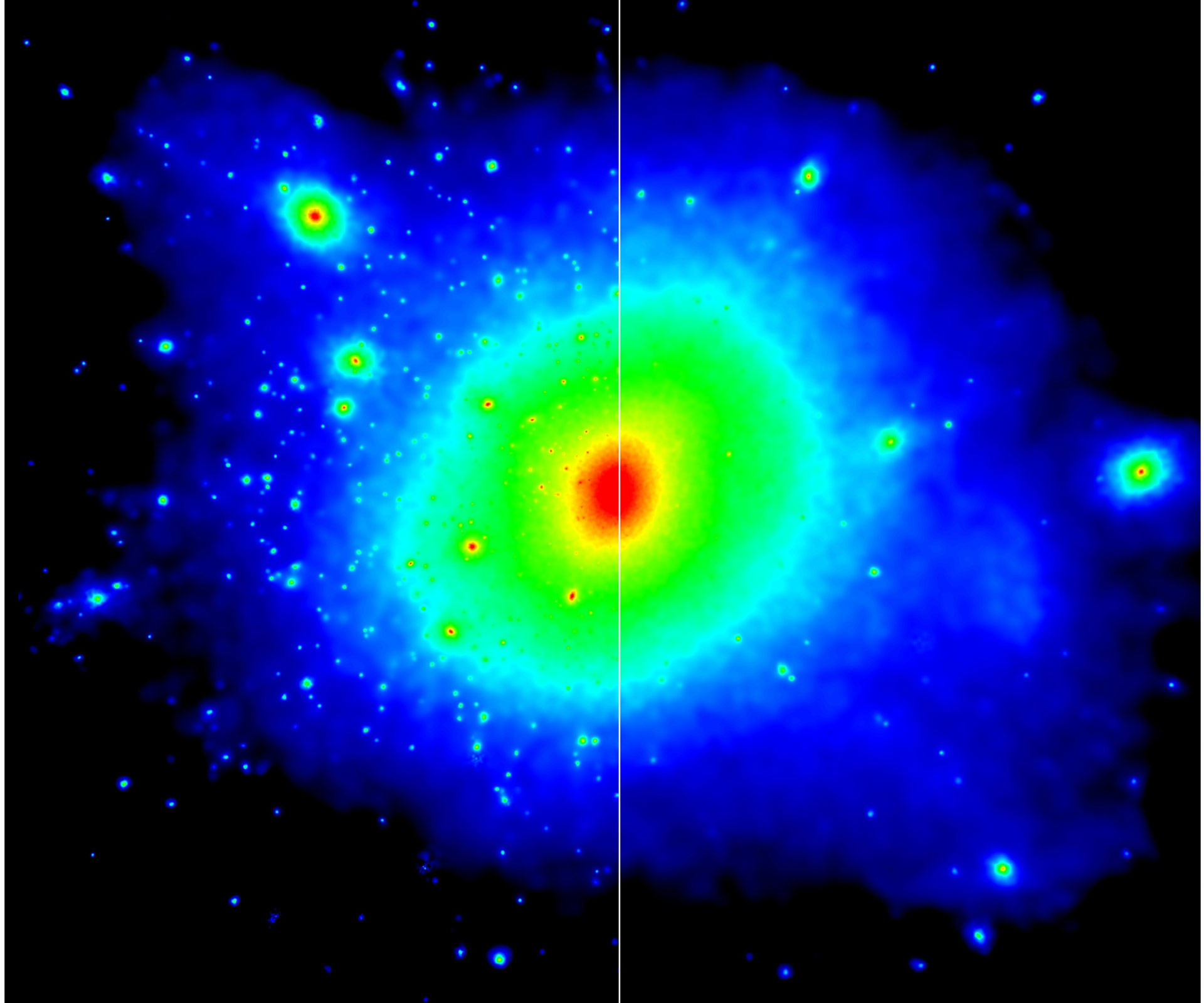
    Two models of the dark matter distribution in the halo of a galaxy like the Milky Way, separated by the white line. The colors represent the density of dark matter, with red indicating high density and blue indicating low density. On the left is a simulation of how non-interacting cold dark matter produces an abundance of smaller satellite galaxies. On the right the simulation shows the situation when the interaction of dark matter with other particles reduces the number of satellite galaxies we expect to observe around the Milky Way. Credit: Durham University.

    Scientists think clumps of dark matter – or haloes – that emerged from the early Universe, trapped the intergalactic gas needed to form stars and galaxies. Scattering the dark matter particles wipes out the structures that can trap gas, stopping more galaxies from forming around the Milky Way and reducing the number that should exist.

    Lead author Dr Celine Boehm, in the Institute for Particle Physics Phenomenology at Durham University, said: “We don’t know how strong these interactions should be, so this is where our simulations come in.”

    “By tuning the strength of the scattering of particles, we change the number of small galaxies, which lets us learn more about the physics of dark matter and how it might interact with other particles in the Universe.”

    “This is an example of how a cosmological measurement, in this case the number of galaxies orbiting the Milky Way, is affected by the microscopic scales of particle physics.”

    There are several theories about why there are not more galaxies orbiting the Milky Way, which include the idea that heat from the Universe’s first stars sterilized the gas needed to form stars. The researchers say their current findings offer an alternative theory and could provide a novel technique to probe interactions between other particles and cold dark matter.

    Co-author Professor Carlton Baugh said: “Astronomers have long since reached the conclusion that most of the matter in the Universe consists of elementary particles known as dark matter.”

    “This model can explain how most of the Universe looks, except in our own backyard where it fails miserably.”

    “The model predicts that there should be many more small satellite galaxies around our Milky Way than we can observe.”

    “However, by using computer simulations to allow the dark matter to become a little more interactive with the rest of the material in the Universe, such as photons, we can give our cosmic neighborhood a makeover and we see a remarkable reduction in the number of galaxies around us compared with what we originally thought.”

    The calculations were carried out using the COSMA supercomputer at Durham University, which is part of the UK-wide DiRAC super-computing framework.

    The work was funded by the Science and Technology Facilities Council and the European Union.

    Reference: “Using the Milky Way satellites to study interactions between cold dark matter and radiation” by C. Boehm, J. A. Schewtschenko, R. J. Wilkinson, C. M. Baugh and S. Pascoli, 1 September 2014, MNRAS Letters.
    DOI: 10.1093/mnrasl/slu115
    arXiv: 1404.7012

    Never miss a breakthrough: Join the SciTechDaily newsletter.
    Follow us on Google and Google News.

    Astronomy Astrophysics Cosmology Dark Matter Particle Physics Royal Astronomical Society
    Share. Facebook Twitter Pinterest LinkedIn Email Reddit

    Related Articles

    In a First for Humanity, Scientists May Have Finally Seen Dark Matter

    New Research Shows Dark Matter Might Not Be Interactive After All

    99.996 Percent Chance That Dark Energy Exists

    Planck Satellite Observations May Help Solve the Mystery of Dark Matter

    New Measuring Technique Suggests Plenty of Dark Matter Near the Sun

    Dark Matter Filament in Galaxy Supercluster Directly Measured

    New Model May Rule Out the Presence of Dark Matter

    The Bolshoi Simulation: Boxing the Universe

    Baryon Oscillation Spectroscopic Survey Measures the Universe’s Expansion and Dark Energy

    Leave A Reply Cancel Reply

    • Facebook
    • Twitter
    • Pinterest
    • YouTube

    Don't Miss a Discovery

    Subscribe for the Latest in Science & Tech!

    Trending News

    Scientists Uncover Potential Brain Risks of Popular Fish Oil Supplements

    Scientists Discover a Surprising Way To Make Bread Healthier and More Nutritious

    After 60 Years, Scientists Uncover Unexpected Brain Effects of Popular Diabetes Drug Metformin

    New Research Uncovers Hidden Side Effects of Popular Weight-Loss Drugs

    Scientists Rethink Extreme Warming After Surprising Ocean Discovery

    Landmark Study Links Never Marrying to Significantly Higher Cancer Risk

    Researchers Discover Unknown Beetle Species Just Steps From Their Lab

    Largest-Ever Study Finds Medicinal Cannabis Ineffective for Anxiety, Depression, PTSD

    Follow SciTechDaily
    • Facebook
    • Twitter
    • YouTube
    • Pinterest
    • Newsletter
    • RSS
    SciTech News
    • Biology News
    • Chemistry News
    • Earth News
    • Health News
    • Physics News
    • Science News
    • Space News
    • Technology News
    Recent Posts
    • Researchers Uncover Source of Strange Deformation in Earth’s Largest Continental Rift
    • Scientists Solve Mystery of Where the Colorado River Vanished Millions of Years Ago
    • Not Just Alzheimer’s: Scientists Uncover Clues to a Second, Overlooked Disorder
    • Scientists Uncover Dangerous Connection Between Serotonin and Heart Valve Disease
    • Scientists Discover a “Protector” Protein That Could Help Reverse Hair Loss
    Copyright © 1998 - 2026 SciTechDaily. All Rights Reserved.
    • Science News
    • About
    • Contact
    • Editorial Board
    • Privacy Policy
    • Terms of Use

    Type above and press Enter to search. Press Esc to cancel.