
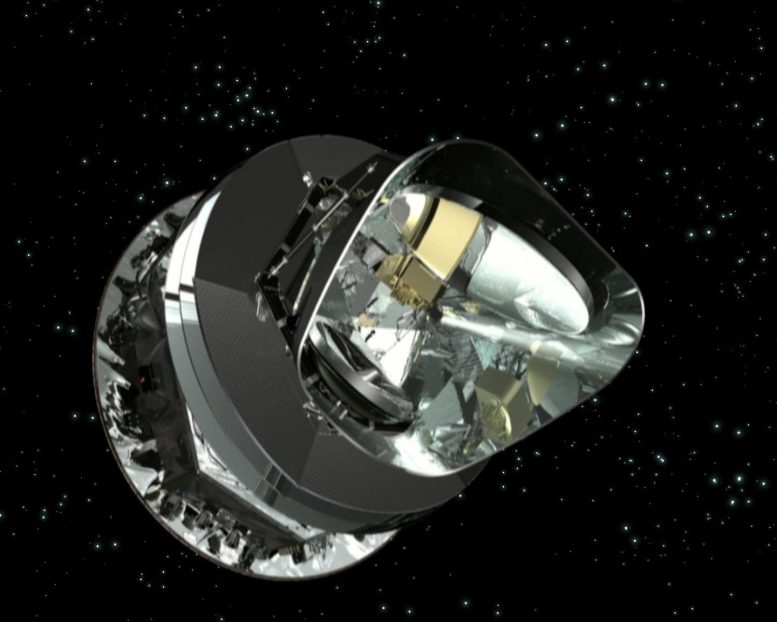
The Planck Satellite has observed a very unique emission of radio radiation from the center of the Milky Way, moving scientists closer than ever to a solution to the origin of dark matter.
The universe is comprised of a large amount of invisible matter, dark matter. It fills the space between the galaxies and between the stars in the galaxies. Since the prediction of the existence of dark matter more than 70 years ago, all sorts of researchers – astronomers, cosmologists, and particle physicists have been looking for answers to what it could be. With the latest observations from the Planck satellite, researchers from the Niels Bohr Institute, among others, may be closer than ever to a solution to the origin of the mysterious dark matter.
The Planck satellite, which was launched in 2009, has extremely sensitive instruments that can map microwave radiation in the entire sky with great precision. The latest data from the Planck mission reveals unusual radiation from our own galaxy, which open a new direction in understanding the most fundamental properties of the space, time, and matter in the Universe.
Radiation from dark matter
“The Planck Satellite has observed a very unique emission of radio radiation from the center of our galaxy, the Milky Way. By using different methods to separate the signal for very broad range of wavelengths, the Planck team has been able to determine the spectrum of the radiation. The radiation has a spectrum which has the same form as that of synchrotron emission, which originates from electrons and positrons circulating at high energies around the lines of the Magnetic Field in the center of the galaxy, and I believe that there are quite strong indications that it could come from dark matter,” explains Pavel Naselsky, professor of cosmology at the Discovery Center at the Niels Bohr Institute at the University of Copenhagen.
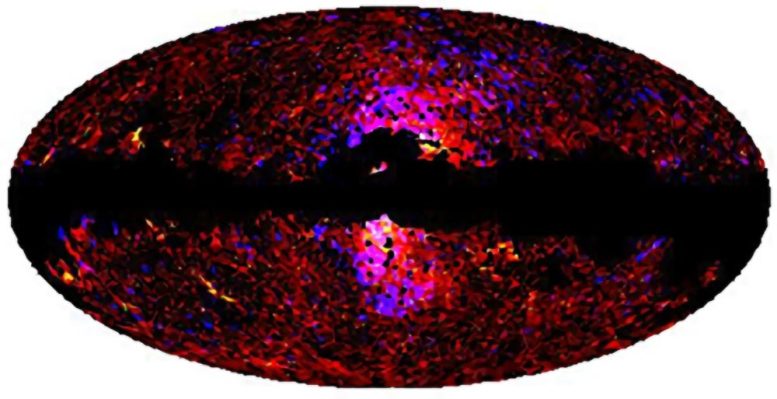
Pavel Naselsky explains that leading scientists like Niels Bohr professor Subir Sarkar have predicted, using calculations, that dark matter may consist of very heavy particles that are around 10 times as heavy as the Higgs particle, that is to say, 1,000 times heavier than a proton. But they have very unique properties and do not interact with ‘normal’ matter particles. Dark matter particles are also usually very scattered and do not interact with each other.
“But we know from theoretical predictions that the concentration of dark matter particles around the center of galaxies is very high and we have a strong argument they can collide there and in the collision electrons and positrons are formed. These electrons and positrons start to rotate around the magnetic field at the center of the galaxy and in doing so produce this very unusual synchrotron radiation.
It has simply not been possible to observe this radiation in such detail before, as previous instruments have not been sensitive enough. But with Planck, this unusual radiation is seen very clearly.
“The radiation cannot be explained by the structural mechanisms in the galaxy and it cannot be radiation from supernova explosions. I believe that this could be proof of dark matter. Otherwise, we have discovered absolutely new (and unknown for physics) mechanism of acceleration of particles in the Galactic center”, says Pavel Naselsky, and he expects exciting new results already within the next few months.
The results have been published in ArXiv.org. and submitted to the scientific journal, Astronomy & Astrophysics.
Reference: “Planck intermediate results – IX. Detection of the Galactic haze with Planck” by
Planck Collaboration: P. A. R. Ade, N. Aghanim, M. Arnaud, M. Ashdown, F. Atrio-Barandela, J. Aumont, C. Baccigalupi, A. Balbi, A. J. Banday, R. B. Barreiro, J. G. Bartlett, E. Battaner, K. Benabed, A. Benoît, J.-P. Bernard, M. Bersanelli, A. Bonaldi, J. R. Bond, J. Borrill, F. R. Bouchet, C. Burigana, P. Cabella, J.-F. Cardoso, A. Catalano, L. Cayón, R.-R. Chary, L.-Y Chiang, P. R. Christensen, D. L. Clements, L. P. L. Colombo, A. Coulais, B. P. Crill, F. Cuttaia, L. Danese, O. D’Arcangelo, R. J. Davis, P. de Bernardis, G. de Gasperis, A. de Rosa, G. de Zotti, J. Delabrouille, C. Dickinson, J. M. Diego, G. Dobler, H. Dole, S. Donzelli, O. Doré, U. Dörl, M. Douspis, X. Dupac, G. Efstathiou, T. A. Enßlin, H. K. Eriksen, F. Finelli, O. Forni, M. Frailis, E. Franceschi, S. Galeotta, K. Ganga, M. Giard, G. Giardino, J. González-Nuevo, K. M. Górski, S. Gratton, A. Gregorio, A. Gruppuso, F. K. Hansen, D. Harrison, G. Helou, S. Henrot-Versillé, C. Hernández-Monteagudo, S. R. Hildebrandt, E. Hivon, M. Hobson, W. A. Holmes, A. Hornstrup, W. Hovest, K. M. Huffenberger, T. R. Jaffe, T. Jagemann, W. C. Jones, M. Juvela, E. Keihänen, J. Knoche, L. Knox, M. Kunz, H. Kurki-Suonio, G. Lagache, A. Lähteenmäki, J.-M. Lamarre, A. Lasenby, C. R. Lawrence, S. Leach, R. Leonardi, P. B. Lilje, M. Linden-Vørnle, M. López-Caniego, P. M. Lubin, J. F. Macías-Pérez , B. Maffei, D. Maino, N. Mandolesi, M. Maris, P. G. Martin, E. Martínez-González, S. Masi, M. Massardi, S. Matarrese, F. Matthai, P. Mazzotta, P. R. Meinhold, A. Melchiorri, L. Mendes, A. Mennella, S. Mitra, M.-A. Miville-Deschênes, A. Moneti, L. Montier, G. Morgante, D. Munshi, J. A. Murphy, P. Naselsky, P. Natoli, H. U. Nørgaard-Nielsen, F. Noviello, S. Osborne, F. Pajot, R. Paladini, D. Paoletti, B. Partridge, T. J. Pearson, O. Perdereau, F. Perrotta, F. Piacentini, M. Piat, E. Pierpaoli, D. Pietrobon, S. Plaszczynski, E. Pointecouteau, G. Polenta, N. Ponthieu, L. Popa, T. Poutanen, G. W. Pratt, S. Prunet, J.-L. Puget, J. P. Rachen, R. Rebolo, M. Reinecke, C. Renault, S. Ricciardi, T. Riller, G. Rocha, C. Rosset, J. A. Rubiño-Martín, B. Rusholme, M. Sandri, G. Savini, B. M. Schaefer, D. Scott, G. F. Smoot, F. Stivoli, R. Sudiwala, A.-S. Suur-Uski, J.-F. Sygnet, J. A. Tauber, L. Terenzi, L. Toffolatti, M. Tomasi, M. Tristram, M. Türler, G. Umana, L. Valenziano, B. Van Tent, P. Vielva, F. Villa, N. Vittorio, L. A. Wade, B. D. Wandelt, M. White, D. Yvon, A. Zacchei and A. Zonca , 18 June 2013, Astronomy & Astrophysics.
DOI: 10.1051/0004-6361/201220271
Never miss a breakthrough: Join the SciTechDaily newsletter.
Follow us on Google and Google News.