
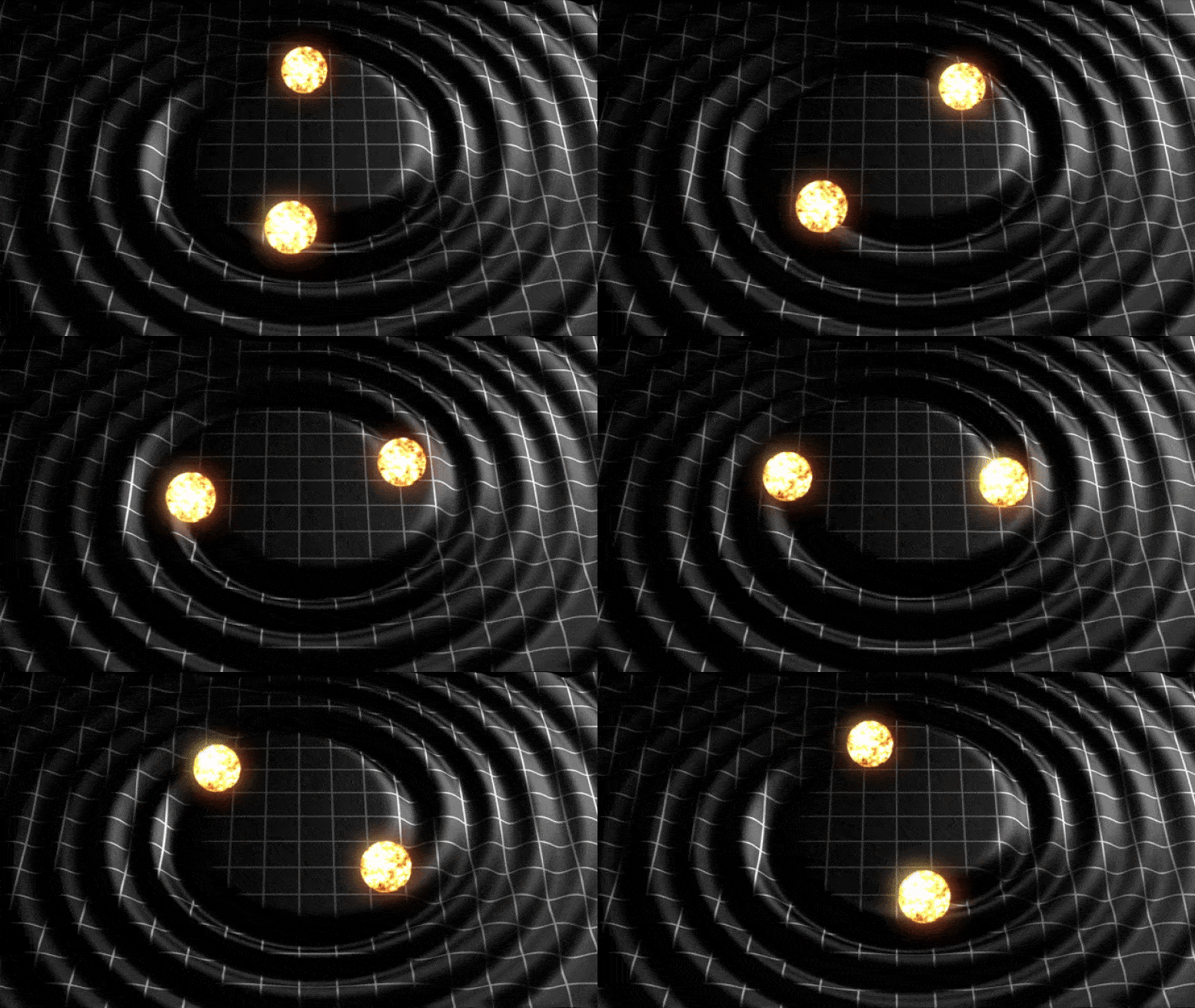
Scientists of the PRISMA+ Cluster of Excellence analyze data from the gravitational wave observatory NANOGrav.
The NANOGrav Collaboration recently captured the first signs of very low-frequency gravitational waves. Prof. Pedro Schwaller and Wolfram Ratzinger analyzed the data and, in particular, considered the possibility of whether this may point towards new physics beyond the Standard Model. In an article published in the journal SciPost Physics, they report that the signal is consistent with both a phase transition in the early universe and the presence of a field of extremely light axion-like particles (ALPs). The latter are considered as promising candidates for dark matter.
Gravitational waves open a window into the early universe. While the ubiquitous cosmic microwave background yields no clues about the first 300,000 years of our universe, they provide some glimpses of what happened during Big Bang. “It’s exactly this very early universe that is so exciting for particle physicists,” explains Pedro Schwaller, Professor of Theoretical Physics at the PRISMA+ Cluster of Excellence at Johannes Gutenberg University Mainz (JGU). “This is the time when the elementary particles like quarks and gluons are present, and then combine to form the building blocks of atomic nuclei.”
A Unique Gravitational Signature
The special thing about the gravitational waves which the NANOGrav Collaboration has detected for the first time is that they have a very low frequency of 10-8 Hertz, which equates to approximately one oscillation per year. Due to their correspondingly large wavelength, in order to detect them any detector would also have to be equally large. As such a detector is not possible here on Earth, the astronomers at NANOGrav use distant pulsars and their light signals as huge detectors.
Wolfram Ratzinger outlines the motivation behind their work: “Even though so far the data only provides us with a first hint of the existence of low-frequency gravitational waves, it is still very exciting for us to work with them. This is because such waves could be produced by various processes that occurred in the early universe. We can now use the data we already have to decide, which of these come into consideration and which do not fit the data at all.”
Phase Transitions and Axion-Like Particles
As a result, the Mainz-based scientists decided to take a particularly close look at two scenarios that could have caused the observed gravitational waves: Phase transitions in the early universe and a dark matter field of extremely light axion-like particles (ALPs). Phase transitions such as these occur due to the falling temperature in the primordial soup after the Big Bang and result in massive turbulences – however, like dark matter, they are not covered by the Standard Model.
Based on the data available, Pedro Schwaller and Wolfram Ratzinger interpret the results of their analysis with relative caution: “Perhaps slightly more probable is the early phase transition scenario.” On the other hand, the two physicists believe that the fact that they are able to work out certain possibilities based only on limited data proves the potential of their approach. “Our work is a first, but important development – it gives us a lot of confidence that with more precise data we can draw reliable conclusions about the message gravitational waves are sending us from the early universe.”
“Furthermore,” Pedro Schwaller concludes, “we can already begin to pin down certain characteristics of the scenarios and put constraints on them, in our case the strength of the phase transition and the mass of the axions.”
Reference: “Whispers from the dark side: Confronting light new physics with NANOGrav data” by Wolfram Ratzinger and Pedro Schwaller, 23 February 2021, SciPost Physics.
DOI: 10.21468/SciPostPhys.10.2.047
Never miss a breakthrough: Join the SciTechDaily newsletter.
Follow us on Google and Google News.
2 Comments
… yeah, that is a proof we expect…
Dark matter is the spacetime fabric. Dark matter is a supersolid that fills ’empty’ space and is displaced by ordinary matter. The ‘missing mass’ associated with dark matter is the mass of the supersolid dark matter connected to and neighboring the galaxy which is displaced by the galaxy.
Gravitational waves are waves in the supersolid dark matter that fills ’empty’ space.