
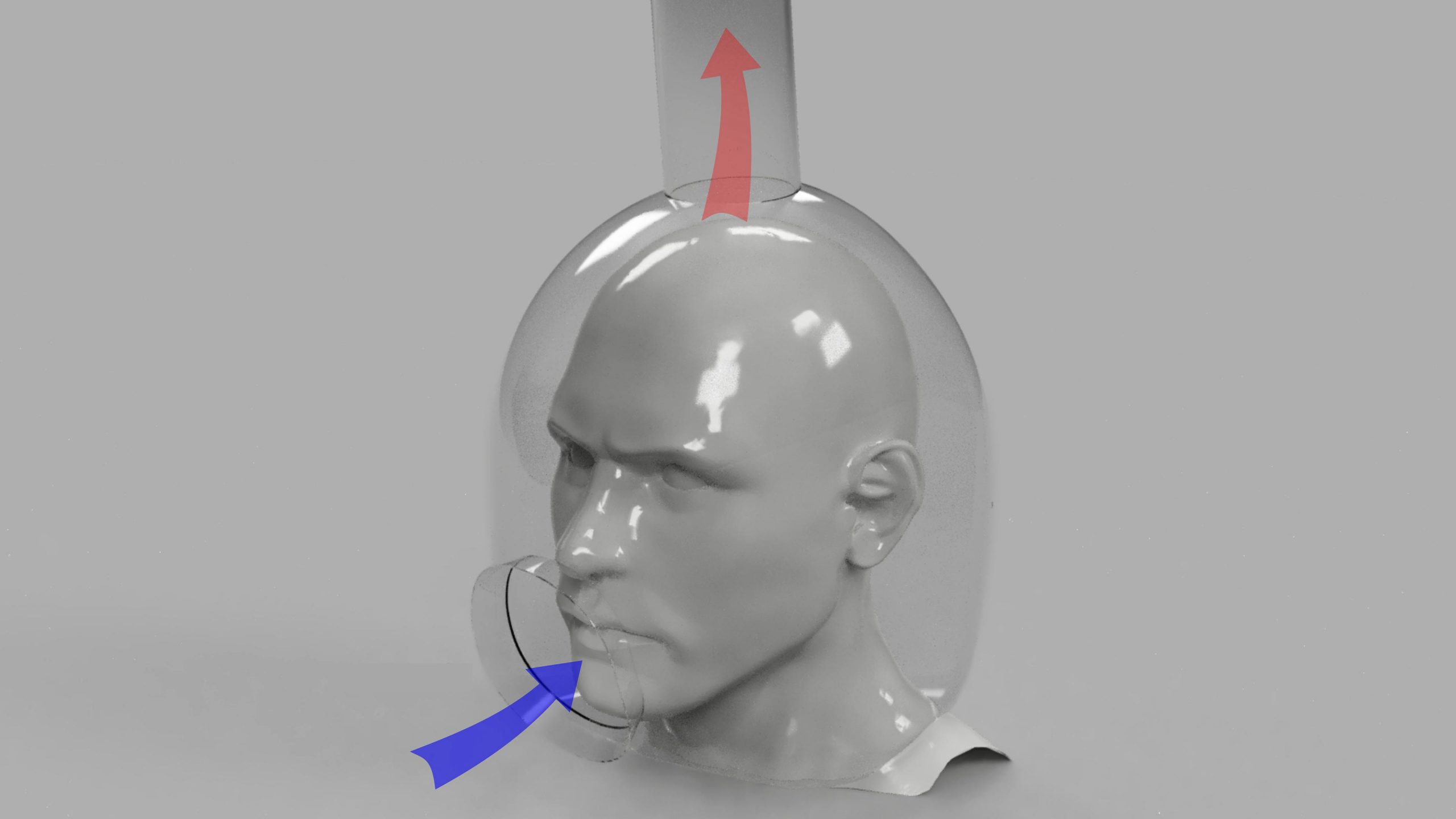
An open-faced helmet connected to an air filtration pump decreases risk of disease transmission from patients to dentists or otolaryngologists.
The risk of infection of COVID-19 is high for medical specialists who come in contact with symptomatic or asymptomatic patients. Dentists and otolaryngologists are at particular risk, since they need direct access to the mouth, nose, and throat of patients.
The current solutions, which include wearing N95 masks and face shields, clinic room evacuation, negative pressure rooms, and special air filtration systems, are expensive, not highly effective, and not very accessible.
In Physics of Fluids, by AIP Publishing, researchers at Cornell University discuss their design of an open-faced helmet for patient use that is connected to a medical-grade air filtration pump from the top that creates a reverse flow of air to prevent cough droplets from exiting the helmet.
In a computer simulation using computational fluid dynamics, they showed the helmet design can contain 99.6% of droplets emitted from coughing within 0.1 seconds.
Comparison with Negative Pressure Rooms
“To put this into context, if we use the same air pump to create a negative pressure isolation room, it will take about 45 minutes to remove 99.0% of the airborne contaminants from the room,” said author Mahdi Esmaily.
Currently available personal protective equipment does not provide open face access while maintaining high effectiveness in containing contaminants. The proposed helmet has a shell that is 1 millimeter thick and fully encloses the head with access and vacuum ports.
A nozzle is attached to the access port to extend the distance droplets must travel against the flow and minimize their chance of escape through the opening, allowing for a smoother flow transition that reduces patient discomfort generated by flow turbulence.
Potential Cost Savings and Accessibility
The proposed helmet design could also greatly reduce cost by replacing current practices. For example, building a negative pressure room with air filtration can cost tens of thousands of dollars. The cost of each helmet could be as cheap as couple of dollars if made disposable, said the researchers. Medical-grade HEPA filter negative air machines designed to power the helmets are readily available and cost around $1,000.
“Our next step is to refine the helmet design to have higher efficiency and broader application,” said author Dongjie Jia. “After that, we plan to build prototypes of the helmet and perform experiments to verify our simulation predictions.”
The simulation framework could be used as a fast and accurate way to study other particle-related phenomena and designs.
Reference: “Simulation of a vacuum helmet to contain pathogen-bearing droplets in dental and otolaryngologic outpatient interventions” by Dongjie Jia, Jonathan Lee Baker, Anais Rameau and Mahdi Esmaily, 12 January 2021, Physics of Fluids.
DOI: 10.1063/5.0036749
Never miss a breakthrough: Join the SciTechDaily newsletter.
Follow us on Google and Google News.
1 Comment
When looking for solutions always look at nature and its animals, mammals, and insects and see how all of that existed quite well as all of them and nature figured out how to overcome every obstacle that had to be face! Too bad us humans aren’t as smart. We messed everything up! When looking for a way to stop the transmission of flying molecules that are expelled from other humans just look at the beaks of birds and you’ll see a certain bird that has a beak that is long and curved downward and inward. Create a see through mask that has the same design that fits a few inches off the face and covers the whole front part of one’s face. Have the mask strap on the head or design ones that drape over the head. Kids would love being able to wear a mask that looks like a bird’s beak! Put a near see through,replaceable cotton batch inside the mask to catch molecules being emitted as one talks, breathes, sneezes or any other thing that causes the expulsion of molecules from the body. Put disposable cotton patches inside the beak at the bottom part to absorb the droplets of molecules as they travel through the chamber that they will have to travel through before exiting the bottom part of the beak mask where they will most likely be out of harms way more so then if the beak mask wasn’t used. Make the beak mask design large enough to fit over school desk or work desk or workstation or workplace and then separate them 5-10 feet apart and you’ll have a safe place to work or to be in an area for school classroom to operate. Of course all of them, especially school classrooms, should set up classrooms and work places outside to minimize the possibility of transfer of germs and if they can’t be outside then open all windows and if possible doors to let new air in which will cause whatever molecules inside a dwelling or room to dissipate quicker and easier. There you have it folks, a way to make your lives easier. Now let’s see if you are smarter than all other life on Earth or are you humans so dumb that you can’t figure out what to do about a floating deadly molecule that is so easy to destroy?