
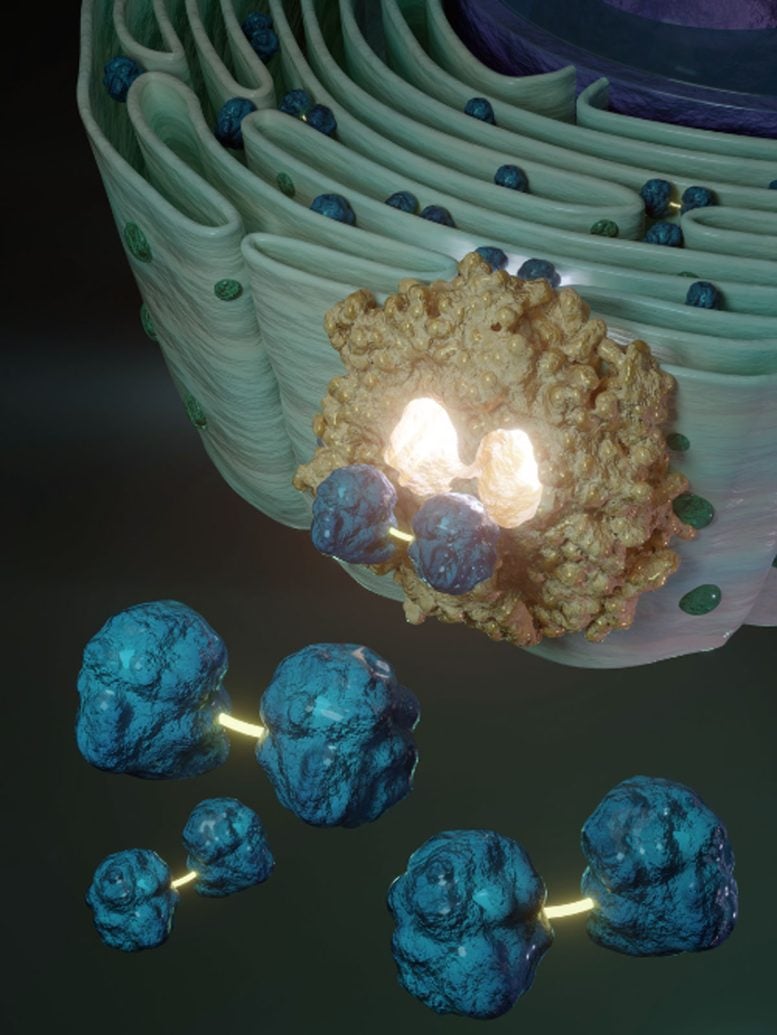
Glutathione balance in the ER, controlled by SLC33A1, is essential for proper protein folding and disease prevention.
Glutathione is one of the cell’s most versatile defenders, an antioxidant that neutralizes harmful molecules, repairs damage, and helps keep essential systems running smoothly. But scientists are discovering that its role is far more complex and consequential than once thought.
Over the past several years, Kivanç Birsoy and his team at Rockefeller University have been mapping glutathione’s hidden influence inside cells. Their work has revealed how it is transported to where it’s needed, how it helps regulate iron levels, and how its delicate balance within mitochondria—the cell’s energy hubs—can mean the difference between normal function and the spread of cancer.
More recently, the researchers found that glutathione is also essential for maintaining proper function in the endoplasmic reticulum (ER), a structure responsible for producing and processing proteins. Their findings were published in Nature Cell Biology.
“Rockefeller has an incredibly rich history of research on the endoplasmic reticulum, so we know that when things go wrong in this organelle, many diseases ranging from neurodegeneration to cancer can result,” says Birsoy. “We discovered a glutathione regulator in the ER that likely plays a key role in these conditions.”
Discovery of a Protein-Folding Regulator in the ER
The team determined that this regulator acts as a proofreader, helping ensure that proteins formed in the ER are folded correctly.
Earlier work by Birsoy’s group showed that even small disruptions in glutathione levels within mitochondria can cause widespread cellular failure. Building on that research, co-first authors Shanshan Liu, a postdoctoral researcher, and Mark Gad, a PhD student jointly supervised by Birsoy and Richard Hite of Memorial Sloan Kettering Cancer Center, turned their attention to the ER. This organelle works closely with mitochondria to maintain cellular balance.
Previous studies had already shown that glutathione helps maintain the ER’s carefully controlled environment, where proteins made by ribosomes are folded before being sent to other parts of the cell. These proteins are exported into the cytosol (the jelly-like fluid that fills the cell) and then travel to perform their functions. Unlike mitochondria, which favor a reduced form of glutathione, the ER requires a more oxidized environment. The researchers set out to understand why this difference exists and how the correct balance is achieved.
Mechanisms of Glutathione Balance in the ER
To investigate, Liu developed a method to quickly analyze the ER’s chemical conditions. She found that the ER maintains its oxidized state by importing oxidized glutathione (GSSG) from the cytosol while exporting the reduced form (GSH). Keeping a high ratio of GSSG to GSH is critical.
A genetic screen identified the transporter SLC33A1 as the key regulator of this exchange. Further structural studies led by Gad, in collaboration with the Hite lab, confirmed that SLC33A1 transports GSSG and clarified how the process works at a molecular level.
“Before this work, we knew the ER needed to stay oxidized to fold proteins correctly, but the machinery responsible for maintaining that balance was essentially a black box,” says Gad.
“We discovered that the correct glutathione ratio is essential to a proofreading step in protein folding. It may even be its primary job,” Liu says. “So if something goes wrong and the GSSG accumulates, it inhibits an enzyme that relies on the correct oxidation of the ER environment to operate a protein quality control system.”
Protein Misfolding, Cell Stress, and Disease Links
When proteins are misfolded and fail quality control, they are not exported and instead accumulate inside the ER. Over time, this buildup can trigger cell death.
“Identifying SLC33A1 as the key exporter—and being able to visualize exactly how it binds its cargo—gives us a handle on a process that, when it goes wrong, is linked to neurodegeneration and cancer,” says Gad.
The researchers also uncovered glutathione-related mechanisms that may contribute to a range of diseases. One example is Huppke-Brindle Syndrome, a rare and severe neurodevelopmental disorder marked by intellectual disability, motor impairment, and progressive neurodegeneration. Although this condition is known to involve mutations in the gene that produces SLC33A1, its underlying biology has remained unclear.
Implications for Neurodevelopmental Disorders and Cancer
“Our findings raise the possibility that the dysfunction of this gene alters the delicate glutathione balance in the ER and leads to protein misfolding during brain development,” Liu says. “We think this could lead to new interventions, such as reducing the glutathione overload through synthesis inhibitors or compounds that can dissipate it.”
The findings may also inform new approaches to treating certain lung cancers associated with mutations in the KEAP1 gene. “These cancer cells rely on a high level of glutathione synthesis,” she adds. “So if we were to inhibit the SLC33A1 transporter, the GSSG would accumulate, and the cancer cells would die.”
“Our work demonstrates that defining how nutrients and metabolites are transported across cellular and organelle membranes reveals fundamental principles of cell biology while uncovering a major class of disease-relevant and therapeutically tractable proteins,” Birsoy says. “We will continue to illuminate this largely uncharted area in future work.”
Reference: “SLC33A1 exports oxidized glutathione to maintain endoplasmic reticulum redox homeostasis” by Shanshan Liu, Mark Gad, Caifan Li, Kevin Cho, Yuyang Liu, Khando Wangdu, Viktor Belay, Alon Millet, Hiroyuki Kojima, Henry Sanford, Michele Wölk, Linas Urnavicius, Maria Fedorova, Gary J. Patti, Ekaterina V. Vinogradova, Richard K. Hite and Kıvanç Birsoy, 17 April 2026, Nature Cell Biology.
DOI: 10.1038/s41556-026-01922-y
Never miss a breakthrough: Join the SciTechDaily newsletter.
Follow us on Google and Google News.
1 Comment
These are good factual discoveries