
Close Menu
    Facebook X (Twitter) Instagram
    SciTechDaily
    • Biology
    • Chemistry
    • Earth
    • Health
    • Physics
    • Science
    • Space
    • Technology
    Facebook X (Twitter) Pinterest YouTube RSS
    SciTechDaily
    Home»Biology»Researchers Identify Molecular Factors that Push the Domino of Life into Motion
    Biology

    Researchers Identify Molecular Factors that Push the Domino of Life into Motion

    By Bill Hathaway, Yale UniversitySeptember 23, 20131 Comment3 Mins Read
    Facebook Twitter Pinterest Telegram LinkedIn WhatsApp Email Reddit
    Share
    Facebook Twitter LinkedIn Pinterest Telegram Email Reddit
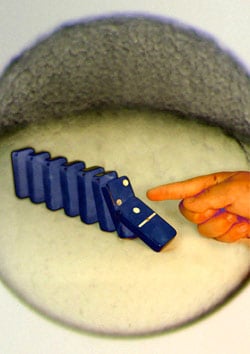
    Researchers Identify Molecular Finger that Starts the Domino of Life
    Geneticists have confirmed that three crucial factors—Nanog, Pou5f1 (also known as Oct4), and SoxB1—are essential for initiating the cascade of life in zebrafish development. Credit: Yale University

    In a newly published study, Yale University geneticists report that three factors — Nanog, Pou5f1 (or Oct4) and SoxB1 — are indeed needed to push the domino of life into motion in zebrafish. These are the same factors that reprogram adult human cells into an embryonic-like state.

    The basics of conception are familiar to any high school freshman biology student, yet scientists have yet to find the initial molecular mechanisms that set off the cascade of events that form a developing embryo.

    Yale University geneticists report online September 22 in the journal Nature that they have identified one such trigger of life — “the finger that pushes that first domino that makes all the other ones fall and initiate the making of an embryo,” according to Antonio Giraldez, associate professor of genetics and senior author of the paper.

    Scientists have known for a century that mothers provide the genetic instruction manual that drives early embryogenesis. This set of temporary maternal instructions help teach the embryo how to read its genome. However, the instructions that lead the mother to cede control of development to the incipient embryo remain undiscovered.

    Giraldez and colleagues working with zebrafish measured which of those instructions are read with the highest frequency between the time of fertilization and the transfer of developmental control to the embryo — about three hours in zebrafish and 24 hours in humans.

    They found that three factors — Nanog, Pou5f1 (or Oct4), and SoxB1 — had the highest level of activity and were indeed needed to push the domino of life into motion. To their surprise, these factors were the same ones that reprogram adult human cells into an embryonic-like state, a discovery that won Japanese scientist Shinya Yamanaka a share of the Nobel Prize in 2012.

    “The same factors that are the fountain of youth of adult cells now provide an entry point to understanding the first domino to fall in the creation of life,” Giraldez said.

    Miller T. Lee and Ashley R. Bonneau of Yale were co-lead authors of the paper. Other authors are Carter M. Takacs, Ariel A. Bazzini, Kate R. DiVito, and Elizabeth S. Fleming.

    The research was supported by the National Institutes of Health, the Pew Program in Biomedical Sciences, and the Yale Scholars Program.

    Reference: “Nanog, Pou5f1 and SoxB1 activate zygotic gene expression during the maternal-to-zygotic transition” by Miler T. Lee, Ashley R. Bonneau, Carter M. Takacs, Ariel A. Bazzini, Kate R. DiVito, Elizabeth S. Fleming and Antonio J. Giraldez, 22 September 2013, Nature.
    DOI: 10.1038/nature12632


    Never miss a breakthrough: Join the SciTechDaily newsletter.
    Follow us on Google and Google News.

    Cell Biology Embryo Genetics Molecular Biology Yale University Zebrafish
    Share. Facebook Twitter Pinterest LinkedIn Email Reddit

    Related Articles

    Scientists Discover a Gene for Brain Size

    Key Process in Brain Development Identified

    Study Shows Root of Birth Defects Grounded in Early Embryonic Development

    Scientists Create an Organism with a New Genetic Code

    New Research Changes the View about the Genetics of Leukemia Risk

    New Genome Analysis Reveals Dozens of Cancer Triggers

    A Closer Look at the Antifreeze Protein That Allows Siberian Beetles to Survive

    Key Differences in Seemingly Synonymous Parts of the Genetic Code

    Atomic Level Splicing Further Establishes RNA’s Chemical and Structural Complexity

    1 Comment

    1. Madanagopal.V.C on September 25, 2013 7:39 am

      Nobel Laurette 2012 Shinya Yamanaka had clearly demonstrated that specialised cells are no end point from stem cells which are pluripotent and omnipotent. They can be reprogrammed backwards towards the initial stage of growth. Hence mother’s specialised cells teach the embryogenesis to become omnipotent during fertilization. Mother’s egg is taught in the embryo to fertilize and divide itself into many pluripotent fragments to become nerve, skin, blood, bone, eye, brain etc., Yamanaka also showed that only a few changes in the genomes are enough to bring about this rejuvination. We have already seen skin cells transforming into brain cells in the later research of genetics. Only a few changes in the instructions of the cells can bring about the Domino effect to go back to the starting point. Thank You.

      Reply
    Leave A Reply Cancel Reply

    • Facebook
    • Twitter
    • Pinterest
    • YouTube

    Don't Miss a Discovery

    Subscribe for the Latest in Science & Tech!

    Trending News

    Just a Few Breathless Minutes a Day Could Slash Your Risk of 8 Major Diseases

    This Simple Habit Could Cut Your Risk of Dementia by 30%

    Scientists Debunk Rattlesnake Myth That Fooled Hikers and Doctors for Decades

    Scientists Discover Plants Can “Count” – and May Be Smarter Than We Thought

    New Research Reveals Ancient Mars May Have Been Warm, Wet – and Possibly Alive

    This Surprising Daily Habit Could Cut Dementia Risk by 35%

    Just 10 Minutes a Day: Scientists Say This Ancient Chinese Practice Shows Powerful Blood Pressure Benefits

    Scientists Say This Popular Food Could Help Your Body Get Rid of Microplastics

    Follow SciTechDaily
    • Facebook
    • Twitter
    • YouTube
    • Pinterest
    • Newsletter
    • RSS
    SciTech News
    • Biology News
    • Chemistry News
    • Earth News
    • Health News
    • Physics News
    • Science News
    • Space News
    • Technology News
    Recent Posts
    • What Causes Chronic Pain? Scientists Identify Key Culprit in the Brain
    • Semaglutide Shows Surprising Mental Health Benefits in Massive 100,000-Person Study
    • This Little-Known Japanese Fruit Could Help Stop Lung Cancer Before It Starts
    • Scientists Uncover Giant Lava Fields From an Active Underwater Volcano
    • Baffling Geologists for 150 Years: New Study Finally Solves Green River Mystery
    Copyright © 1998 - 2026 SciTechDaily. All Rights Reserved.
    • Science News
    • About
    • Contact
    • Editorial Board
    • Privacy Policy
    • Terms of Use

    Type above and press Enter to search. Press Esc to cancel.