
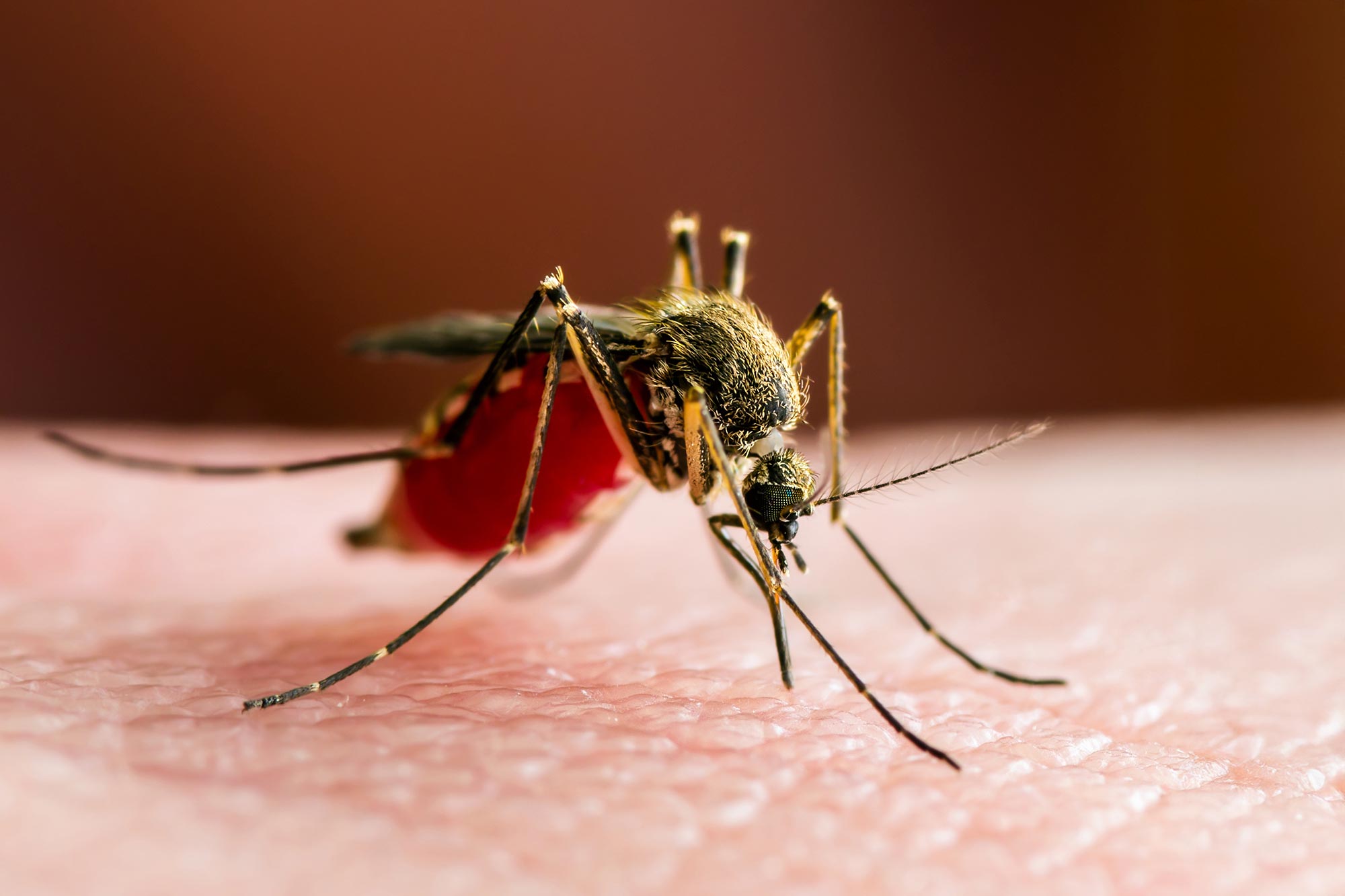
Early humans avoided malaria-prone regions, which fragmented populations and influenced human evolution and genetic diversity.
Modern humans may not have emerged from one birthplace, but from a shifting mosaic of populations spread across Africa. For decades, scientists have looked mainly to climate to explain where those groups lived and how they interacted. Now, new research suggests another powerful force was shaping the map of early humanity: disease.
In a study published in Science Advances, researchers from the Max Planck Institute of Geoanthropology, the University of Cambridge, and their collaborators examined whether malaria caused by Plasmodium falciparum influenced where humans lived between 74,000 and 5,000 years ago. This crucial window spans the period before humans dispersed widely beyond Africa and before agriculture transformed the ecology of malaria transmission.
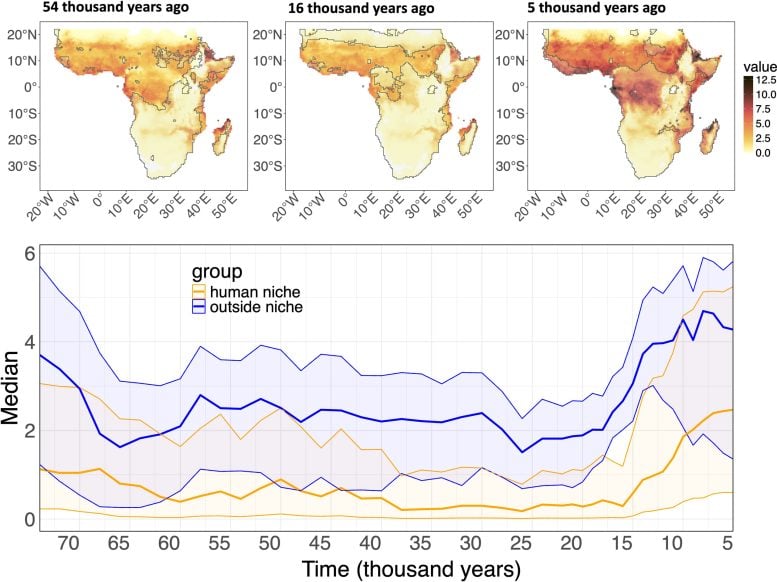
Comparing the extent of human niche and potential malaria transmission risk through time. Upper panel shows the extent of the human niche (outlined in black) against the map of potential malaria transmission risk at 54, 16 and 8 thousand years ago; Lower panel shows the median of level of malaria risk in the area of human range (dark orange line) and outside the area of human range (dark blue line), including the uncertainty (interquartile, colour in transparency around the darker lines that shows median values). We can see that the level of malaria in the human niche is consistently lower than the areas avoided by humans. Credit: Colucci, et al., Science Advances, 2026.The results suggest that malaria, one of the oldest and most persistent infectious diseases affecting humans, shaped settlement patterns by driving people away from high-risk areas. This process separated populations across the landscape.
Over many thousands of years, this separation influenced how groups interacted and exchanged genes, contributing to the population patterns seen in humans today. The findings indicate that infectious disease was not just an obstacle for early humans. It was a major force shaping our species’ deep history.
Modeling Malaria’s Impact on Human Settlement
“We used species distribution models of three major mosquito complexes together with paleoclimate models,” explains lead author Dr. Margherita Colucci of the Max Planck Institute of Geoanthropology and the University of Cambridge. “Combining these with epidemiological data allowed us to estimate malaria transmission risk across sub-Saharan Africa.”
The team then compared these malaria risk estimates with a separate reconstruction of the human ecological niche across the same region and time frame. Their analysis shows that humans either avoided or could not sustain populations in areas with high malaria risk.
“The effects of these choices shaped human demography for the last 74,000 years, and likely much earlier,” says Professor Andrea Manica of the University of Cambridge, one of the senior authors of the study. “By fragmenting human societies across the landscape, malaria contributed to the population structure we see today. Climate and physical barriers were not the only forces shaping where human populations could live.”
“This study opens up new frontiers in research on human evolution,” adds Professor Eleanor Scerri of the Max Planck Institute of Geoanthropology, also senior author of the study. “Disease has rarely been considered a major factor shaping the earliest prehistory of our species, and without ancient DNA from these periods, it has been difficult to test. Our research changes that narrative and provides a new framework for exploring the role of disease in deep human history.”
Reference: “Malaria shaped human spatial organization for the past 74 thousand years” by Margherita Colucci, Michela Leonardi, James Blinkhorn, Seth R. Irish, Cecilia Padilla-Iglesias, Stefanie Kaboth-Bar, William D. Gosling, Robert W. Snow, Andrea Manica and Eleanor M. L. Scerri, 22 April 2026, Science Advances.
DOI: 10.1126/sciadv.aea2316
Never miss a breakthrough: Join the SciTechDaily newsletter.
Follow us on Google and Google News.