

New Study Reexamines Shukbah Cave Discoveries
Long held in a private collection, the newly analyzed tooth of an approximately 9-year-old Neanderthal child marks the hominin’s southernmost known range. Analysis of the associated archaeological assemblage suggests Neanderthals used Nubian Levallois technology, previously thought to be restricted to Homo sapiens.
With a high concentration of cave sites harboring evidence of past populations and their behavior, the Levant is a major center for human origins research. For over a century, archaeological excavations in the Levant have produced human fossils and stone tool assemblages that reveal landscapes inhabited by both Neanderthals and Homo sapiens, making this region a potential mixing ground between populations. Distinguishing these populations by stone tool assemblages alone is difficult, but one technology, the distinct Nubian Levallois method, is argued to have been produced only by Homo sapiens.
In a new study published in Scientific Reports, researchers from the Max Planck Institute for the Science of Human History teamed up with international partners to re-examine the fossil and archaeological record of Shukbah Cave. Their findings extend the southernmost known range of Neanderthals and suggest that our now-extinct relatives made use of a technology previously argued to be a trademark of modern humans. This study marks the first time the lone human tooth from the site has been studied in detail, in combination with a major comparative study examining the stone tool assemblage.
“Sites where hominin fossils are directly associated with stone tool assemblages remain a rarity — but the study of both fossils and tools is critical for understanding hominin occupations of Shukbah Cave and the larger region,” says lead author Dr. Jimbob Blinkhorn, formerly of Royal Holloway, University of London and now with the Pan-African Evolution Research Group (Max Planck Institute for the Science of Human History).
Revisiting the Lone Human Tooth of Shukbah
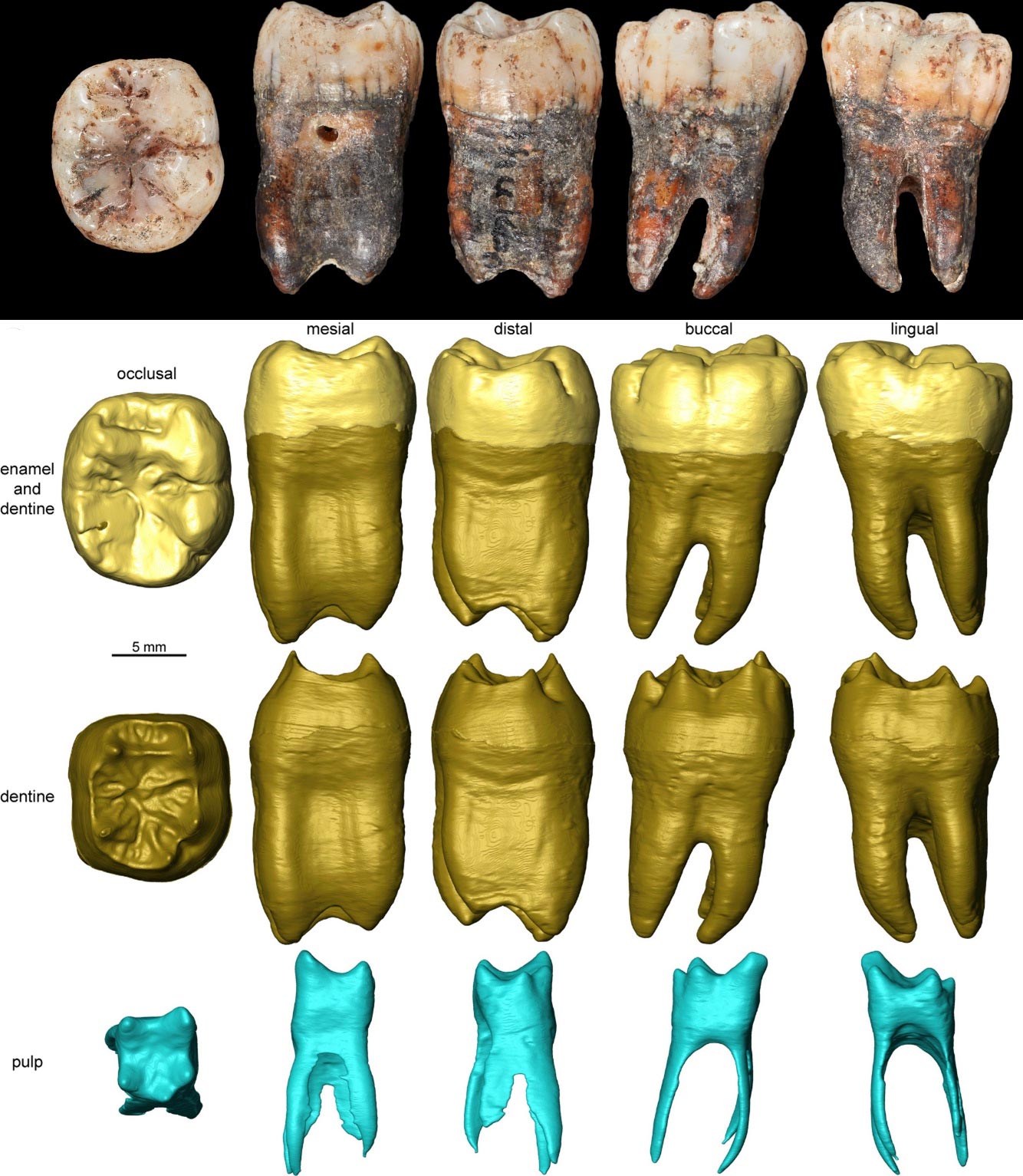
Shukbah Cave was first excavated in the spring of 1928 by Dorothy Garrod, who reported a rich assemblage of animal bones and Mousterian-style stone tools cemented in breccia deposits, often concentrated in well-marked hearths. She also identified a large, unique human molar. However, the specimen was kept in a private collection for most of the 20th century, prohibiting comparative studies using modern methods. The recent re-identification of the tooth at the Natural History Museum in London has led to new detailed work on the Shukbah collections.
“Professor Garrod immediately saw how distinctive this tooth was. We’ve examined the size, shape, and both the external and internal 3D structure of the tooth, and compared that to Holocene and Pleistocene Homo sapiens and Neanderthal specimens. This has enabled us to clearly characterize the tooth as belonging to an approximately 9-year-old Neanderthal child,” says Dr. Clément Zanolli, from Université de Bordeaux. “Shukbah marks the southernmost extent of the Neanderthal range known to date,” adds Zanolli.
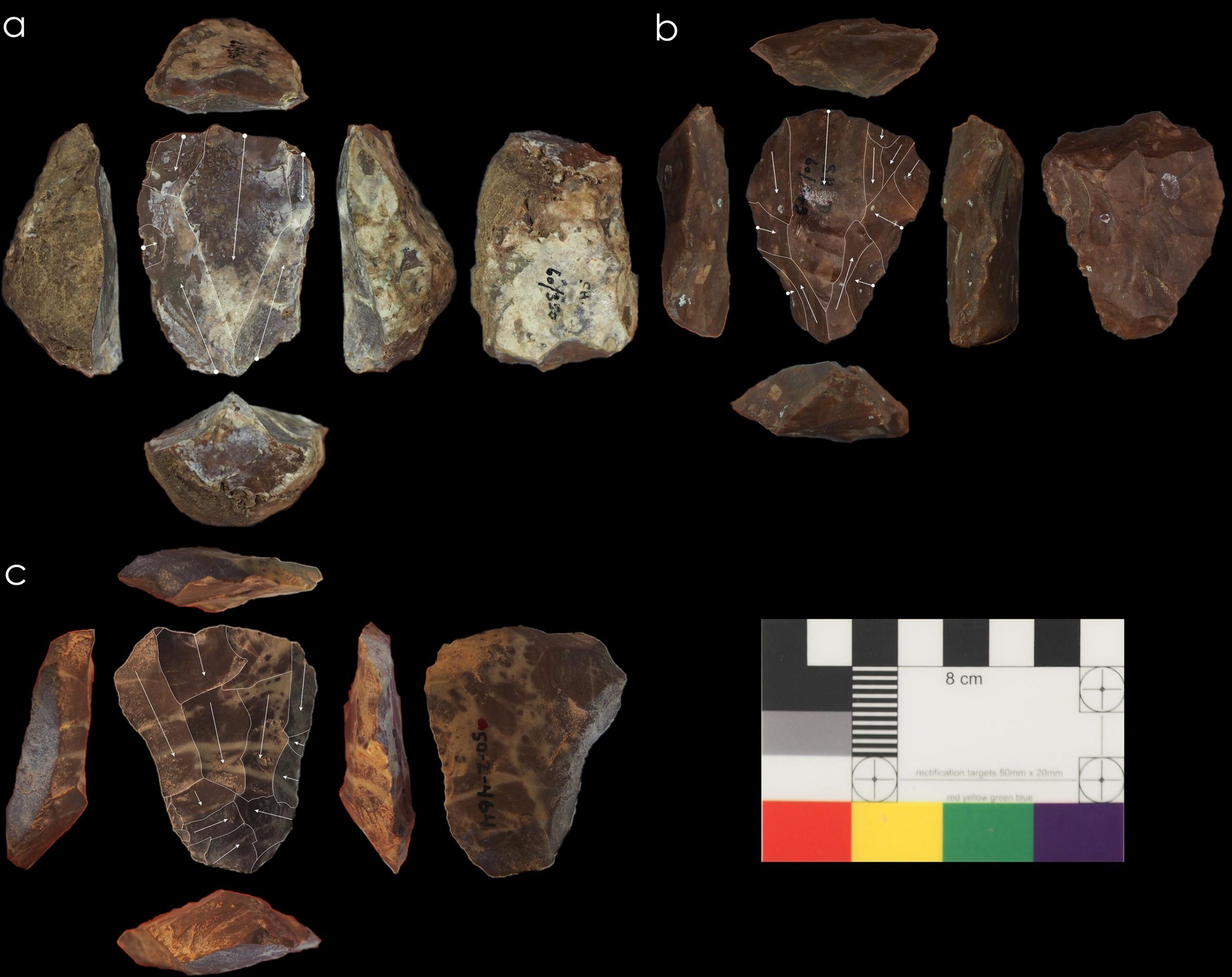
Although Homo sapiens and Neanderthals shared the use of a wide suite of stone tool technologies, Nubian Levallois technology has recently been argued to have been exclusively used by Homo sapiens. The argument has been made particularly in southwest Asia, where Nubian Levallois tools have been used to track human dispersals in the absence of fossils.
“Illustrations of the stone tool collections from Shukbah hinted at the presence of Nubian Levallois technology so we revisited the collections to investigate further. In the end, we identified many more artifacts produced using the Nubian Levallois methods than we had anticipated,” says Blinkhorn. “This is the first time they’ve been found in direct association with Neanderthal fossils, which suggests we can’t make a simple link between this technology and Homo sapiens.”
Caution Against Oversimplifying Tool and Species Links
“Southwest Asia is a dynamic region in terms of hominin demography, behavior, and environmental change, and may be particularly important to examine interactions between Neanderthals and Homo sapiens,” adds Prof Simon Blockley, of Royal Holloway, University of London. “This study highlights the geographic range of Neanderthal populations and their behavioral flexibility, but also issues a timely note of caution that there are no straightforward links between particular hominins and specific stone tool technologies.”
“Up to now we have no direct evidence of a Neanderthal presence in Africa,” said Prof Chris Stringer of the Natural History Museum. “But the southerly location of Shukbah, only about 400 km from Cairo, should remind us that they may have even dispersed into Africa at times.”
Reference: “Nubian Levallois technology associated with southernmost Neanderthals” by James Blinkhorn, Clément Zanolli, Tim Compton, Huw S. Groucutt, Eleanor M. L. Scerri, Lucile Crété, Chris Stringer, Michael D. Petraglia and Simon Blockley, 15 February 2021, Scientific Reports.
DOI: 10.1038/s41598-021-82257-6
Researchers involved in this study include scholars from the Max Planck Institute for the Science of Human History, Royal Holloway, University of London, the Université de Bordeaux, the Max Planck Institute for Chemical Ecology, the University of Malta, and the Natural History Museum, London. This work was supported by the Leverhulme trust (RPH-2017-087).
Never miss a breakthrough: Join the SciTechDaily newsletter.
Follow us on Google and Google News.
5 Comments
Formally in a private collection! Just another pocket treasure stolen by another @sshole anothro or archeo, that would throw you in prison for doing the same. Hypocrites one and all.
Whenever I see some story like this I always think about what could be hidden away in somebody’s secret/private/illegal collection … that goes for museums as well.
When will scientists finally understand that “Neanderthals” were actually just us with enough adaptations to their environment that make them look slightly different. It has been proven that they bred with us. There is no real thing as a “Neanderthal.” Even some people today share the same physical characteristics. They are simply a tribe of people with genetic anomalies that explored and settled a wide variety of places just as we do. They are finding more and more that “Neanderthals” are more like us than ever imagined because guess what? They weren’t some primitive creature with no sense of community. They ARE us.
I think it’s a shame that all these rich people take all these artifacts they could be studied and there could be more understood about our history and our past and I’m like some of these other people I believe that neanderthals were just as we are they were just a different species of us
hank you for the last information