
Close Menu
    Facebook X (Twitter) Instagram
    SciTechDaily
    • Biology
    • Chemistry
    • Earth
    • Health
    • Physics
    • Science
    • Space
    • Technology
    Facebook X (Twitter) Pinterest YouTube RSS
    SciTechDaily
    Home»Space»Building Blocks of Life Revealed in Solar System’s Oldest Molecular Fluids?
    Space

    Building Blocks of Life Revealed in Solar System’s Oldest Molecular Fluids?

    By Royal Ontario MuseumMay 13, 2020No Comments3 Mins Read
    Facebook Twitter Pinterest Telegram LinkedIn WhatsApp Email Reddit
    Share
    Facebook Twitter LinkedIn Pinterest Telegram Email Reddit
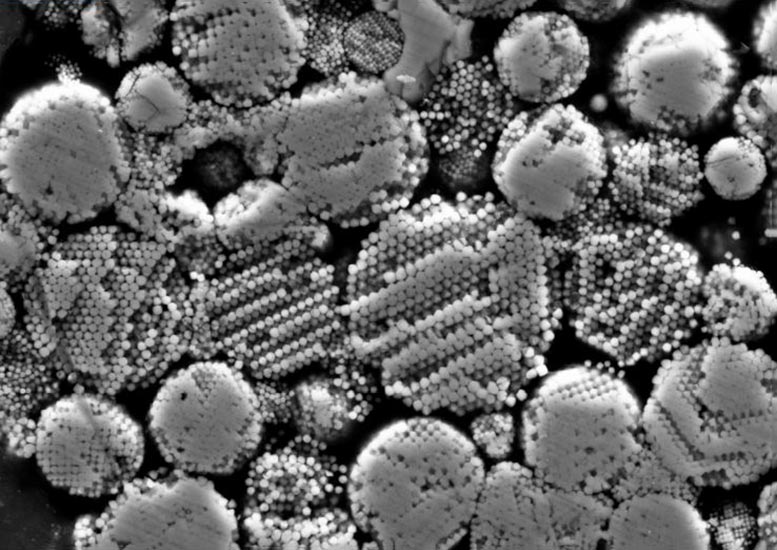
    Magnetite Framboids in Tagish Lake
    The spherical interlocking structure is indicative of formation in water, allowing scientists the measure the chemistry of the remnant solution trapped between grains. Credit: Chi Ma

    Scientists reveal solar system’s oldest molecular fluids could hold the key to early life.

    The oldest molecular fluids in the solar system could have supported the rapid formation and evolution of the building blocks of life, new research in the journal Proceedings of the National Academy of Sciences reveals.

    An international group of scientists, led by researchers from the Royal Ontario Museum (ROM) and co-authors from McMaster University and York University, used state-of-the-art techniques to map individual atoms in minerals formed in fluids on an asteroid over 4.5 billion years ago.

    Studying the ROM’s iconic Tagish Lake meteorite, scientists used atom-probe tomography, a technique capable of imaging atoms in 3D, to target molecules along boundaries and pores between magnetite grains that likely formed on the asteroid’s crust. There, they discovered water precipitates left in the grain boundaries on which they conducted their ground-breaking research.

    “We know water was abundant in the early solar system,” explains lead author Dr. Lee White, Hatch postdoctoral fellow at the ROM, “but there is very little direct evidence of the chemistry or acidity of these liquids, even though they would have been critical to the early formation and evolution of amino acids and, eventually, microbial life.”

    This new atomic-scale research provides the first evidence of the sodium-rich (and alkaline) fluids in which the magnetite framboids formed. These fluid conditions are preferential for the synthesis of amino acids, opening the door for microbial life to form as early as 4.5 billion years ago.

    “Amino acids are essential building blocks of life on Earth, yet we still have a lot to learn about how they first formed in our solar system,” says Beth Lymer, a Ph.D. student at York University and co-author of the study. “The more variables that we can constrain, such as temperature and pH, allows us to better understand the synthesis and evolution of these very important molecules into what we now know as biotic life on Earth.”

    The Tagish Lake carbonaceous chondrite was retrieved from an ice sheet in B.C.’s Tagish Lake in 2000, and later acquired by the ROM, where it is now considered to be one of the museum’s iconic objects. This history means that the sample used by the team has never been above room temperature or exposed to liquid water, allowing the scientists to confidently link the measured fluids to the parent asteroid.

    By using new techniques, such as atom probe tomography, the scientists hope to develop analytical methods for planetary materials returned to Earth by space craft, such as by NASA’s OSIRIS-REx mission or a planned sample-return mission to Mars in the near future.

    “Atom probe tomography gives us an opportunity to make fantastic discoveries on bits of material a thousand times thinner than a human hair,” says White. “Space missions are limited to bringing back tiny amounts of material, meaning these techniques will be critical to allowing us to understand more about the solar system while also preserving material for future generations.”

    Never miss a breakthrough: Join the SciTechDaily newsletter.
    Follow us on Google and Google News.

    Astrobiology Astronomy Meteors Royal Ontario Museum
    Share. Facebook Twitter Pinterest LinkedIn Email Reddit

    Related Articles

    Possible Signs of Alien Life? Methane in the Plumes of Saturn’s Moon Enceladus

    Habitable Planets With Earth-Like Biospheres May Be Much Rarer Than Thought

    Alien Life in These Star-Systems Could Have Spotted Earth After Human Civilization Blossomed

    Scientists Use New Technology to Detect Signatures of Life Remotely

    Using Game Theory to Help Discover Intelligent Alien Life

    Potentially Hazardous 4,000 Year Comets Can Cause Meteor Showers on Earth

    Search for Extraterrestrial Intelligence: How Microbes Could Communicate With Alien Species

    Massive Flare Seen on Closest Star to the Solar System: What It Means for Chances of Alien Neighbors

    Hydroxyl Molecule Signature Detected in an Exoplanet Atmosphere for the First Time

    Leave A Reply Cancel Reply

    • Facebook
    • Twitter
    • Pinterest
    • YouTube

    Don't Miss a Discovery

    Subscribe for the Latest in Science & Tech!

    Trending News

    Scientists Discover How Coffee Impacts Memory, Mood, and Gut Health

    Why Did the Neanderthals Disappear? Scientists Reveal Humans Had a Hidden Advantage

    Physicists Propose Strange Experiment Where Time Goes Quantum

    Magnesium Magic: New Drug Melts Fat Even on a High-Fat, High-Sugar Diet

    Weight-Loss Drugs Like Ozempic May Come With an Unexpected Cost

    Mezcal “Worm” in a Bottle Mystery: DNA Testing Reveals a Surprise

    New Research Reveals That Your Morning Coffee Activates an Ancient Longevity Switch

    This Is What Makes You Irresistible to Mosquitoes

    Follow SciTechDaily
    • Facebook
    • Twitter
    • YouTube
    • Pinterest
    • Newsletter
    • RSS
    SciTech News
    • Biology News
    • Chemistry News
    • Earth News
    • Health News
    • Physics News
    • Science News
    • Space News
    • Technology News
    Recent Posts
    • This New Memory Technology Could Make Devices Last Months on One Charge
    • Scientists Turn Cancer’s Own Bacteria Against It in Breakthrough Therapy
    • Cannabis Can Make You Remember Things That Never Happened
    • Doctors Are Surprised by What This Vaccine Is Doing to the Heart
    • Quantum Breakthrough Turns Simple Forces Into Powerful New Interactions
    Copyright © 1998 - 2026 SciTechDaily. All Rights Reserved.
    • Science News
    • About
    • Contact
    • Editorial Board
    • Privacy Policy
    • Terms of Use

    Type above and press Enter to search. Press Esc to cancel.