
Close Menu
    Facebook X (Twitter) Instagram
    SciTechDaily
    • Biology
    • Chemistry
    • Earth
    • Health
    • Physics
    • Science
    • Space
    • Technology
    Facebook X (Twitter) Pinterest YouTube RSS
    SciTechDaily
    Home»Earth»Utah’s Great Salt Lake Is Disappearing – Megadrought Persists Across the US Southwest
    Earth

    Utah’s Great Salt Lake Is Disappearing – Megadrought Persists Across the US Southwest

    By European Space Agency (ESA)August 2, 2022No Comments5 Mins Read
    Facebook Twitter Pinterest Telegram LinkedIn WhatsApp Email Reddit
    Share
    Facebook Twitter LinkedIn Pinterest Telegram Email Reddit
    Great Salt Lake Disappearing
    As a megadrought persists across the US southwest, Utah’s Great Salt Lake dropped to its lowest recorded water level.

    The Great Salt Lake’s declining water levels, caused by drought and urban expansion, endanger the environment, public health, and the region’s economy.

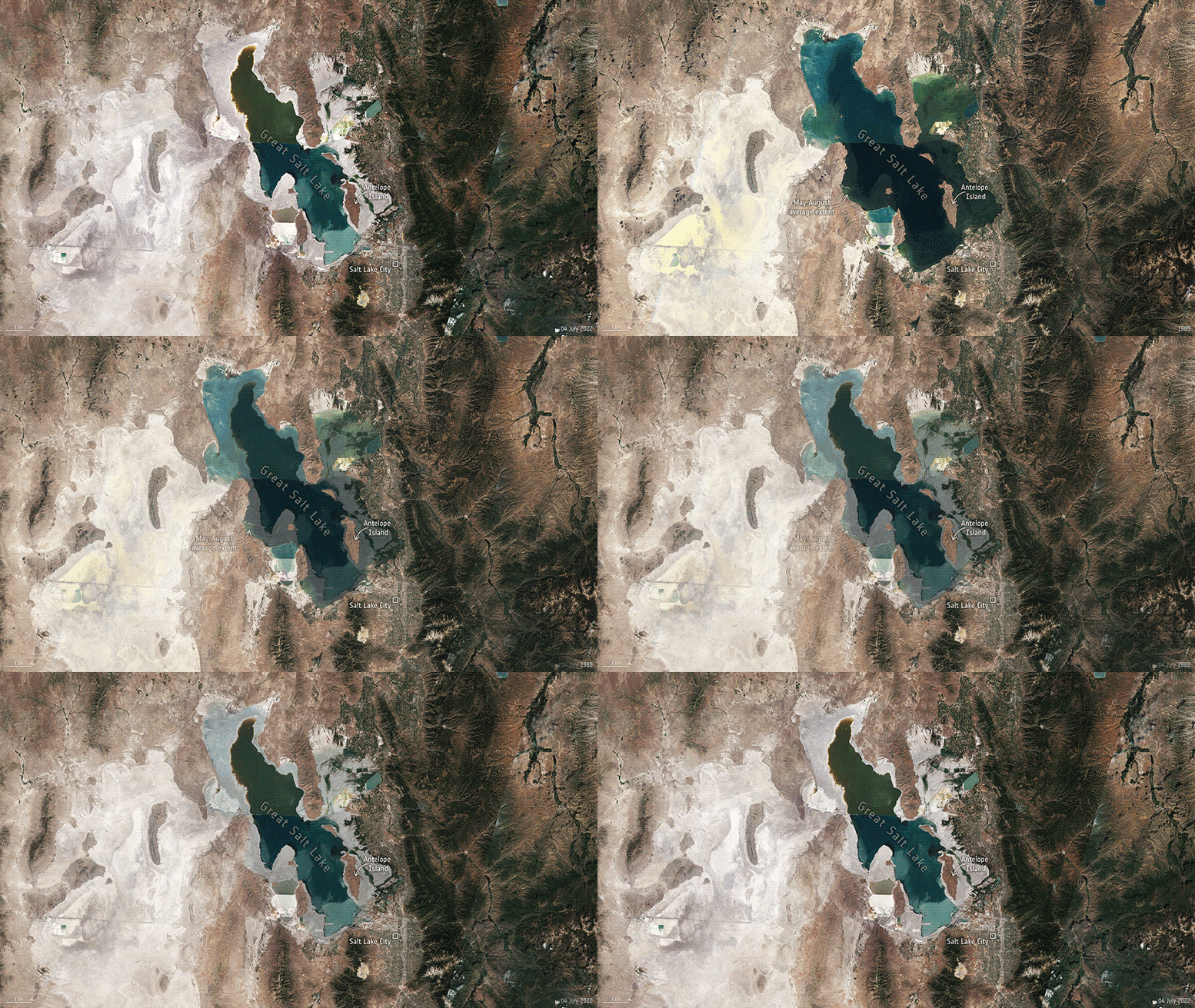
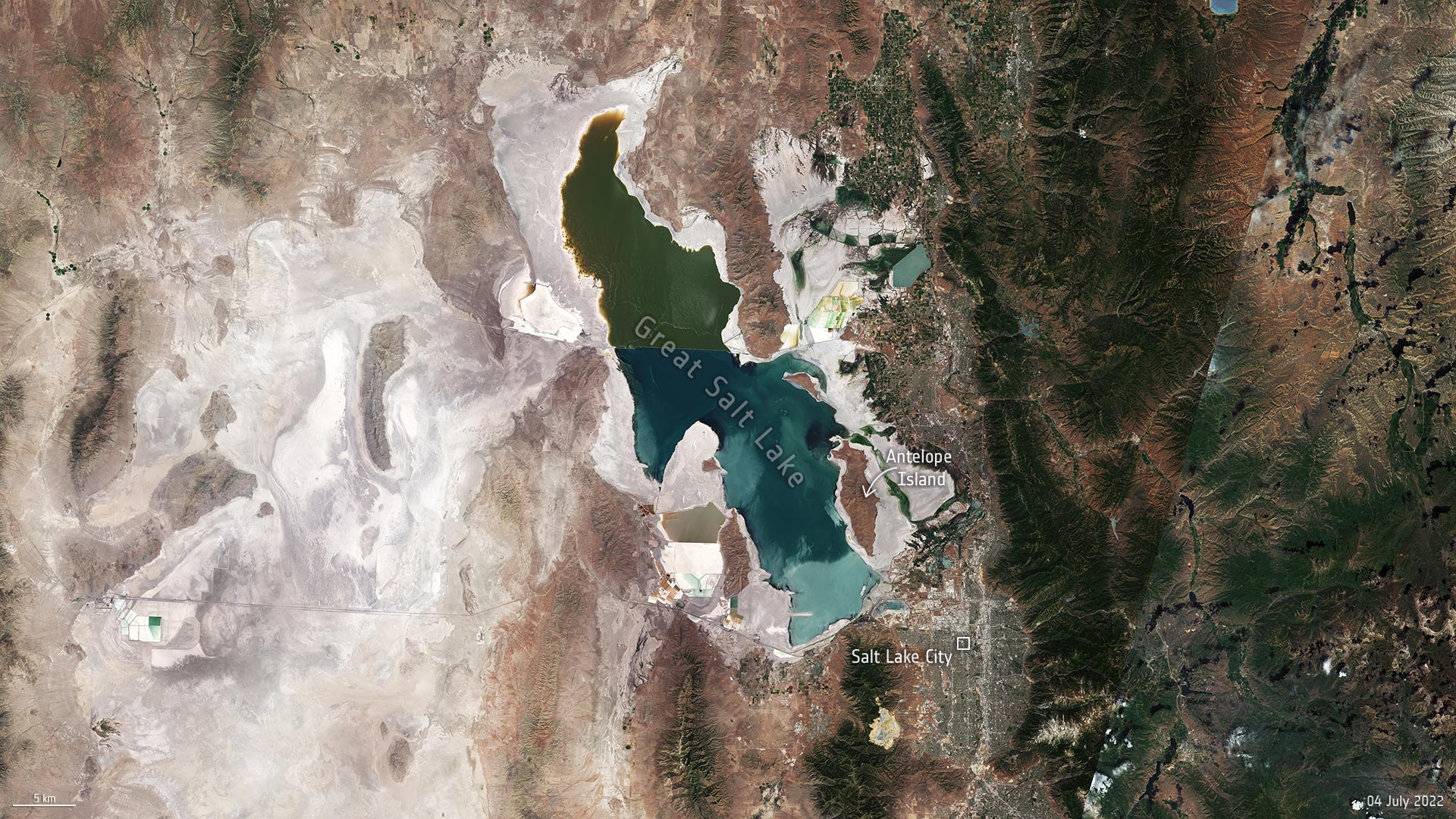
    Utah’s Great Salt Lake dropped to its lowest recorded water level last month as a megadrought persists across the US southwest. This has forced the fast-growing city to curb its water use. From space, satellite images show how water levels have dramatically fallen from 1985 to 2022 – exposing large expanses of lakebed.

    According to data from the US Geological Survey (USGS), the Great Salt Lake’s surface water elevation fell to the lowest level since records began in the mid-1800s, to an average of 1277 m (4,190 feet) above sea level. As a result of this drop in water level, the lake has lost nearly half of its surface area from the historical average, exposing around 2000 sq km (770 square miles) of lakebed – an area the same size as Tenerife.

    Causes Behind the Lake’s Decline

    Now the lake barely contains more than one-fourth of the volume of water that it did at its high point in 1987, according to the USGS. Two of the main reasons behind the lake’s decline are water usage and the climate change-fueled drought.

    The lake goes through seasonal cycles of water loss and replenishment after rain and snow melt fills it back up. According to officials, the water evaporation and depletion exceed the amount of water entering the lake. The lake’s water levels are expected to further decrease until autumn or early winter, when incoming water equals or exceeds the evaporative losses.

    The satellite images below reveal how water levels have fallen from 1985 (top) to 2022 (bottom), exposing large expanses of the lakebed.

    Great Salt Lake 1985
    Great Salt Lake 1985. Credit: USGS/contains modified Copernicus Sentinel data (2022), processed by ESA
    Great Salt Lake 2022
    Great Salt Lake 2022. Credit: USGS/contains modified Copernicus Sentinel data (2022), processed by ESA

    Ecological and Economic Impacts

    The declining waters of the Great Salt Lake poses devastating consequences for the economy, ecology, and people of northern Utah. The lake generates snowpack, acts as a refuge for hundreds of migratory birds and other wildlife, and generates millions in economic development through mineral extraction and tourism.

    The Great Salt Lake is the largest saltwater lake in the Western Hemisphere, and one of the most saline inland bodies of water in the world. As the lake shrinks, it becomes saltier which endangers flies and brine shrimp which millions of birds rely on for food.

    Declining water levels also impacts the local air quality. As the bottom of the lake dries up and more lakebed is exposed, the dry soil leads to an increase of dust in the air. The dust is laced with copper, arsenic, and other dangerous heavy metals that have accumulated in the lake, much of it being residue from mining activity in the region.

    These can, over time, pose a public health hazard when dust storms carry them into populated areas, causing damage when inhaled and exacerbating other respiratory illnesses.

    The image below shows the average aerosol concentrations near the open areas of the lake bed produced using data from the Copernicus Sentinel-5P satellite from June 1 to July 15, 2022.

    Great Salt Lake Dangerous Dust
    This image shows the average aerosol concentrations near the open-areas of the lake bed produced using Copernicus Sentinel-5P data from June 1 to July 15, 2022. The exposed lake bed of the Great Salt Lake could impact public health in the long term. As the bottom of the lake dries up and more lakebed is exposed, the dry soil leads to an increase of dust in the air. The dust is laced with copper, arsenic, and other dangerous heavy metals that have accumulated in the lake, much of it being residue from mining activity in the region. Credit: Contains modified Copernicus Sentinel data (2022), processed by ESA, CC BY-SA 3.0 IGO

    Another factor contributing to the lake’s dropping water levels is the reduction in ways that the lake regains water. Water is re-directed from the streams that feed the lake each year to agriculture and nearby residential areas, meaning the lake cannot easily replace the water it loses via evaporation.

    Increased water demand due to the growing number population of the metropolitan Salt Lake City is another reason behind the Great Salt Lake’s desertification. Utah is the fastest-growing state in the US and is projected to increase almost 50% by 2060.

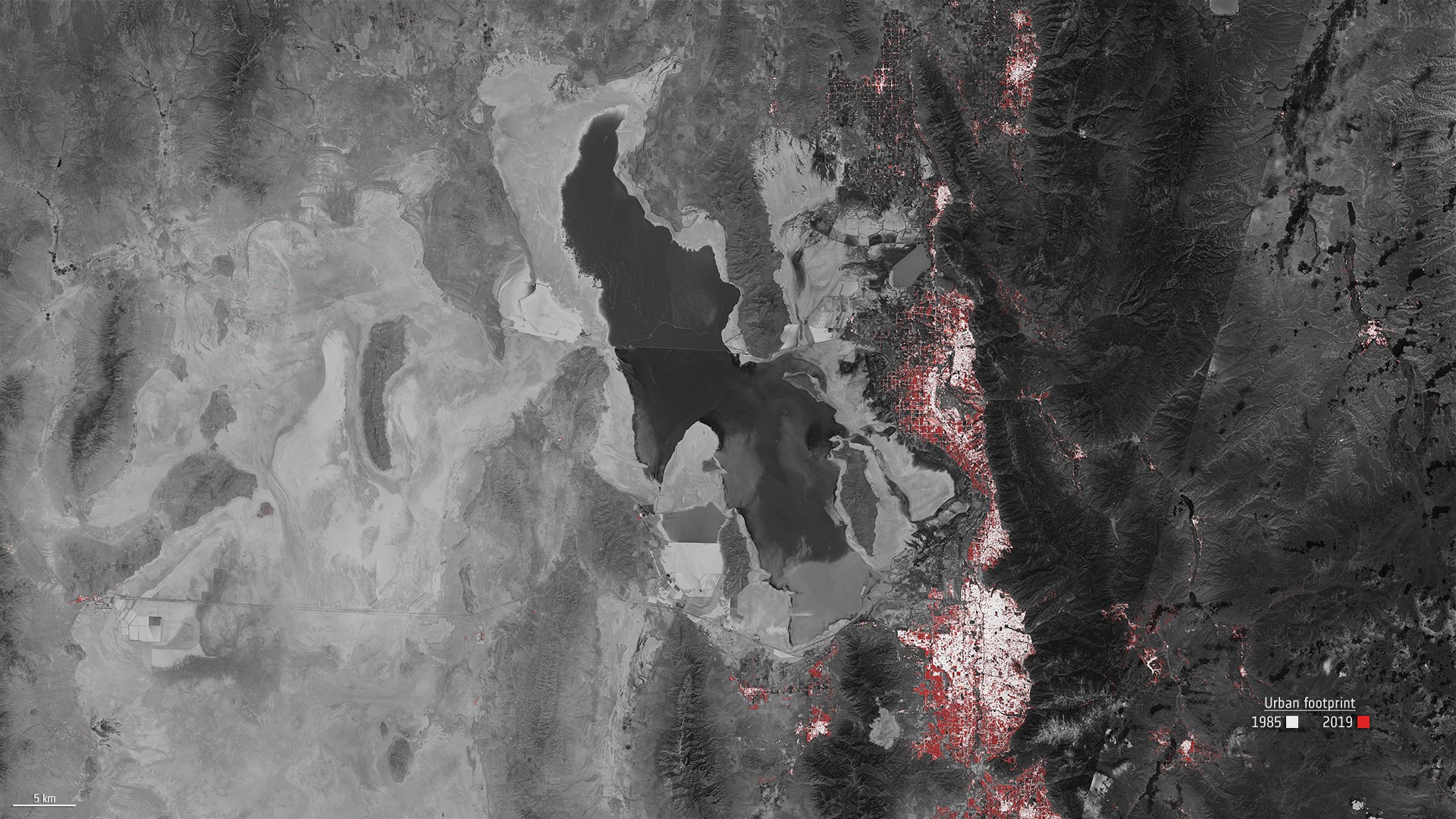
    The image below utilizes data from the World Settlement Footprint to highlight the urban expansion of Salt Lake City occurring between 1985 to 2019.
    Salt Lake City Urban Expansion
    The population of Salt Lake City has grown by around 20% since the 1980s. Increased water demand due to the large number of inhabitants in the surrounding area is one of the reasons of the Great Salt Lake’s desertification. This image utilizes data from the World Settlement Footprint to highlight the urban expansion occurring between 1985 to 2019. The World Settlement Footprint is the world’s most comprehensive dataset on human settlement created to improve the understanding of current trends in global urbanization. The World Settlement Footprint is a joint project by ESA, the German Aerospace Center (DLR), in collaboration with the Google Earth Engine team. Credit: ESA (Contains data from the DLR World Settlement Footprint)

    The World Settlement Footprint is the world’s most comprehensive dataset on human settlement created to improve the understanding of current trends in global urbanization. The World Settlement Footprint is a joint project by ESA, the German Aerospace Center (DLR), in collaboration with the Google Earth Engine team.

    Never miss a breakthrough: Join the SciTechDaily newsletter.
    Follow us on Google and Google News.

    Drought European Space Agency Geography Weather
    Share. Facebook Twitter Pinterest LinkedIn Email Reddit

    Related Articles

    Lake Powell – The Second Largest Reservoir in the United States – Reaches New Low

    Mediterranean Continues To Bake – Surface Temperatures Over 120° in Turkey and Cyprus

    Smoke Billows From Deadly Wildfires in Turkey

    Monitoring the Devastating US-Canada Heatwave From Space

    California Reservoirs Reflect Deepening Drought – Worst They Have Been Since the 1970s

    Spain’s chilly blanket – Spain Heavy Snowfall Satellite Image

    Madrid Snowbound – Stunning Satellite Image Captures Heaviest Snowfall in 50 Years

    ESA’s Earth Explorer Satellite SMOS Monitoring Droughts [Video]

    Severe Drought in the Czech Republic Visible From Space

    Leave A Reply Cancel Reply

    • Facebook
    • Twitter
    • Pinterest
    • YouTube

    Don't Miss a Discovery

    Subscribe for the Latest in Science & Tech!

    Trending News

    Popular Vitamin B3 Supplements May Help Cancer Cells Survive, Scientists Warn

    Scientists Discover Strange Property of Rice and Turn It Into a Smart Material

    NASA Artemis II Skips Burn As Astronaut Captures Stunning View of Earth

    NASA’s Artemis II: Humans Just Left Earth Orbit for the First Time Since 1972

    What Causes Chronic Pain? Scientists Identify Key Culprit in the Brain

    Semaglutide Shows Surprising Mental Health Benefits in Massive 100,000-Person Study

    This Liquid Snapped Instead of Flowing and Scientists Were Shocked

    Breakthrough Alzheimer’s Drug Rewires the Brain Instead of Just Clearing Plaques

    Follow SciTechDaily
    • Facebook
    • Twitter
    • YouTube
    • Pinterest
    • Newsletter
    • RSS
    SciTech News
    • Biology News
    • Chemistry News
    • Earth News
    • Health News
    • Physics News
    • Science News
    • Space News
    • Technology News
    Recent Posts
    • Scientists Uncover the Secret “Glue” That Helps Soil Hold Water
    • Climate Change Is Altering a Key Greenhouse Gas in a Way Scientists Didn’t Expect
    • Why Antarctic Sea Ice Suddenly Collapsed After Decades of Growth
    • Astronomers Discover the Most Pristine Star Ever Found
    • New Study Suggests Gravitational Waves May Have Created Dark Matter
    Copyright © 1998 - 2026 SciTechDaily. All Rights Reserved.
    • Science News
    • About
    • Contact
    • Editorial Board
    • Privacy Policy
    • Terms of Use

    Type above and press Enter to search. Press Esc to cancel.