
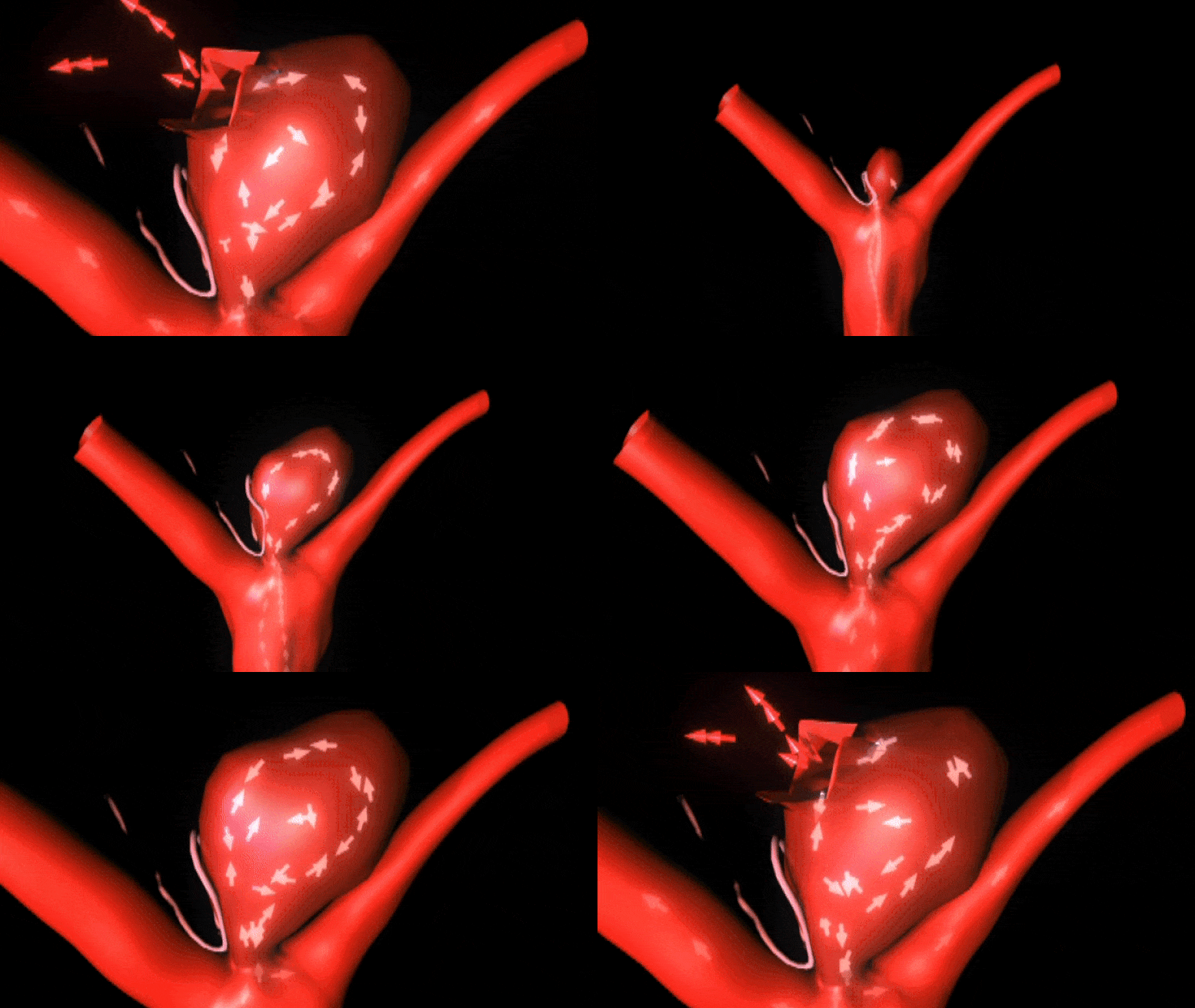
Patient-specific data and a mathematical model determine how aneurysm shape and size influence growth and rupture.
Cerebral aneurysms appear in approximately 5% to 8% of the general population. When they result in a blood vessel rupture, the ensuing blood leakage within the brain can lead to severe stroke or fatal consequences. Over one-quarter of patients who experience a hemorrhagic stroke die before reaching a hospital or healthcare facility.
A cerebral aneurysm (also called a brain aneurysm) is a weak or thin spot on an artery in the brain that balloons out and fills with blood. The bulging aneurysm can put pressure on the nerves or brain tissue. It may also burst or rupture, spilling blood into the surrounding tissue (called a hemorrhage). A ruptured aneurysm can cause serious health problems such as brain damage, hemorrhagic stroke, coma, and even death.
Mathematical Modeling for Aneurysm Risk Assessment
Predicting the rupture of aneurysms is crucial for medical prevention and treatment. In the journal Physics of Fluids, by AIP Publishing, researchers from the Sree Chitra Tirunal Institute for Medical Sciences and Technology, Trivandrum, and the Indian Institute of Technology Madras, developed a patient-specific mathematical model to examine what aneurysm parameters influence rupture risk prior to surgery.
Aneurysms occur when the weakest point of a blood vessel thins, expands, and, after a certain limit, bursts. In the case of cerebral aneurysms such as internal carotid artery bifurcation aneurysms, blood leaks into the intracranial cavity
“Since clinicians encounter these aneurysms at various growth stages, it motivated us to analyze internal carotid artery aneurysms in a systematic manner,” said B. Jayanand Sudhir, of the Sree Chitra Tirunal Institute for Medical Sciences and Technology. “The current study is a sincere and systematic attempt to address the dynamics of blood flow at various stages to understand the initiation, progression, and rupture risk.”
Animation showing an aneurysm arising from a blood vessel bifurcation, progressively expanding and ending in rupture. Credit: Sajan Abdul Salam, Subash M. Nair, B. Jayanand Sudhir
Factors Influencing Rupture Risk: Aspect and Size Ratios
The team examined the aspect ratio and size ratio of aneurysms, which describe the shape and size characteristics of the bulge in a holistic manner. As these parameters increase and the aneurysm expands, the stress applied against the aneurysm walls and the time blood spends within the aneurysm increase. This leads the probability of rupture to rise.
Patient-specific computed tomography scans are fed into the model, which reconstructs the geometry and blood flow of the aneurysm. It then uses mathematical equations to describe the fluid flow, generating information about the blood vessel walls and blood flow patterns.
“This was feasible due to the access we had to the national supercomputing cluster for performing the computational fluid dynamics-based simulations,” said S.V. Patnaik of the Indian Institute of Technology Madras.
“The novelty of this work lies in close collaboration and amalgamation of expertise from clinical and engineering backgrounds,” said Sudhir. “The aneurysm models were of different shapes, which helped us build and understand the complexity of flow structures in multilobed cerebral aneurysms.”
Multilobed aneurysms, which include more than one balloonlike pocket of expanding blood, contained more complex blood flow structures than their single-lobed counterparts.
The authors hope to transform the rupture risk predictions into a user-friendly software application to help clinicians and neurosurgeons prioritize and manage high-risk patients. They plan to use the model to assess the effectiveness of different treatment options for aneurysms.
Reference: “Influence of morphological parameters on hemodynamics in internal carotid artery bifurcation aneurysms” by Mahesh S. Nagargoje, Chanikya Valeti, N. Manjunath, Bhushan Akhade, B.J. Sudhir, B.S.V. Patnaik and Santhosh K. Kannath, 11 October 2022, Physics of Fluids.
DOI: 10.1063/5.0117879
Never miss a breakthrough: Join the SciTechDaily newsletter.
Follow us on Google and Google News.