
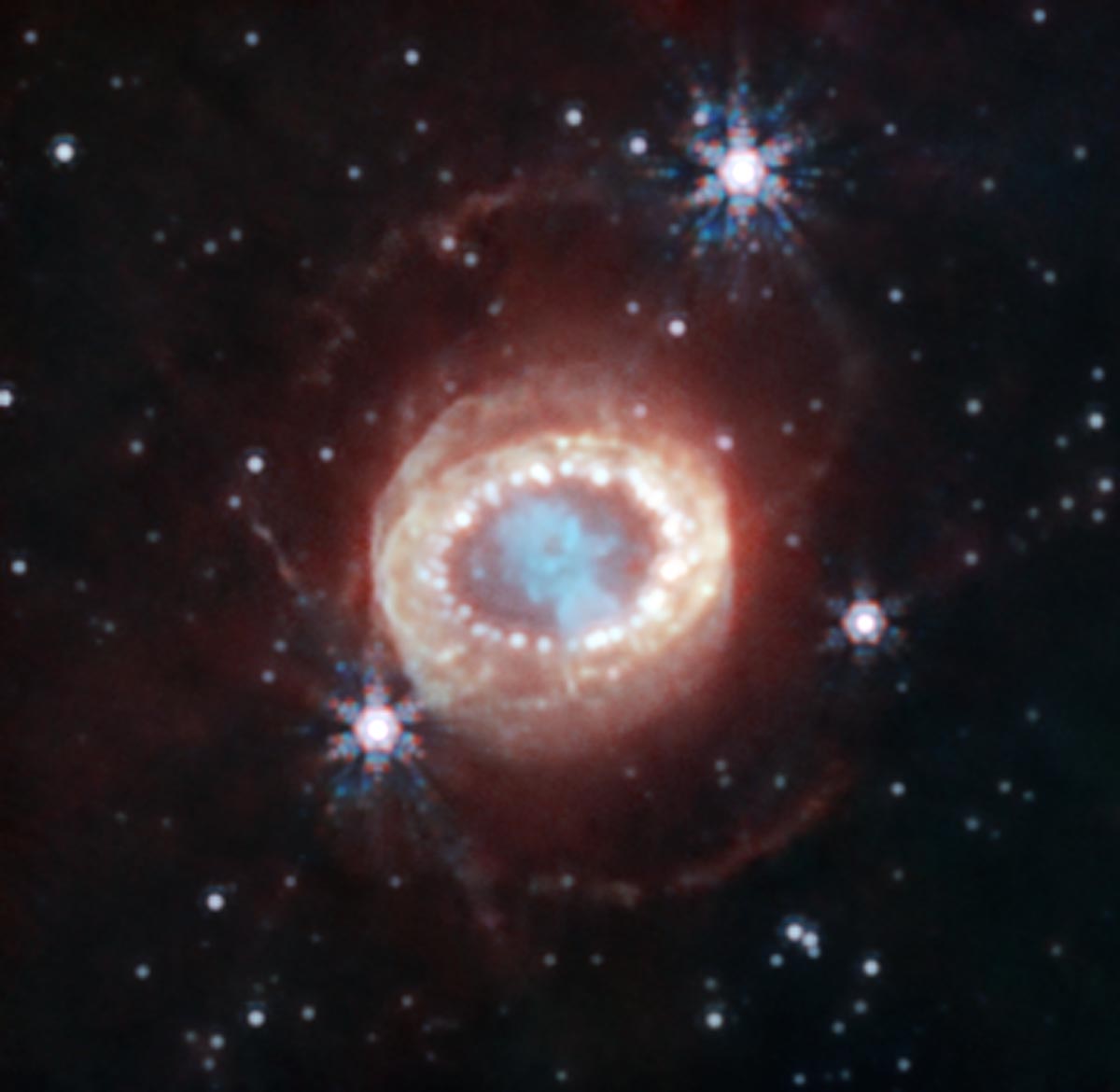
Credit: NASA, ESA, CSA, Mikako Matsuura (Cardiff University), Richard Arendt (NASA-GSFC, UMBC), Claes Fransson (Stockholm University), Josefin Larsson (KTH), Alyssa Pagan (STScI)
Researchers believe that a supernova in our galaxy could reveal the secrets of dark matter by emitting detectable gamma rays from axions. This discovery would provide key insights into the elusive particle’s properties and its role in the universe.
For nearly a century, scientists have been striving to unravel the mysteries of dark matter, a substance that shapes our universe but remains unseen. Proposed in the 1960s to explain why galaxies rotate as they do, dark matter neither emits nor interacts with light and other forms of electromagnetic radiation. It is thought to interact only through gravity and makes up a staggering 85% of the universe’s total mass. Central to the widely accepted Lambda Cold Dark Matter (LCDM) model of cosmology, dark matter plays a crucial role in our understanding of the cosmos. Yet, its true nature remains elusive.
The Axion Hypothesis
One of the most promising leads in this search is the axion — a hypothetical low-mass particle first proposed in the 1970s to address unresolved issues in quantum physics. Recent advances suggest axions could reveal themselves under specific conditions, such as in the presence of strong magnetic fields found around neutron stars.
A groundbreaking study by astrophysicists at the University of California, Berkeley, supported by the U.S. Department of Energy, suggests that axions might be detected in the moments following a nearby supernova explosion. According to the researchers, gamma rays generated by axions during such an event could provide the first direct evidence of these particles, potentially solving one of science’s greatest puzzles.
Supernovae as Cosmic Laboratories
The study was conducted by researchers at the Berkeley Center for Theoretical Physics (BCTP) and a member of the Lawrence Berkeley National Laboratory’s (LBNL) Theoretical Physics Group. The paper that describes their findings was published recently in the journal Physical Review Letters. As they argue, axions would be produced in copious quantities during the first 10 seconds after a massive star undergoes core collapse and becomes a neutron star. These axions would then escape and be transformed into high-energy gamma rays in the star’s intense magnetic field.
The Quest for Detection
For decades, the search for Dark Matter focused on MAssive Compact Halo Objects (MACHOs). When they failed to materialize, physicists began to consider Weakly Interacting Massive Particles (WIMPs) as the most likely candidate but also failed to find anything tangible. This led to axions becoming the most widely accepted candidate, an elementary particle that fits within the Standard Model of Particle Physics and resolves several unresolved questions in Quantum Mechanics – including a Theory of Everything (ToE).
The strongest candidate for axions is the quantum chromodynamics (QCD) axion, which theoretically interacts with all matter, though weakly. As previous research has shown, axions will occasionally turn into photons in the presence of a strong magnetic field that can be detected. However, such detections would be very challenging since it would require that the supernova be nearby (within the Milky Way or one of its satellite galaxies). In addition, observable supernovae are rare, occurring once every few decades.
The Rarity and Potential of Supernova Observations
The last time astronomers observed this phenomenon was in 1987 when a Type II supernova (SN1987A) appeared suddenly in the Large Magellanic Cloud (LMC), roughly 168,000 light-years from Earth. At the time, NASA’s Solar Maximum Mission (SMM) was observing the LMC but wasn’t sensitive enough to detect the predicted intensity of gamma rays. Benjamin Safdi, a UC Berkeley associate professor of physics and senior author of a paper, explained in a recent UC Berkeley News statement:
“If we were to see a supernova, like supernova 1987A, with a modern gamma-ray telescope, we would be able to detect or rule out this QCD axion, this most interesting axion, across much of its parameter space — essentially the entire parameter space that cannot be probed in the laboratory, and much of the parameter space that can be probed in the laboratory, too. And it would all happen within 10 seconds.”
Supercomputer Simulations and Future Technologies
Through a series of supercomputer simulations that used SN1987A to constrain higher mass axions, Safdi and his colleagues determined that Type II supernovae simultaneously produce bursts of gamma rays and neutrinos. They further noted that the gamma rays produced would depend on the axions’ mass and only last 10 seconds after the neutron star forms. After that, the production rate would drop dramatically. This means a gamma-ray space telescope must be pointed toward the supernova at precisely the right time.
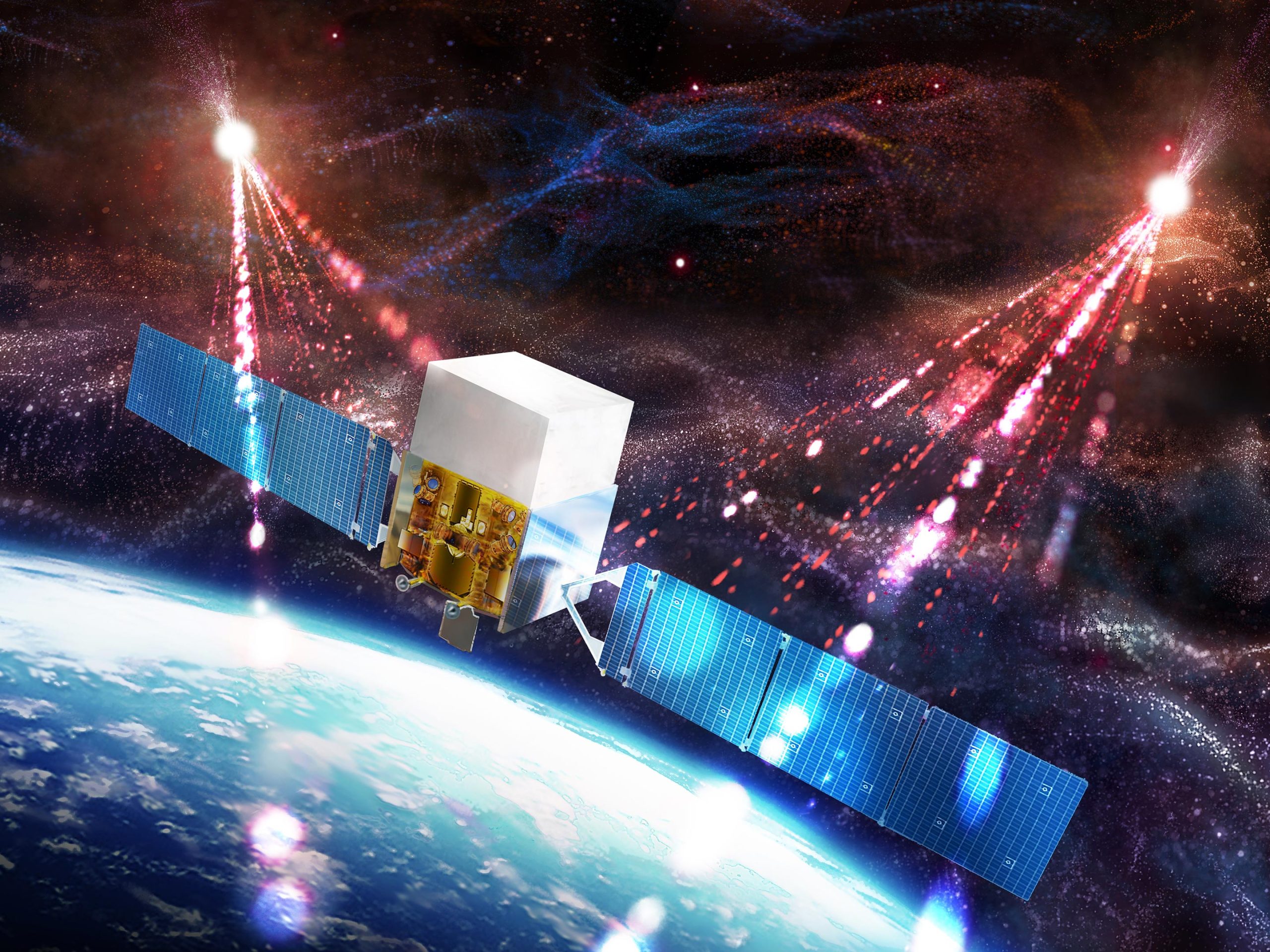
The Fermi Gamma-ray Space Telescope is currently the only observatory capable of detecting cosmic gamma-ray sources. Based on its field of view, scientists estimate that Fermi would have about a one-in-ten chance of spotting a supernova. To that end, the team proposes that we create a next-generation gamma-ray telescope known as the GALactic AXion Instrument for Supernova (GALAXIS). Said Safdi:
“This has really led us to thinking about neutron stars as optimal targets for searching for axions as axion laboratories. Neutron stars have a lot of things going for them. They are extremely hot objects. They also host very strong magnetic fields. The strongest magnetic fields in our universe are found around neutron stars, such as magnetars, which have magnetic fields tens of billions of times stronger than anything we can build in the laboratory. That helps convert these axions into observable signals.”
Implications of a Potential Discovery
As they note, a single detection of gamma rays would pinpoint the mass of an axion over a huge range of theoretical masses and allow for laboratory experiments to refocus their efforts on confirming this mass. Even a lack of detection would mean that scientists could eliminate a large range of potential masses for the axion, which would narrow the search for Dark Matter considerably. In the meantime, Safdi and his colleagues hope the Fermi telescope will catch a lucky break.
“The best-case scenario for axions is Fermi catches a supernova,” he added. “It’s just that the chance of that is small. But if Fermi saw it, we’d be able to measure its mass. We’d be able to measure its interaction strength. We’d be able to determine everything we need to know about the axion and incredibly confident in the signal because there’s no ordinary matter which could create such an event.”
Adapted from an article originally published on Universe Today.
Explore further: A Nearby Supernova Could Finally Solve the Dark Matter Puzzle
Reference: “Supernova Axions Convert to Gamma Rays in Magnetic Fields of Progenitor Stars” by Claudio Andrea Manzari, Yujin Park, Benjamin R. Safdi and Inbar Savoray, 19 November 2024, Physical Review Letters.
DOI: 10.1103/PhysRevLett.133.211002
Never miss a breakthrough: Join the SciTechDaily newsletter.
Follow us on Google and Google News.