
Researchers believe that observing gamma rays from a supernova could confirm the existence of axions, potentially solving the mystery of dark matter.
UC Berkeley scientists suggest that the detection of these particles would revolutionize our understanding of the universe and advocate for enhanced gamma-ray telescopes to capture this rare event.
Unveiling Dark Matter: The Role of Supernovae
The search for the universe’s dark matter could end tomorrow — given a nearby supernova and a little bit of luck.
For 90 years, scientists have puzzled over dark matter, the invisible substance making up 85% of the universe’s total matter. Despite its critical role in cosmic structure and dynamics, it cannot be directly observed with telescopes. Among the leading candidates to explain dark matter is the axion, a theoretical lightweight particle that has captivated researchers worldwide.
Discovering Axions Through Gamma Rays
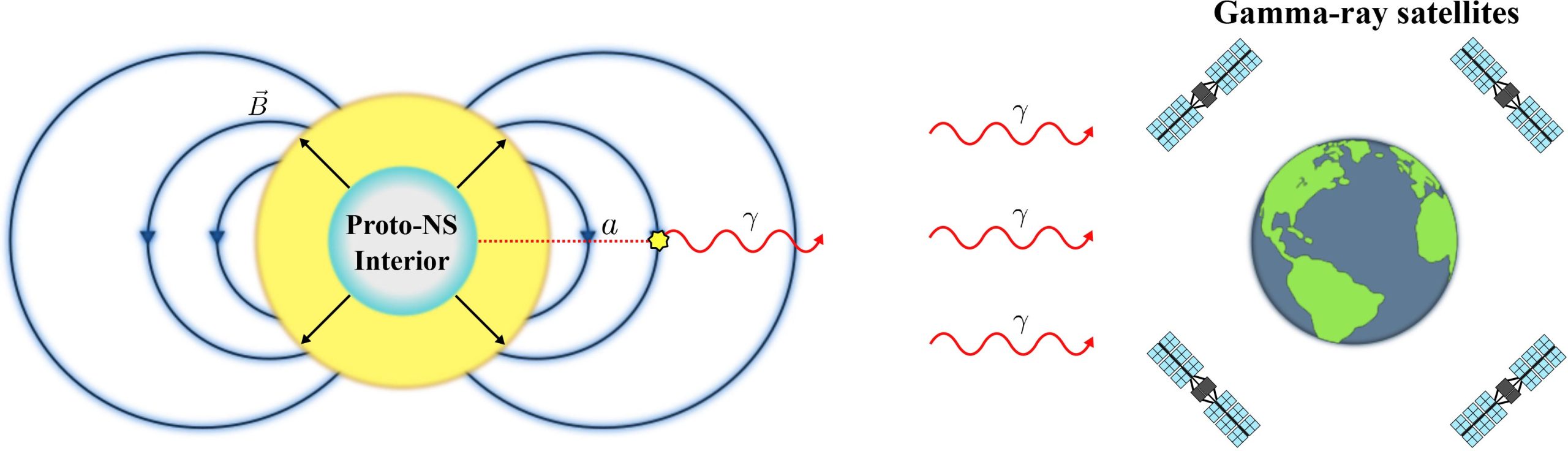
Astrophysicists at the University of California, Berkeley, propose that detecting axions might be possible within seconds of observing gamma rays from a nearby supernova. During the initial 10 seconds after a massive star collapses into a neutron star, axions — if they exist — would be generated in vast quantities. These axions would then escape the collapsing star and interact with its intense magnetic field, transforming into high-energy gamma rays detectable from Earth.
Such a detection is possible today only if the lone gamma-ray telescope in orbit, the Fermi Gamma-ray Space Telescope, is pointing in the direction of the supernova at the time it explodes. Given the telescope’s field of view, that is about one chance in 10.
The Challenge of Detecting Gamma Rays
Yet, a single detection of gamma rays would pinpoint the mass of the axion, in particular the so-called QCD axion, over a huge range of theoretical masses, including mass ranges now being scoured in experiments on Earth. The lack of a detection, however, would eliminate a large range of potential masses for the axion, and make most current dark matter searches irrelevant.
The problem is that, for the gamma rays to be bright enough to detect, the supernova has to be nearby — within our Milky Way galaxy or one of its satellite galaxies — and nearby stars explode only on average every few decades. The last nearby supernova was in 1987 in the Large Magellanic Cloud, one of the Milky Way’s satellites. At the time, a now defunct gamma-ray telescope, the Solar Maximum Mission, was pointing in the supernova’s direction, but it wasn’t sensitive enough to be able to detect the predicted intensity of gamma rays, according to the UC Berkeley team’s analysis.
Advancements in Gamma-Ray Detection Technology
“If we were to see a supernova, like supernova 1987A, with a modern gamma-ray telescope, we would be able to detect or rule out this QCD axion, this most interesting axion, across much of its parameter space — essentially the entire parameter space that cannot be probed in the laboratory, and much of the parameter space that can be probed in the laboratory, too,” said Benjamin Safdi, a UC Berkeley associate professor of physics and senior author of a paper that was published online on November 19 in the journal Physical Review Letters. “And it would all happen within 10 seconds.”
The researchers are anxious, however, that when the long-overdue supernova pops off in the nearby universe, we won’t be ready to see the gamma rays produced by axions. The scientists are now talking with colleagues who build gamma-ray telescopes to judge the feasibility of launching one or a fleet of such telescopes to cover 100% of the sky 24/7 and be assured of catching any gamma-ray burst. They have even proposed a name for their full-sky gamma-ray satellite constellation — the GALactic AXion Instrument for Supernova, or GALAXIS.
“I think all of us on this paper are stressed about there being a next supernova before we have the right instrumentation,” Safdi said. “It would be a real shame if a supernova went off tomorrow and we missed an opportunity to detect the axion — it might not come back for another 50 years.”
Safdi’s co-authors are graduate student Yujin Park and postdoctoral fellows Claudio Andrea Manzari and Inbar Savoray. All four are members of UC Berkeley’s physics department and the Theoretical Physics Group at Lawrence Berkeley National Laboratory.
Theoretical Underpinnings and Laboratory Searches
Searches for dark matter originally focused on faint, massive compact halo objects (MACHOs) theoretically sprinkled throughout our galaxy and the cosmos, but when those didn’t materialize, physicists began to look for elementary particles that theoretically are all around us and should be detectable in Earth-bound labs. These weakly interacting massive particles (WIMPs) also failed to show up. The current best candidate for dark matter is the axion, a particle that fits nicely within the standard model of physics and solves several other outstanding puzzles in particle physics. Axions also fall neatly out of string theory, a hypothesis about the underlying geometry of the universe, and might be able to unify gravity, which explains interactions on cosmic scales, with the theory of quantum mechanics, which describes the infinitesimal.
“It seems almost impossible to have a consistent theory of gravity combined with quantum mechanics that does not have particles like the axion,” Safdi said.
The strongest candidate for an axion, called a QCD axion — named after the reigning theory of the strong force, quantum chromodynamics — theoretically interacts with all matter, though weakly, through the four forces of nature: gravity, electromagnetism, the strong force, which holds atoms together, and the weak force, which explains the breakup of atoms. One consequence is that, in a strong magnetic field, an axion should occasionally turn into an electromagnetic wave, or photon. The axion is distinctly different from another lightweight, weakly-interacting particle, the neutrino, which only interacts through gravity and the weak force and totally ignores the electromagnetic force.
Supernova Observations: A Key to Axion Detection
Lab bench experiments — such as the ALPHA Consortium (Axion Longitudinal Plasma HAloscope), DMradio and ABRACADABRA, all of which involve UC Berkeley researchers — employ compact cavities that, like a tuning fork, resonate with and amplify the faint electromagnetic field or photon produced when a low-mass axion transforms in the presence of a strong magnetic field.
Alternatively, astrophysicists have proposed looking for axions produced inside neutron stars immediately after a core-collapse supernova, like 1987A. Until now, however, they’ve focused primarily on detecting gamma rays from these axions’ slow transformation into photons in the magnetic fields of galaxies. Safdi and his colleagues realized that that process is not very efficient at producing gamma rays, or at least not enough to detect from Earth.
Instead, they explored the production of gamma rays by axions in the strong magnetic fields around the very star that generated the axions. That process, supercomputer simulations showed, very efficiently creates a burst of gamma rays that is dependent on the mass of the axion, and the burst should occur simultaneously with a burst of neutrinos from inside the hot neutron star. That burst of axions, however, lasts a mere 10 seconds after the neutron star forms — after that, the production rate drops dramatically — though hours before the outer layers of the star explode.
Neutron Stars as Laboratories for Axion Research
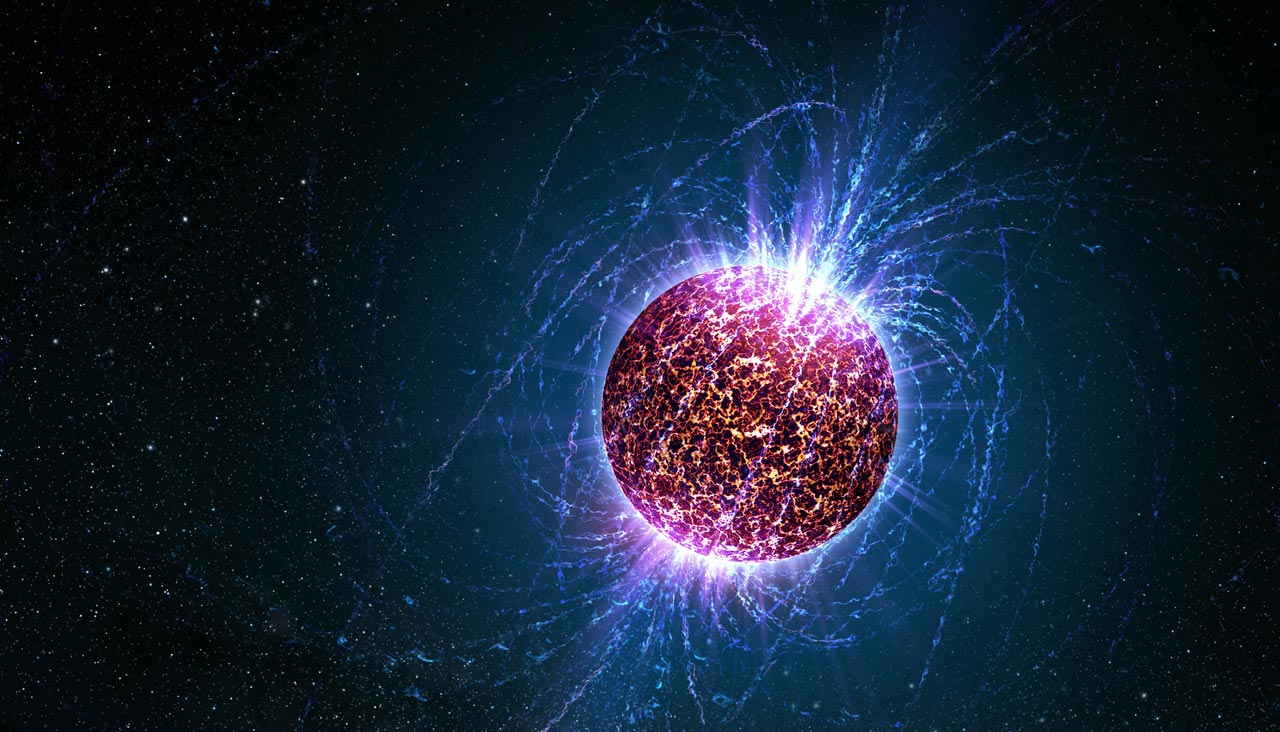
“This has really led us to thinking about neutron stars as optimal targets for searching for axions as axion laboratories,” Safdi said. “Neutron stars have a lot of things going for them. They are extremely hot objects. They also host very strong magnetic fields. The strongest magnetic fields in our universe are found around neutron stars, such as magnetars, which have magnetic fields tens of billions of times stronger than anything we can build in the laboratory. That helps convert these axions into observable signals.”
Two years ago, Safdi and his colleagues put the best upper limit on the mass of the QCD axion at about 16 million electron volts, or about 32 times less than the mass of the electron. This was based on the cooling rate of neutron stars, which would cool faster if axions were produced along with neutrinos inside these hot, compact bodies.
In the current paper, the UC Berkeley team not only describes the production of gamma rays following core collapse to a neutron star, but also uses the non-detection of gamma rays from the 1987A supernova to put the best constraints yet on the mass of axion-like particles, which differ from QCD axions in that they do not interact via the strong force.
They predict that a gamma ray detection would allow them to identify the QCD axion mass if it is above 50 microelectron volts (micro-eV, or μeV), or about one 10-billionth the mass of the electron. A single detection could refocus existing experiments to confirm the mass of the axion, Safdi said. While a fleet of dedicated gamma-ray telescopes is the best option for detecting gamma rays from a nearby supernova, a lucky break with Fermi would be even better.
“The best-case scenario for axions is Fermi catches a supernova. It’s just that the chance of that is small,” Safdi said. “But if Fermi saw it, we’d be able to measure its mass. We’d be able to measure its interaction strength. We’d be able to determine everything we need to know about the axion, and we’d be incredibly confident in the signal because there’s no ordinary matter that could create such an event.”
Reference: “Supernova Axions Convert to Gamma Rays in Magnetic Fields of Progenitor Stars” by Claudio Andrea Manzari, Yujin Park, Benjamin R. Safdi and Inbar Savoray, 19 November 2024, Physical Review Letters.
DOI: 10.1103/PhysRevLett.133.211002
The research was supported by funds from the U.S. Department of Energy.
Never miss a breakthrough: Join the SciTechDaily newsletter.
Follow us on Google and Google News.