
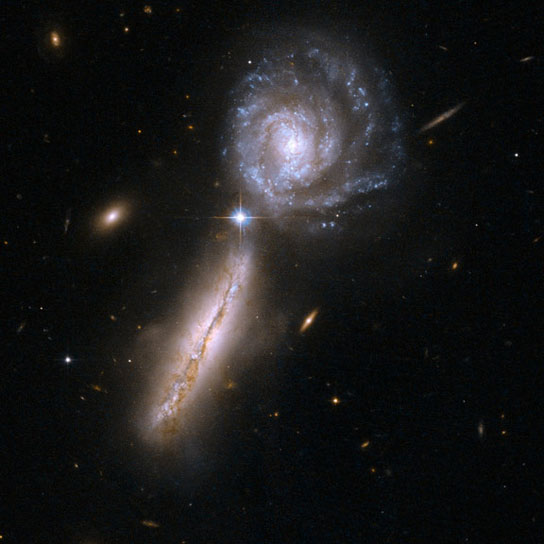
Searching for dark matter and studying conventional models for the origin and evolution of the universe has led astronomers from the University of Bonn to assemble data in an effort to better understand what surrounds our galaxy. Their analysis of this data paints a new picture of our cosmic neighborhood, which appears to rule out the presence of dark matter.
Astronomers from the University of Bonn in Germany have discovered a vast structure of satellite galaxies and clusters of stars surrounding our Galaxy, stretching out across a million light years. The work challenges the existence of dark matter, part of the standard model for the evolution of the universe. PhD student and lead author Marcel Pawlowski reports the team’s findings in a paper in the journal Monthly Notices of the Royal Astronomical Society.
The Milky Way, the galaxy we live in, consists of around three hundred thousand million stars as well as large amounts of gas and dust arranged with arms in a flat disk that wind out from a central bar. The diameter of the main part of the Milky Way is about 100,000 light years, meaning that a beam of light takes 100,000 years to travel across it. A number of smaller satellite galaxies and spherical clusters of stars (so-called globular clusters) orbit at various distances from the main Galaxy.
Conventional models for the origin and evolution of the universe (cosmology) are based on the presence of ‘dark matter’, invisible material thought to make up about 23% of the content of the cosmos that has never been detected directly. In this model, the Milky Way is predicted to have far more satellite galaxies than are actually seen.
In their effort to understand exactly what surrounds our Galaxy, the scientists used a range of sources from twentieth-century photographic plates to images from the robotic telescope of the Sloan Deep Sky Survey. Using all these data they assembled a picture that includes bright ‘classical’ satellite galaxies, more recently detected fainter satellites and the younger globular clusters.
“Once we had completed our analysis, a new picture of our cosmic neighborhood emerged,” says Pawlowski. The astronomers found that all the different objects are distributed in a plane at right angles to the galactic disk. The newly-discovered structure is huge, extending from as close as 33,000 light years to as far away as one million light years from the center of the Galaxy.
Team member Pavel Kroupa, professor for astronomy at the University of Bonn, adds “We were baffled by how well the distributions of the different types of objects agreed with each other.” As the different companions move around the Milky Way, they lose material, stars and sometimes gas, which forms long streams along their paths. The new results show that this lost material is aligned with the plane of galaxies and clusters too. “This illustrates that the objects are not only situated within this plane right now, but that they move within it,” says Pawlowski. “The structure is stable.”
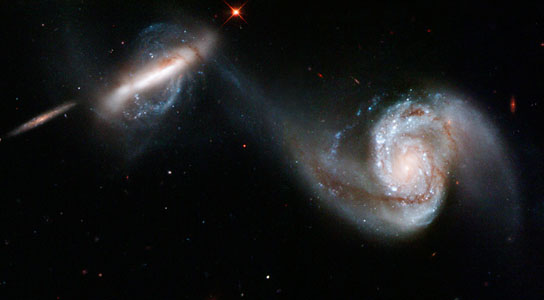
The various dark matter models struggle to explain this arrangement. “In the standard theories, the satellite galaxies would have formed as individual objects before being captured by the Milky Way,” explains Kroupa. “As they would have come from many directions, it is next to impossible for them to end up distributed in such a thin plane structure.”
Postdoctoral researcher and team member Jan Pflamm-Altenburg suggests an alternative explanation. “The satellite galaxies and clusters must have formed together in one major event, a collision of two galaxies.” Such collisions are relatively common and lead to large chunks of galaxies being torn out due to gravitational and tidal forces acting on the stars, gas and dust they contain, forming tails that are the birthplaces of new objects like star clusters and dwarf galaxies.
Pawlowski adds, “We think that the Milky Way collided with another galaxy in the distant past. The other galaxy lost part of its material, material that then formed our Galaxy’s satellite galaxies and the younger globular clusters and the bulge at the galactic center. The companions we see today are the debris of this 11 billion-year-old collision.”
Kroupa concludes by highlighting the wider significance of the new work. “Our model appears to rule out the presence of dark matter in the universe, threatening a central pillar of current cosmological theory. We see this as the beginning of a paradigm shift, one that will ultimately lead us to a new understanding of the universe we inhabit.”
Reference: “The VPOS: a vast polar structure of satellite galaxies, globular clusters and streams around the Milky Way” by M. S. Pawlowski, J. Pflamm-Altenburg and P. Kroupa, 8 June 2012, Monthly Notices of the Royal Astronomical Society.
DOI: 10.1111/j.1365-2966.2012.20937.x
Never miss a breakthrough: Join the SciTechDaily newsletter.
Follow us on Google and Google News.
2 Comments
This tentative hypothesis supports the Theory of a SUPRAGOD. Atheism is boring.
Maybe as celestail objects get farther from celestial bodies the speed at wich they travel increases because beyond the event horizon of the known universe is unbalanced charge drawing everything to it. Once the event horizon has drawn a certain amount of material , the universe collapses?
Question do black holes accelerate at the same speed as suns ?
The unbalanced charged omniverse behaves like a pot of bioling water. As “things” boil, universes are released and as the bubble closes “pressure”, the universe colapses.