
A flat plane of dark matter beyond the Local Group may explain why nearby galaxies move away from us instead of falling inward.
Astronomers using advanced computer simulations have discovered that most of the matter beyond the Local Group of galaxies, which includes the Milky Way and the Andromeda Galaxy, is arranged in a vast, flattened structure rather than spread evenly in all directions. Large regions with very little matter lie above and below this plane.
The researchers found that this “flat” distribution is the only way to accurately account for both the combined mass of the Milky Way and Andromeda and the unexpected motions of nearby galaxies. The study was led by PhD graduate Ewoud Wempe and Professor Amina Helmi at the University of Groningen, in collaboration with scientists from Germany, France, and Sweden, and was published in Nature Astronomy.
Nearly 100 years ago, astronomer Edwin Hubble showed that most galaxies are moving away from the Milky Way, a key observation that helped establish the idea that the universe is expanding and began with the Big Bang. Even then, astronomers noticed important exceptions. The Andromeda Galaxy, for instance, is moving toward the Milky Way at a speed of about 100 kilometers per second.
For decades, scientists have struggled to explain why most large galaxies near the Milky Way, apart from Andromeda, appear to be receding and seem largely unaffected by the gravitational pull of the Local Group (the Milky Way, the Andromeda Galaxy, and dozens of smaller galaxies).
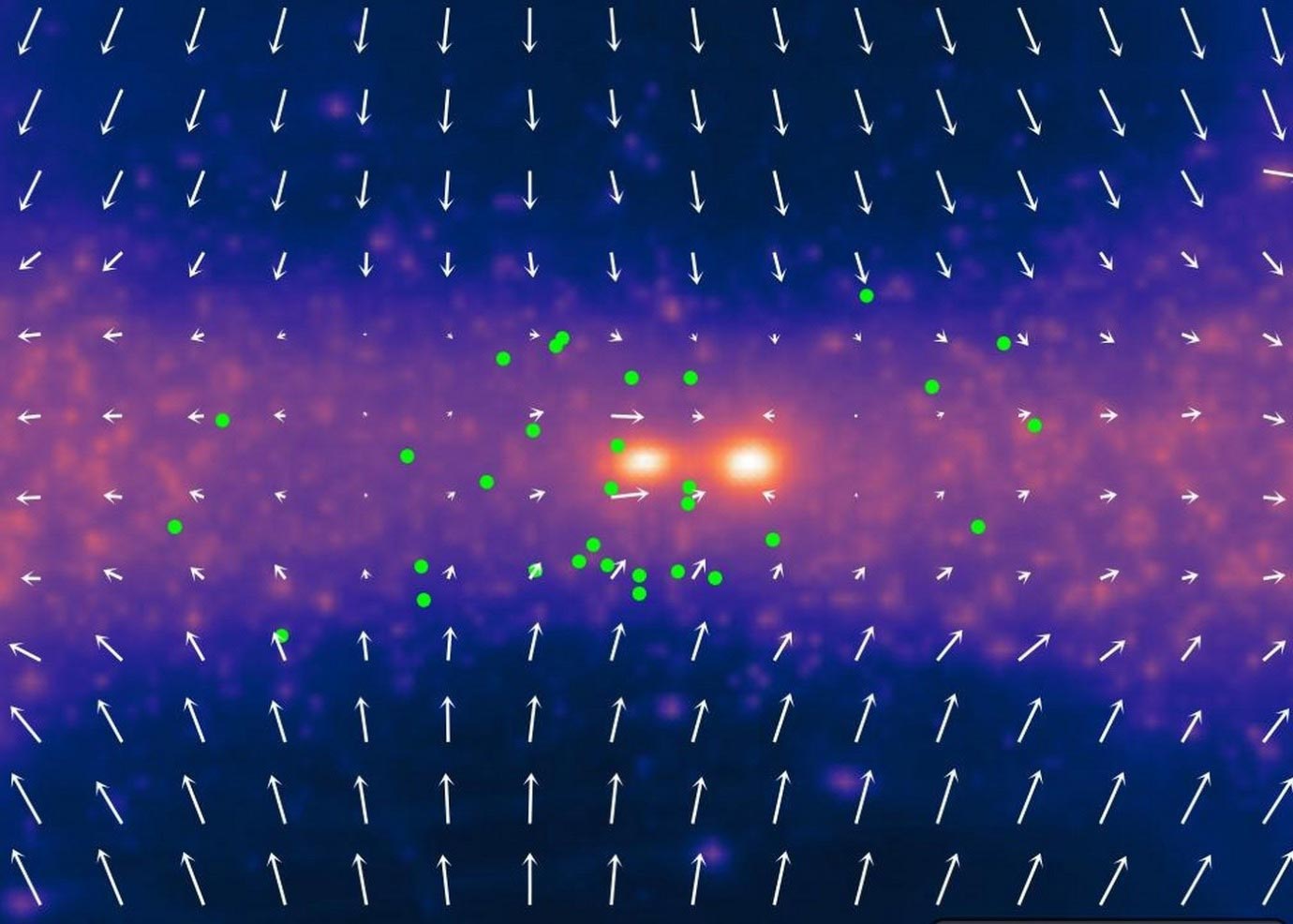
The new simulations offer a solution to this long-standing mystery. Led by Ewoud Wempe at the Kapteyn Institute in Groningen, the international research team found that matter just beyond the Local Group, including its surrounding dark matter, forms a broad, flat sheet stretching tens of millions of light-years across. Vast empty regions lie above and below this structure. When this configuration is included, the simulations closely match the observed positions and speeds of nearby galaxies, providing a coherent explanation for their motions.

A ‘virtual twin’ of the Local Group
The algorithm started from regions in the early universe, with a mass distribution based on observations of the cosmic microwave background. With a powerful computer, the model then evolved to reproduce the present-day characteristics of the Local Group, with the mass, position, and velocity of the Milky Way and the Andromeda Galaxy, and the positions and velocities of 31 galaxies just outside the Local Group. This resulted in the creation of simulations that may be considered ‘virtual twins’ of our cosmic environment.
In the computer result with the flat mass distribution, the 31 surrounding galaxies have a velocity comparable to that observed. Galaxies are moving away from us, despite the mass of the Local Group. The explanation is that for nearby galaxies in the plane, the gravitational pull of the Local Group is counteracted by the mass further away in the plane. And outside the plane, where you would expect matter to be moving towards us, there are no galaxies.
Pleased with the discovery
According to lead researcher Ewoud Wempe, this is the first assessment of the distribution and velocity of dark matter in the region surrounding the Milky Way and the Andromeda Galaxy.
“We are exploring all possible local configurations of the early universe that ultimately could lead to the Local Group. It is great that we now have a model that is consistent with the current cosmological model on the one hand, and with the dynamics of our local environment on the other.”
Amina Helmi is also very pleased with the discovery. According to her, astronomers have been trying to solve this problem for decades without success. “I am excited to see that, based purely on the motions of galaxies, we can determine a mass distribution that corresponds to the positions of galaxies within and just outside the Local Group.”
Reference: “The mass distribution in and around the Local Group” by Ewoud Wempe, Simon D. M. White, Amina Helmi, Guilhem Lavaux and Jens Jasche, 27 January 2026, Nature Astronomy.
DOI: 10.1038/s41550-025-02770-w
Never miss a breakthrough: Join the SciTechDaily newsletter.
Follow us on Google and Google News.
2 Comments
Memo 2602040144_Source 1. Reinterpretation []
Source 1.
https://scitechdaily.com/why-nearby-galaxies-are-fleeing-us-scientists-finally-solve-a-50-year-mystery/
1.
_Why Nearby Galaxies Are Fleeing Us: Scientists Finally Solve a 50-Year-Old Mystery
_New simulations reveal that matter just beyond our Milky Way Galaxy’s Local Group is arranged in a massive, flat structure with vast voids above and below.
_This hidden geometry helps explain why nearby galaxies move in certain ways despite the powerful gravitational pull of our Milky Way and Andromeda.
ㅡb2.【msbase is the ordinary matter system. Beyond it is the dark matter system, sample4.msoss. The universe expands infinitely, doubling in size through ordinary matter. 0147.
—Ironically, it’s not limited to the Local Galaxy, msbase. Beyond the massive galaxy cluster, msbase.power, msoss.nsum extends. Oh, my. 0150.
】
1-1.
The flat plane of dark matter beyond the Local Group of galaxies may explain why nearby galaxies are moving away from us instead of falling toward us.
—b1. [I defined the domain (*) as msoss.dark_matter.sysem beyond msbase long ago. 0140.
—msoss is a sample4 dark matter system extended through the msbase of ordinary matter. Hmm. 0143.
sample4.msoss(standard)
zxdxybzyz
zxdzxezxz
xxbyyxzz
zybzzfxzy
cadccbcdc
cdbdcbdbb
xzezxdyyx
zxezybzyy
bddbcbdca
】
1-2.
_Using advanced computer simulations, astronomers have discovered that matter beyond the Local Group of galaxies, which includes our Milky Way and the Andromeda Galaxy, is not spread evenly in all directions, but is arranged in a vast, flat structure. Above and below this plane are large regions devoid of matter.
ㅡa2.【In my cosmological view, (msbase.msoss).galaxy is treated as a flat surface.
ㅡThe discovery that matter beyond the Local Group of galaxies is not spread evenly in all directions, but is arranged in a vast, flat structure? Is this a coincidence?
】
2.
_The researchers found that this “flat” distribution is the only way to accurately explain the total mass of our Milky Way and Andromeda, as well as the unexpected motions of nearby galaxies.
The study was conducted by Eurd Wempe and Professor Amina Helmi, PhD students at the University of Groningen, in collaboration with scientists from Germany, France, and Sweden, and was published in Nature Astronomy.
2-1.
_About 100 years ago, astronomer Edwin Hubble discovered that most galaxies are moving away from our galaxy. This observation was instrumental in establishing the idea that the universe is expanding and began with a Big Bang.
_Even then, astronomers discovered important exceptions. For example, the Andromeda galaxy is moving toward our galaxy at about 100 kilometers per second.
For decades, scientists have struggled to explain why most large galaxies near our own Milky Way, with the exception of the Andromeda Galaxy, appear to be moving away from us, largely unaffected by the gravity of the Local Group of galaxies (our Milky Way, Andromeda, and dozens of smaller galaxies).
2-2.
New simulations offer a solution to this long-standing puzzle. Led by Euud Wempe of the Kapteinn Institute in Groningen,
An international team of researchers has discovered that matter just outside the Local Group, particularly surrounding dark matter, forms a broad, flat sheet extending tens of millions of light-years. Vast voids lie above and below this structure.
—a1.【msbase.galaxy can be seen as the Local Galaxy (our Milky Way, Andromeda, and dozens of smaller galaxies).
—Then, beyond that lies the world of msoss.dark_matter. 0131.
ㅡThey discovered that it forms a broad, flat plate extending tens of millions of light-years. Hehe. 2602040130.
】
_Incorporating this configuration into the simulation, the observed positions and velocities of nearby galaxies match very well, providing a consistent explanation for their motion.
2-3. The Local Group’s ‘Virtual Twin’
_This algorithm started from a region of the early Universe with a mass distribution based on observations of the cosmic microwave background. Using powerful computers, the model evolved to represent the characteristics of the Local Group, reproducing the masses, positions, and velocities of the Milky Way and Andromeda Galaxy, as well as the positions and velocities of 31 galaxies just outside the Local Group. The result is a simulation that can be considered a ‘virtual twin’ of our cosmic environment.
3.
_In computer simulations with a flat mass distribution, the velocities of the 31 nearby galaxies are similar to the observed velocities.
_Despite the mass of the Local Group, the galaxies are moving away from us. This is because, for nearby galaxies on a flat surface, the gravity of the Local Group of galaxies is offset by the mass of galaxies further away. Furthermore, there are no galaxies outside the flat mass distribution, where matter is expected to move toward us.
_We are pleased with the discovery.
According to Principal Investigator Euud Wempe, this study is the first to assess the distribution and velocity of dark matter in the region surrounding our Milky Way and Andromeda.
3-1.
_”We are exploring all possible local configurations of the early Universe that could ultimately lead to the Local Group of galaxies. It is very encouraging to have a model that is consistent with current cosmological models while also being consistent with the dynamics of the environment surrounding our galaxy.”
_Amina Helmi is also delighted with this discovery. She says astronomers have been trying to solve this problem for decades, without success. “We are very excited that, based solely on the motion of galaxies, we can now determine the mass distribution corresponding to the locations of galaxies within and just outside the Local Group of galaxies.”
Once again direct observation has shown us the way , putting together the puzzle takes an out of the box theory , to color the edges of each piece allows the fit . in other words the edge is narrow but the piece size is flat and expansive . I called it a form resembling mica that grows as crystals from rock . Mica In geological terms, we don’t usually say it “grows” like a plant; instead, it crystallizes or precipitates through specific chemical reactions under intense pressure and heat . Imagen this solution to a 50 mystery could also lead us to a different configuration and size of the universe , several different layers side by side .