
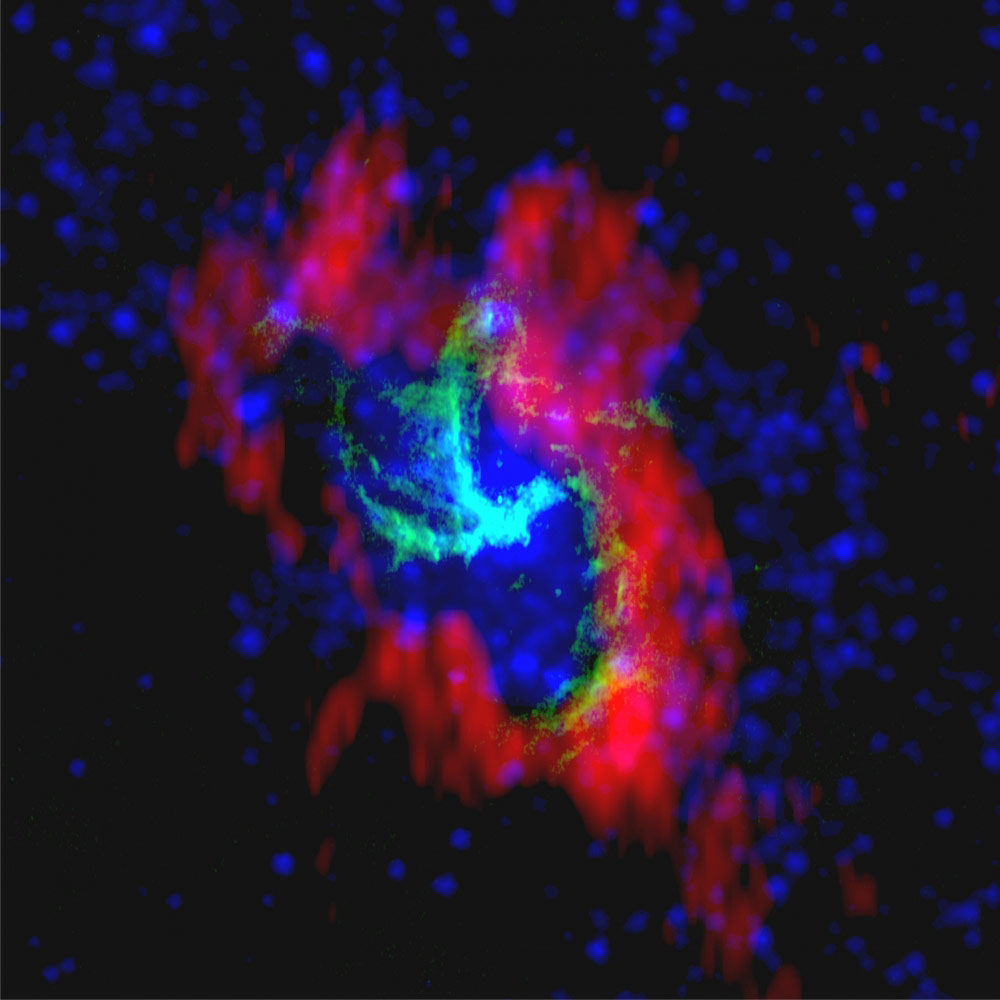
Using data from the Russian spacecraft RadioAstron, astrophysicists are one step closer to figuring out the mysteries of our galaxy’s core.
Is matter falling into the massive black hole at the center of the Milky Way or being ejected from it? No one knows for sure, but a UC Santa Barbara astrophysicist is searching for an answer.
Carl Gwinn, a professor in UCSB’s Department of Physics, and colleagues have analyzed images collected by the Russian spacecraft RadioAstron. Their findings appear in the current issue of The Astrophysical Journal Letters.
RadioAstron was launched into orbit from Baikonur, Kazakhstan, in July 2011 with several missions, one of which was to investigate the scattering of pulsars — the cores of dead stars — by interstellar gas. What the team found led them to examine additional observations of Sagittarius A-Star (A*), the source that marks the Milky Way’s central black hole. Sagittarius A* is visible at radio, infrared and X-ray wavelengths.
This massive black hole — which contains 4 million solar masses — does not emit radiation but is visible from the gas around it. The gas is being acted upon by the black hole’s very strong gravitational field. The wavelengths that make Sagittarius A* visible are scattered by interstellar gas along the line of sight in the same way that light is scattered by fog on Earth.
Gwinn and his colleagues found that the images taken by RadioAstron contained small spots. “I was quite surprised to find that the effect of scattering produced images with small lumps in the overall smooth image,” explained Gwinn. “We call these substructures. Some previous theories had predicted similar effects in the 1980s, and a quite controversial observation in the 1970s had hinted at their presence.”
In order to better understand the substructure, Michael Johnson, Gwinn’s former graduate student now at the Harvard-Smithsonian Center for Astrophysics, conducted theoretical research. He realized that the anomalies could be used to infer the actual size of the underlying source.
Additional observations made using the Very Long Baseline Array — an interferometer consisting of 10 identical antennas distributed across the United States — and the 100-meter Green Bank Telescope in West Virginia showed the presence of lumps in the image of Sagittarius A*. Recent upgrades have greatly increased the sensitivity of these telescopes. Even so, evidence of the lumps, or substructure, remained extremely faint.
“The theory and observations allow us to make statements about the interstellar gas responsible for the scattering, and about the emission region around the black hole,” Johnson said. “It turns out that the size of that emission region is only 20 times the diameter of the event horizon as it would be seen from Earth. With additional observations, we can begin to understand the behavior in this extreme environment.”
While no scientific team has been able to produce a complete image of the black hole’s emission, astronomers have drawn inferences about scattering properties from observations at longer wavelengths. “From these they can extrapolate those properties to 1 centimeter and use that to make a rough estimate of the size of the source,” Gwinn said. “We seem to agree quite well with that estimate.”
Not only did Gwinn and his colleagues directly confirm these indirect inferences about the size of Sagittarius A*, they were also able to provide new information about fluctuations in the interstellar gas that cause scattering. Their work shows that the spectrum of interstellar turbulence is shallow.
“There are different ways of interpreting observations of the scattering, and we showed that one of them is right and the others are wrong,” said co-investigator Yuri Kovalev, the RadioAstron project scientist. “This will be important for future research on the gas near this black hole. This work is a good example of the synergy between different modern research infrastructures, technologies and science ideas.”
A friendly international race is going on to see who will be the first to image the black hole’s emissions and thereby determine whether gas falls into the black hole or is being ejected in the form of a jet.
“The character of the substructure seems to be random, so we are keen to go back and confirm the statistics of our sample with more data,” Gwinn said. “We’re also interested in looking at shorter wavelengths where we think the emission region may be smaller and we can get closer to the black hole. We may be able to extract more information than just the size of the emission region. We might possibly be able to make a simple image of how matter falls into a black hole or is ejected from it. It would be very exciting to produce such an image.”
Reference: “Discovery of Substructure in the Scatter-Broadened Image of Sgr A*” by C. R. Gwinn, Y. Y. Kovalev, M. D. Johnson and V. A. Soglasnov, 30 September 2014, The Astrophysical Journal Letters.
DOI: 10.1088/2041-8205/794/1/L14
arXiv: 1409.0530
Never miss a breakthrough: Join the SciTechDaily newsletter.
Follow us on Google and Google News.