
An unexpected resurgence of X-rays weeks after a stellar explosion has challenged existing models.
An explosion that initially appeared unremarkable in gamma rays went on to produce one of the brightest afterglows astronomers have recorded in the past 20 years. Its visible light became brighter than its host galaxy, and its X-ray emission unexpectedly intensified again weeks later.
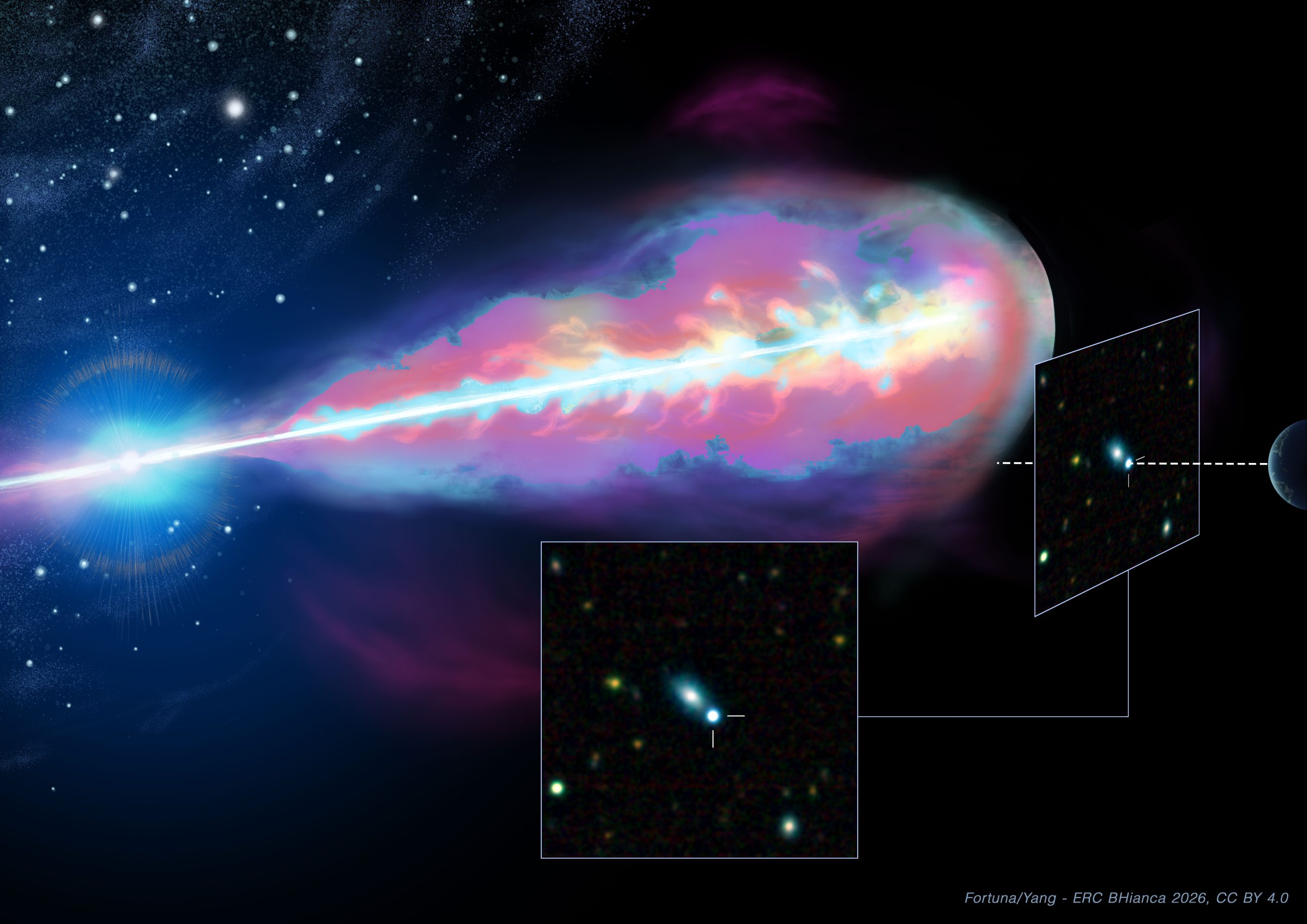
An international research team believes the extraordinary behavior can be explained by the direction of the explosion’s powerful jet. Rather than pointing directly toward Earth, the jet was viewed from an angle that initially concealed its most energetic region. The findings, published in The Astrophysical Journal Letters, suggest that some exceptionally powerful stellar explosions may be difficult to recognize from their initial gamma-ray flashes alone.
A Modest Gamma-Ray Burst With an Extraordinary Afterglow
NASA’s Fermi Gamma-ray Space Telescope detected the event, designated GRB 260310A, on March 10, 2026. Its initial burst of gamma rays lasted approximately 53 seconds and appeared to release relatively little energy. Over the following hours, however, its visible afterglow steadily grew brighter before eventually fading.
The contrast became even more pronounced at other wavelengths. Compared with samples of previously observed gamma-ray bursts, the event’s X-ray and optical afterglows ranked among the brightest 1%, while its radio emission placed it among the brightest 5%. Approximately three weeks after the explosion, the X-ray afterglow brightened again, remaining unusually luminous for more than a week and detectable for months.
“We see hundreds of GRBs every year, but the oddballs are the most informative ones,” says co-author Roberto Ricci, who led the radio observations. “We could explain individual features of this burst, but fitting them all into the same picture proved much harder.”
A Massive Star’s Death Viewed From an Unusual Angle
Gamma-ray bursts are among the most energetic explosions in the universe. Many occur when massive stars collapse and launch narrow jets of matter traveling at nearly the speed of light. As these jets collide with surrounding gas, they generate afterglows that can be detected in X-rays, visible light, and radio waves.
Astronomers typically observe the brightest gamma-ray flashes when a jet points almost directly at Earth. GRB 260310A appears to have been different. Its relatively weak initial emission, followed by an exceptionally bright afterglow, is consistent with a jet viewed from outside its most intensely beamed region.
“Much like a flashlight, the jet appears brightest when seen head-on. Most of our models are calibrated using events seen from that same perspective. This burst gave us a chance to look beyond that glare,” explains Yu-Han Yang, a postdoctoral scholar and lead author of the study.
How a Hidden Jet Can Become Brighter Over Time
The researchers propose that the explosion produced a jet with a narrow, highly energetic core surrounded by a wider, slower outflow. From Earth’s viewing angle, the broader outer regions would dominate the early afterglow, while much of the core’s radiation would initially be directed elsewhere.
As the jet slowed, its emission became visible across a wider range of angles. Radiation from the energetic core could then reach Earth, potentially explaining the delayed increase in X-ray brightness. This structured jet model offers a possible explanation for the unusual observations, although the precise configuration remains uncertain.
“We looked at it from a side angle. As the jet slowed down, its light became visible over a wider range of angles, allowing us to probe the jet’s shape, from its outer edges toward its inner core.”
The delayed X-ray brightening was particularly difficult to explain. “That was unexpected. At first, I thought another X-ray source was contaminating our observations. But the brightening really came from the afterglow,” recalls Yang, who coordinated the X-ray monitoring. “This prompted us to explore a more complex jet’s shape.”
An Explosion With Enormous Hidden Energy
To investigate the event, the international team, led by the ERC-funded BHianca group at the University of Rome Tor Vergata, combined observations from NASA’s Chandra X-ray Observatory, ESA’s XMM-Newton, the Einstein Probe mission, the Large Binocular Telescope, and the Karl G. Jansky Very Large Array. Additional observations from Calar Alto Observatory detected the signature of a supernova, confirming that the gamma-ray burst accompanied the death of a massive star.
The team’s models indicate that the jet’s central region may have carried vastly more energy than the initial gamma-ray measurements suggested. “What appeared to us as an unremarkable GRB might have looked like a monster explosion to an observer looking straight down the jet’s core,” notes Yang. “Our models suggest that the explosion packed roughly a billion years of the Sun’s energy output into a pencil-thin beam.”
The Search for Powerful Explosions Hidden From Earth
The findings also point toward a population of stellar explosions that conventional gamma-ray observations may overlook. As powerful new sky surveys, including those conducted by the Vera Rubin Observatory, expand their coverage, astronomers expect to identify more afterglows from jets that are not directed toward Earth. Such detections could help establish how frequently collapsing massive stars produce relativistic jets and how those jets escape through the stars’ outer layers.
“Gamma rays are not the most efficient route to spot these hidden jets: we find them once in a blue moon,” concludes Muskan Yadav, a graduate student who contributed to the study. “Upcoming surveys will pick up hundreds of them. Identifying them among millions of variable sources won’t be easy, but it’s a challenge I’m excited to take on.”
Reference: “An Extremely Bright Slow-rising Afterglow from an Off-axis Jet in GRB 260310A” by Yu-Han Yang, Roberto Ricci, Eleonora Troja, Muskan Yadav, Yi-Han Iris Yin, Rubén Sánchez-Ramírez, Brendan O’Connor, Niccolò Passaleva, Alberto J. Castro-Tirado, Hendrik van Eerten, Simone Dichiara, Vincenzo Galluzzi, Narjes Shahamat Dehsorkh, Iván Agudo, Jesús Aceituno, Malte Busmann, Maria D. Caballero-García, Emilio Fernández-García, Daniel Gruen, Maria Gritsevich, Sergiy Guziy, David Hiriart, You-Dong Hu, Martin Jelínek, Alexander Kutyrev, Alzbeta Malenakova, Filip Novotny, Ignacio Pérez-García, Shashi B. Pandey, Jorma Ryske, Alfredo Sota, Jan Strobl, Hira Waseem and Siyu Wu, 28 October 2026, The Astrophysical Journal Letters.
DOI: 10.3847/2041-8213/aea990
Never miss a breakthrough: Join the SciTechDaily newsletter.
Follow us on Google and Google News.