
New Research Sheds Light on the Chemical Formation of the Universe
An international team of researchers stumbled upon an exploding supernova in a distant spiral galaxy, using data from the first year of interstellar observation by the James Webb Space Telescope.
The recent research, published in The Astrophysical Journal Letters, offers new infrared measurements of NGC 1566, one of the brightest galaxies in our cosmic neighborhood also known as the Spanish Dancer. Located approximately 40 million light years from Earth, the galaxy’s highly active center has made it a popular subject among scientists seeking to understand the formation and evolution of star-forming nebulae.
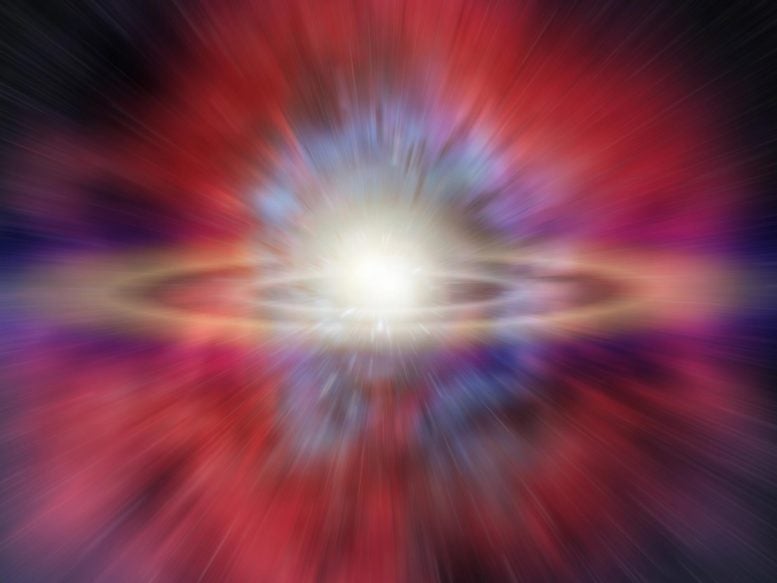
In this case, scientists were able to survey a Type 1a supernova – the explosion of a carbon-oxygen white dwarf star, which Michael Tucker, a fellow at the Center for Cosmology and AstroParticle Physics at The Ohio State University and a co-author of the study, said researchers caught by mere chance while studying NGC 1566.
“White dwarf explosions are important to the field of cosmology, as astronomers often use them as indicators of distance,” said Tucker. “They also produce a huge chunk of the iron group elements in the universe, such as iron, cobalt and nickel.”
The research was made possible thanks to the PHANGS-JWST Survey, which, due to its vast inventory of star cluster measurements, was used to create a reference dataset to study in nearby galaxies. By analyzing images taken of the supernova’s core, Tucker and co-author Ness Mayker Chen, a graduate student in astronomy at Ohio State who led the study, aimed to investigate how certain chemical elements are emitted into the surrounding cosmos after an explosion.
Chemical Formation of the Universe
For instance, light elements like hydrogen and helium were formed during the big bang, but heavier elements can be created only through the thermonuclear reactions that happen inside supernovas. Understanding how these stellar reactions affect the distribution of iron elements around the cosmos could give researchers deeper insight into the chemical formation of the universe, said Tucker.
“As a supernova explodes, it expands, and as it does so, we can essentially see different layers of the ejecta, which allows us to probe the nebula’s core,” he said. Powered by a process called radioactive decay – wherein an unstable atom releases energy to become more stable – supernovas emit radioactive high-energy photons like uranium-238. In this instance, the study specifically focused on how the isotope cobalt-56 decays into iron-56.
Using data from JWST’s near-infrared and mid-infrared camera instruments to investigate the evolution of these emissions, researchers found that more than 200 days after the initial event, supernova ejecta was still visible at infrared wavelengths that would have been impossible to image from the ground.
Validation of Assumptions about Supernova Dynamics
“This is one of those studies where if our results weren’t what we expected, it would have been really concerning,” he said. “We’ve always made the assumption that energy doesn’t escape the ejecta, but until JWST, it was only a theory.”
For many years, it was unclear whether fast-moving particles produced when cobalt-56 decays into iron-56 seeped into the surrounding environment, or were held back by the magnetic fields supernovas create.
Yet by providing new insight into the cooling properties of supernova ejecta, the study confirms that in most circumstances, ejecta doesn’t escape the confines of the explosion. This reaffirms many of the assumptions scientists have made in the past about how these complex entities work, Tucker said.
“This study validates almost 20 years’ worth of science,” he said. “It doesn’t answer every question, but it does a good job of at least showing that our assumptions haven’t been catastrophically wrong.”
Future JWST observations will continue to help scientists develop their theories about star formation and evolution, but Tucker said that further access to other types of imaging filters could help test them as well, creating more opportunities to understand wonders far beyond the edges of our own galaxy.
“The power of JWST is really unparalleled,” said Tucker. “It’s really promising that we’re accomplishing this kind of science and with JWST, there’s a good chance we’ll not only be able to do the same for different kinds of supernovas, but do it even better.”
Reference: “Serendipitous Nebular-phase JWST Imaging of SN Ia SN 2021aefx: Testing the Confinement of 56Co Decay Energy” by Ness Mayker Chen, Michael A. Tucker, Nils Hoyer, Saurabh W. Jha, Lindsey A. Kwok, Adam K. Leroy, Erik Rosolowsky, Chris Ashall, Gagandeep Anand, Frank Bigiel, Médéric Boquien, Chris Burns, Daniel Dale, James M. DerKacy, Oleg V. Egorov, L. Galbany, Kathryn Grasha, Hamid Hassani, Peter Hoeflich, Eric Hsiao, Ralf S. Klessen, Laura A. Lopez, Jing Lu, Nidia Morrell, Mariana Orellana, Francesca Pinna, Sumit K. Sarbadhicary, Eva Schinnerer, Melissa Shahbandeh, Maximilian Stritzinger, David A. Thilker and Thomas G. Williams, 15 February 2023, The Astrophysical Journal Letters.
DOI: 10.3847/2041-8213/acb6d8
The study was funded by the National Science Foundation, the Natural Sciences and Engineering Research Council of Canada, and others.
Never miss a breakthrough: Join the SciTechDaily newsletter.
Follow us on Google and Google News.
7 Comments
You need a better proofreader. I’m pretty sure the galaxy is 40 million light-years away, instead of the 40 million miles stated in the article…the sun is 92 million miles away, just for reference.
Thank you for your note. Article has been corrected.
“miles”? “Photons like uranium”?
What fast moving particles are produced by the decay of cobalt to iron? If you’re referring to neutrons why not just say so.
Stopped reading after “supernovas emit radioactive high-energy photons like uranium-238”. That was after swallowing a galaxy “approximately 40 million miles from Earth”. I do not know the subject of Tatyana Woodall’s studies at Ohio State University, but it better not be astronomy related. I doubt there is something to learn from this article.
“Located approximately 40 million miles from Earth…”
Uh, so there’s a galaxy half the distance between the earth and sun away from us? I don’t think you mean miles. Light years anyone?
Thank you for your note. Article has been corrected.