
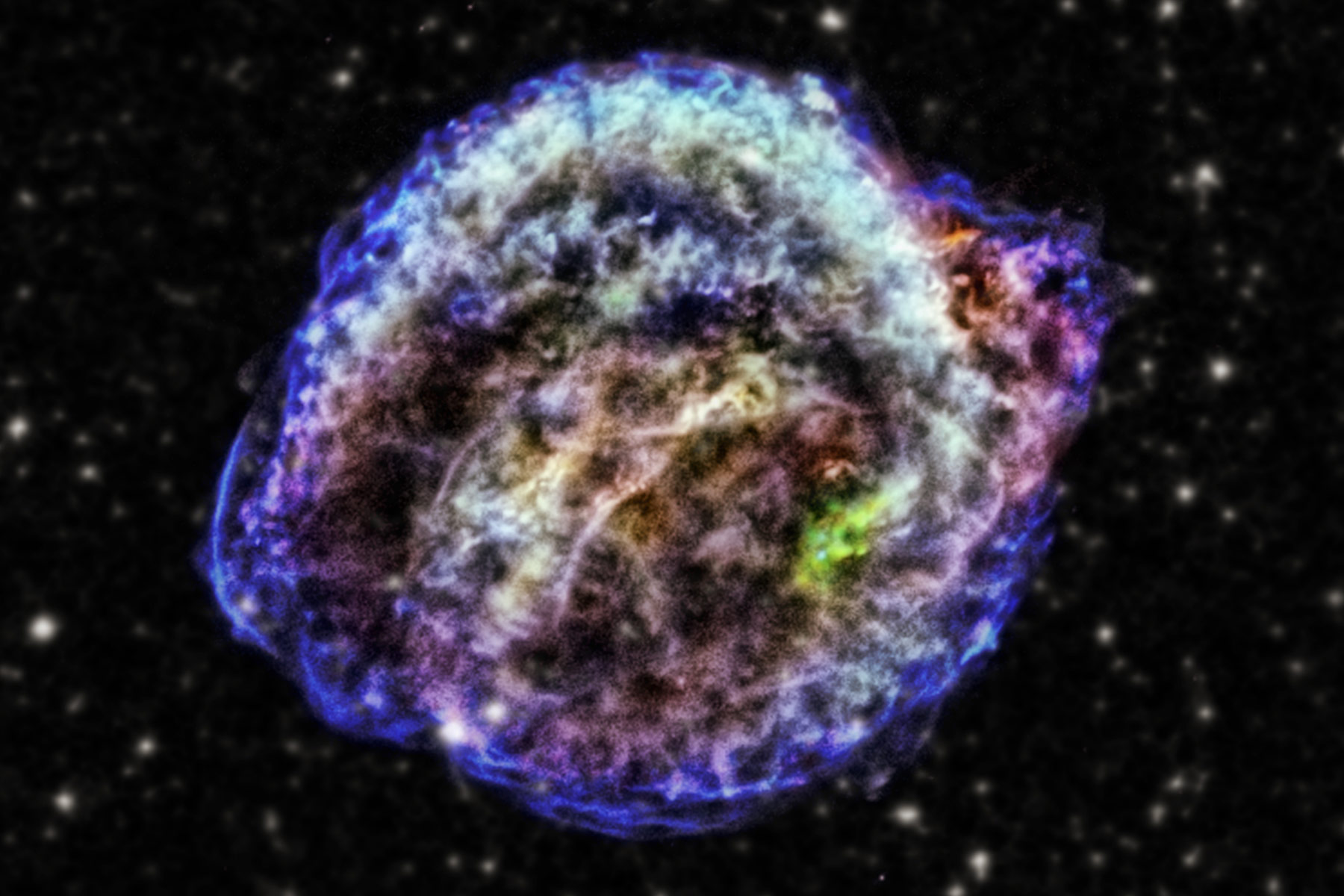
Using data from NASA’s Chandra X-ray Observatory, a newly published study examines the remnant of Kepler’s supernova. The scientists found that the supernova was triggered by an interaction between a white dwarf and a red giant star, not from the merger of two white dwarfs as was previously believed.
A new study using data from NASA’s Chandra X-ray Observatory points to the origin of a famous supernova. This supernova, discovered in 1604 by Johannes Kepler, belongs to an important class of objects that are used to measure the rate of expansion of the universe.
Astronomers have used a very long Chandra observation of the remnant of Kepler’s supernova to deduce that the supernova was triggered by an interaction between a white dwarf and a red giant star. This is significant because another study has already shown that a so-called Type Ia supernova caused the Kepler supernova remnant.
The thermonuclear explosion of a white dwarf star produces such supernovas. Because they explode with nearly uniform brightness, astronomers have used them as cosmic distance markers to track the accelerated expansion of the universe.
However, there is an ongoing controversy about Type Ia supernovas. Are they caused by a white dwarf pulling so much material from a companion star that it becomes unstable and explodes? Or do they result from the merger of two white dwarfs?
“While we can’t speak to all Type Ia supernovas, our evidence points to Kepler being caused by a white dwarf pulling material from a companion star, and not the merger of two white dwarfs,” said the first author of the new Chandra study, Mary Burkey of North Carolina State University (NCSU). “To continue improving distance measurements with these supernovas, it is crucial to understand how they are triggered.”
The Kepler supernova remnant is one of only a few Type Ia supernovas known to have exploded in the Milky Way galaxy. Its proximity and its identifiable explosion date make it an excellent object to study.
“Johannes Kepler made such good naked-eye observations in 1604 that we can identify the supernova as Type Ia,” said co-author Stephen Reynolds, also of NCSU. “He would be thrilled that we can use today’s terrific instruments to reveal the hidden secrets of his supernova.”
The new Chandra images reveal a disk-shaped structure near the center of the remnant. The researchers interpret this X-ray emission to be caused by the collision between supernova debris and disk-shaped material that the giant star expelled before the explosion. Another possibility is that the structure is just debris from the explosion.
The evidence that this disk-shaped structure was left behind by the giant star is two-fold: first, a substantial amount of magnesium — an element not produced in great amounts in Type Ia supernovas — was found in the Kepler remnant. This suggests the magnesium came from the giant companion star.
Secondly, the disk structure seen by Chandra in X-rays bears a remarkable resemblance in both shape and location to one observed by the Spitzer Space Telescope. These infrared-emitting disks are thought to be dusty bands expelled by stars in a wind, rather than material ejected in a supernova.
The researchers found a remarkably large and puzzling concentration of iron on one side of the center of the remnant but not the other. The authors speculate that the cause of this asymmetry might be the “shadow” in iron that was cast by the companion star, which blocked the ejection of material. Previously, theoretical work has suggested this shadowing is possible for Type Ia supernova remnants.
“One remaining challenge is to find the damaged and fast-moving leftovers of the giant star that was pummeled by the explosion at close quarters,” said co-author Kazimierz Borkowski, also of NCSU.
Much of the evidence in the last several years has favored the white dwarf merger scenario for Type Ia supernovas within the Milky Way as well as those found in other galaxies. This result strengthens the case that Type Ia supernovas may have more than one triggering mechanism.
These results could imply that many Type Ia supernovas have a similar origin, but the authors warn that they are unsure whether Kepler was a typical explosion. For example, a recent analysis based on Chandra data and computer simulations, led by Daniel Patnaude from Harvard-Smithsonian Center for Astrophysics, has suggested that Kepler was an unusually powerful explosion.
“We could settle the issue of how normal — or abnormal — the Kepler supernova was if we could discover some light from the supernova explosion that just happened to bounce off some interstellar dust to take a few hundred extra years to get here: a light echo,” said Reynolds. Such light echoes have been found for two other galactic supernovas in the last millennium.
Reference: “X-ray Emission from Strongly Asymmetric Circumstellar Material in the Remnant of Kepler’s Supernova” by Mary T. Burkey, Stephen P. Reynolds, Kazimierz J. Borkowski, John M. Blondin, 28 January 2013, The Astrophysical Journal.
DOI: 10.1088/0004-637X/764/1/63
Never miss a breakthrough: Join the SciTechDaily newsletter.
Follow us on Google and Google News.