
Close Menu
    Facebook X (Twitter) Instagram
    SciTechDaily
    • Biology
    • Chemistry
    • Earth
    • Health
    • Physics
    • Science
    • Space
    • Technology
    Facebook X (Twitter) Pinterest YouTube RSS
    SciTechDaily
    Home»Space»Interstellar Comet 3I/ATLAS Reveals Strange Chemistry Beyond Our Solar System
    Space

    Interstellar Comet 3I/ATLAS Reveals Strange Chemistry Beyond Our Solar System

    By NASAJune 6, 2026No Comments4 Mins Read
    Facebook Twitter Pinterest Telegram LinkedIn WhatsApp Email Reddit
    Share
    Facebook Twitter LinkedIn Pinterest Telegram Email Reddit
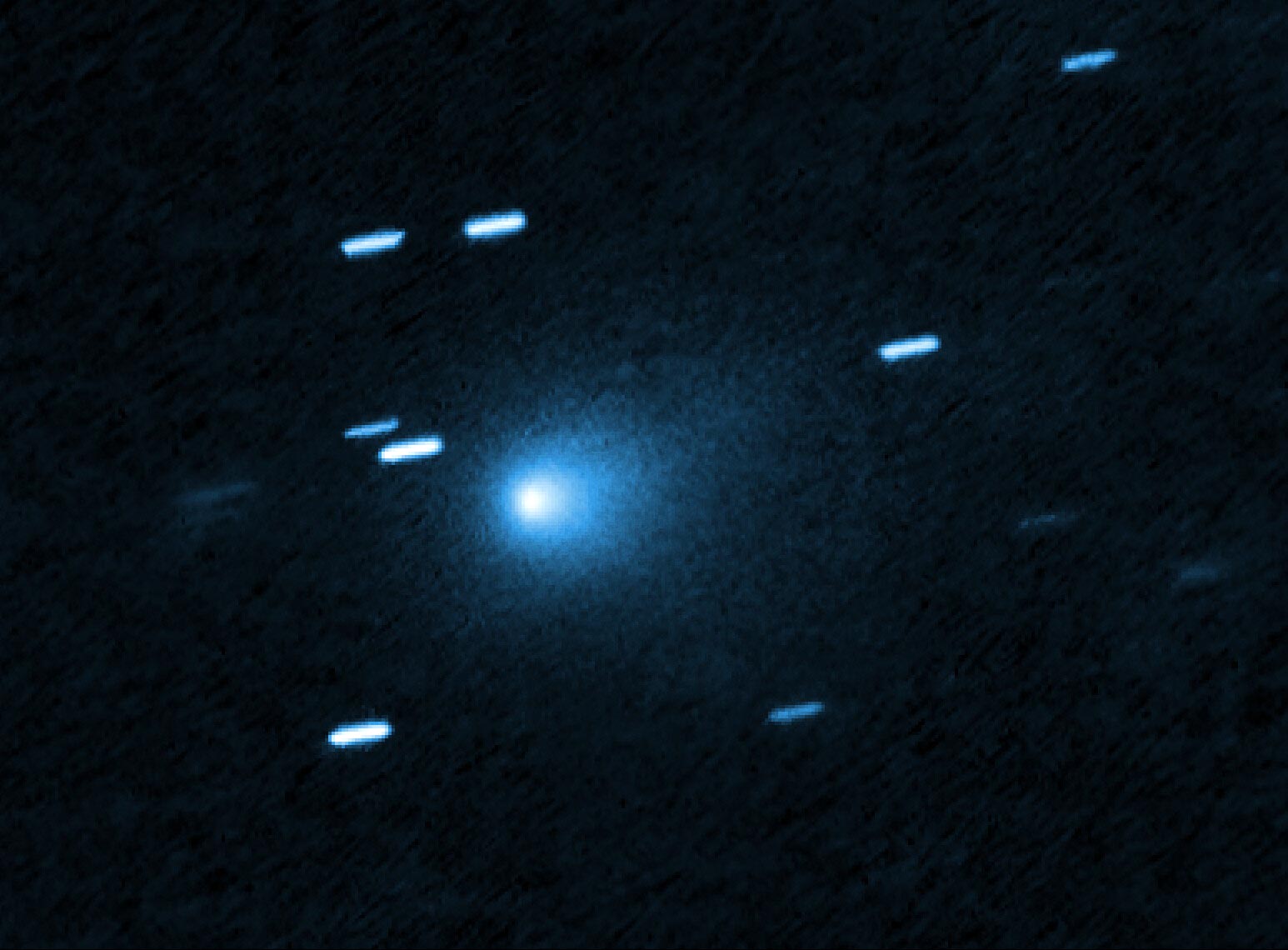
    Interstellar Comet 3I ATLAS
    This is a Hubble Space Telescope image of the interstellar comet 3I/ATLAS. Hubble photographed the comet on July 21 2025, when the comet was 365 million kilometers from Earth. Credit:
    NASA, ESA, D. Jewitt (UCLA); Image Processing: J. DePasquale (STScI)

    An interstellar comet just revealed hidden methane and chemical clues from another star system.

    NASA’s James Webb Space Telescope has achieved another milestone by capturing the first mid-infrared chemical fingerprint of an interstellar object. The observations focused on comet 3I/ATLAS, a rare visitor from beyond our solar system, and the findings have been published in The Astrophysical Journal Letters.

    Webb Tracks a Rare Interstellar Visitor

    Researchers used Webb’s MIRI (Mid-Infrared Instrument) to observe the comet on two occasions as it traveled away from the Sun after reaching its closest approach.

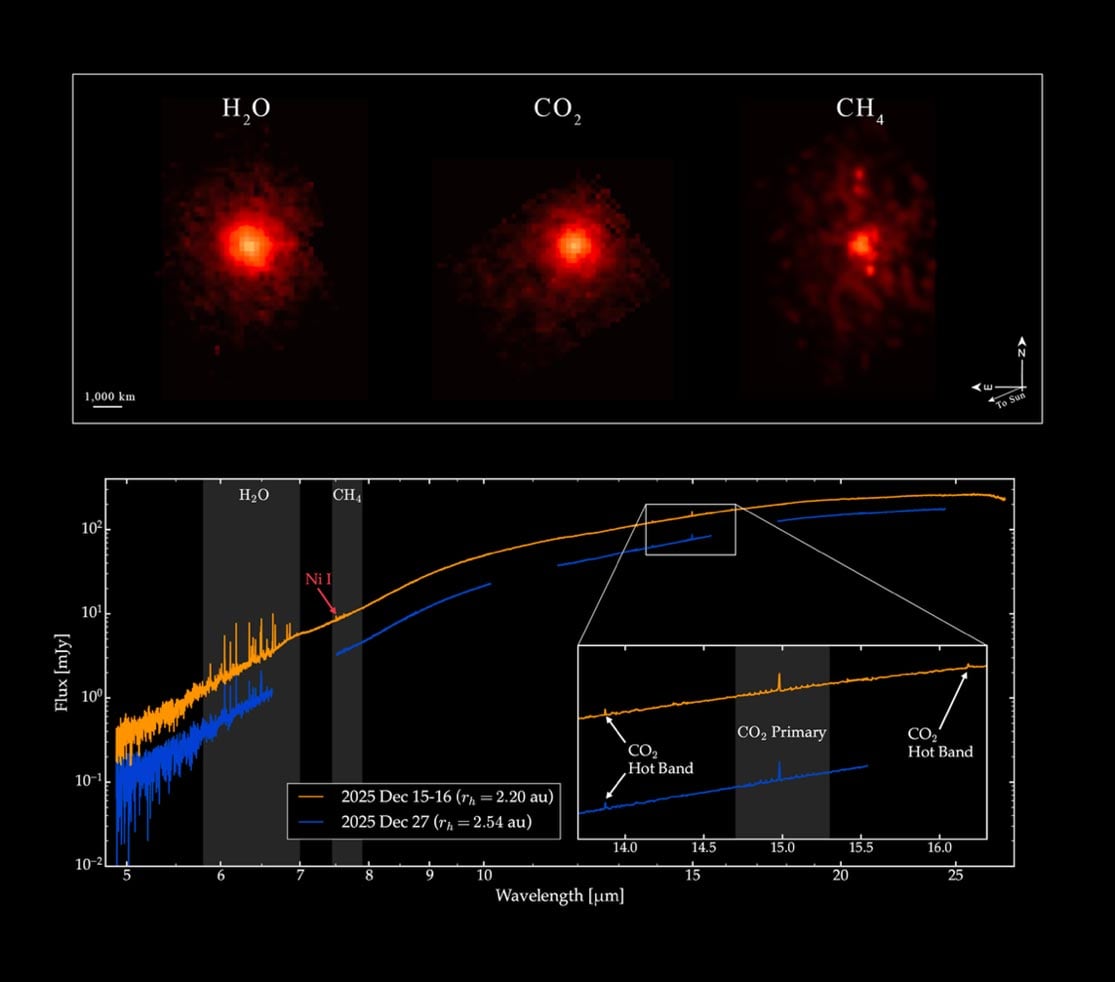
    The first set of observations took place between December 15 and 16, when 3I/ATLAS was about 205 million miles (329 million kilometers) from the Sun. A second round followed on December 27, after the comet had moved farther out to roughly 236 million miles (379 million kilometers) from the Sun.
    NASA Webb Detects Methane 3I ATLAS
    The top image shows interstellar comet 3I/ATLAS as seen with MIRI (Mid-Infrared Instrument) on NASA’s James Webb Space Telescope, along with contours that illustrate where different gases were located at the time the comet was viewed. Water vapor spreads far beyond the nucleus because much of it is released from icy grains in the coma, while carbon dioxide and methane are most concentrated near the comet’s nucleus. The bottom image shows the spectrum, with the labels indicating the features from the various gases that Webb found escaping from the comet. Credit: NASA, ESA, CSA, STScI, M. Belyakov (Caltech), I. Wong (STScI), Image Processing: A. Pagan (STScI)

    First Methane Detection on an Interstellar Object

    For the first time, methane gas has been directly detected on an interstellar visitor.

    Methane is an extremely volatile substance, meaning it can quickly change from solid ice into gas. Its appearance only after the comet passed near the Sun suggests the methane was buried beneath the surface, protected from warming and evaporation. As sunlight heated deeper layers of ice during the comet’s close solar encounter, the trapped methane was finally released.

    Scientists were surprised by how much methane was present compared with water. Very few comets in our own solar system show a similar chemical makeup.

    Unusual Carbon Dioxide Levels Hint at Alien Origins

    The observations also confirmed that 3I/ATLAS contains unusually large amounts of carbon dioxide. Compared with typical comets formed in our solar system, this interstellar object releases far more carbon dioxide relative to water.

    Together, the unexpectedly high methane and carbon dioxide levels point to a formation environment that differs significantly from the one that produced most known solar system comets. The findings suggest 3I/ATLAS may have originated in a very different planetary system around another star.

    Gas Activity Drops as the Comet Moves Away

    As the comet continued its journey away from the Sun, Webb recorded a sharp decrease in gas production.

    Water showed the most dramatic decline. This behavior is expected because the farther a comet travels from the Sun, the less heat it receives. Lower temperatures mean less ice turns into gas. Water ice is less volatile than methane or carbon dioxide, so its activity decreases more quickly as the comet cools.

    How Webb Studied the Comet

    The observations were made with MIRI’s Medium Resolution Spectrometer, an instrument designed to separate infrared light into its individual wavelengths.

    This spectrometer functions as an integral field unit, allowing scientists to collect a spectrum from every point within a small area of sky. As a result, researchers could identify the gases surrounding the comet while also mapping how those materials were distributed around its nucleus.

    Reference: “The Volatile Inventory of 3I/ATLAS as Seen with JWST/MIRI” by Matthew Belyakov, Ian Wong, Bryce T. Bolin, M. Ryleigh Davis, Steven J. Bromley, Carey M. Lisse and Michael E. Brown, 8 April 2026, The Astrophysical Journal Letters.
    DOI: 10.3847/2041-8213/ae5700

    Never miss a breakthrough: Join the SciTechDaily newsletter.
    Follow us on Google and Google News.

    Astronomy Comet James Webb Space Telescope NASA
    Share. Facebook Twitter Pinterest LinkedIn Email Reddit

    Related Articles

    Webb Telescope Captures Mysterious Gas Jets From Speeding Object in the Outer Solar System

    Unexpected New Quest for Astronomers After Webb’s Mysterious Find in Rare Main Belt Comet

    The Cosmic Dust in Your Bones – NASA’s Webb Telescope Will Investigate the Intertwined Origins of Dust and Life

    A Small, Bright Surprise: Two Views of a Sungrazing Comet

    Recently Discovered Comet Seen Flying Past the Sun During Total Solar Eclipse

    NASA James Webb Space Telescope’s Sunshield Successfully Unfolds and Tensions in Final Tests

    NASA’s Cosmic Time Machine

    Universe Simulations Show Webb Telescope Can Reveal Distant Galaxies Hidden in Quasars’ Glare

    NASA’s James Webb Space Telescope Completes Environmental Testing – Survived Harsh Conditions of Rocket Launch

    Leave A Reply Cancel Reply

    • Facebook
    • Twitter
    • Pinterest
    • YouTube

    Don't Miss a Discovery

    Subscribe for the Latest in Science & Tech!

    Trending News

    Scientists Finally Uncover How a “Forever Chemical” Causes Birth Defects

    Scientists Uncover the Earliest Brain Changes That May Predict Alzheimer’s Decades Before Symptoms

    Surprising New Study Challenges a Century-Old Theory of Habit Formation

    Scientists Turn Seawater Into Drinking Water Without Toxic Brine

    Vitamin D Drug Shows Surprising Promise Against One of the Deadliest Cancers

    NASA’s X-59 Sonic Boom Killer Is Ready for Its Biggest Test Yet

    The Best Exercise Combination for Longevity, According to a 30-Year Study

    Popular Weight-Loss Drug Found To Slow Biological Aging in Landmark Human Trial

    Follow SciTechDaily
    • Facebook
    • Twitter
    • YouTube
    • Pinterest
    • Newsletter
    • RSS
    SciTech News
    • Biology News
    • Chemistry News
    • Earth News
    • Health News
    • Physics News
    • Science News
    • Space News
    • Technology News
    Recent Posts
    • Interstellar Comet 3I/ATLAS Reveals Strange Chemistry Beyond Our Solar System
    • A Newly Found Cellular Shift May Explain Why Aging Leads to Disease
    • A Normal Kidney Test Could Still Signal Serious Risk
    • Scientists Discover Gut Signal That Turns Off Sugar Cravings
    • NASA Captures Typhoon Jangmi’s Massive Eye in Stunning Nighttime Image
    Copyright © 1998 - 2026 SciTechDaily. All Rights Reserved.
    • Science News
    • About
    • Contact
    • Editorial Board
    • Privacy Policy
    • Terms of Use

    Type above and press Enter to search. Press Esc to cancel.