
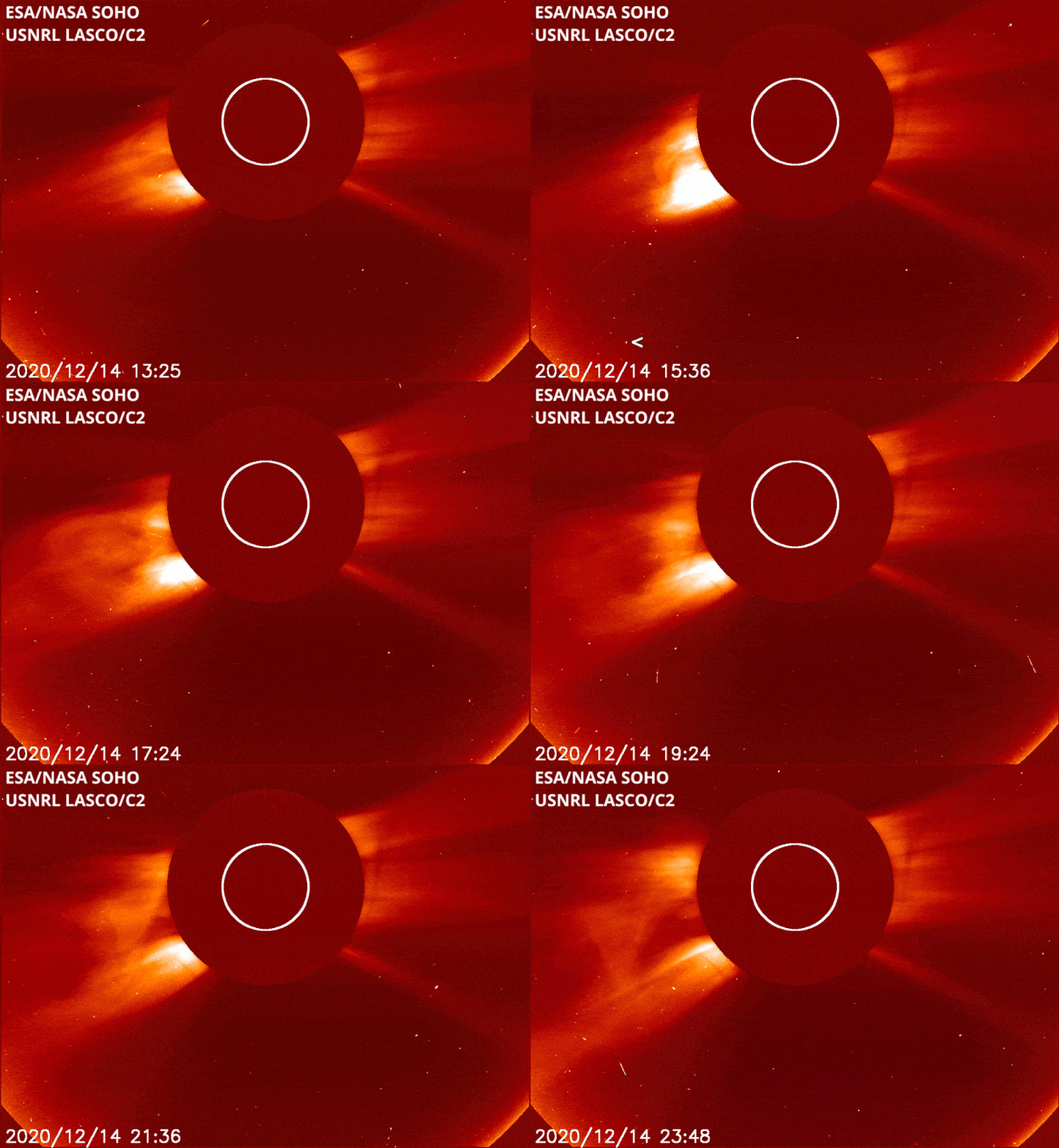
As Chile and Argentina witnessed the total solar eclipse on December 14, 2020, unbeknownst to skywatchers, a little tiny speck was flying past the Sun — a recently discovered comet.
This comet was first spotted in satellite data by Thai amateur astronomer Worachate Boonplod on the NASA-funded Sungrazer Project — a citizen science project that invites anyone to search for and discover new comets in images from the joint European Space Agency (ESA) and NASA Solar and Heliospheric Observatory, or SOHO.
Boonplod discovered the comet on December 13, the day before the eclipse. He knew the eclipse was coming, and was eager to see whether his new comet discovery might appear in the Sun’s outer atmosphere as a small speck in eclipse photographs.
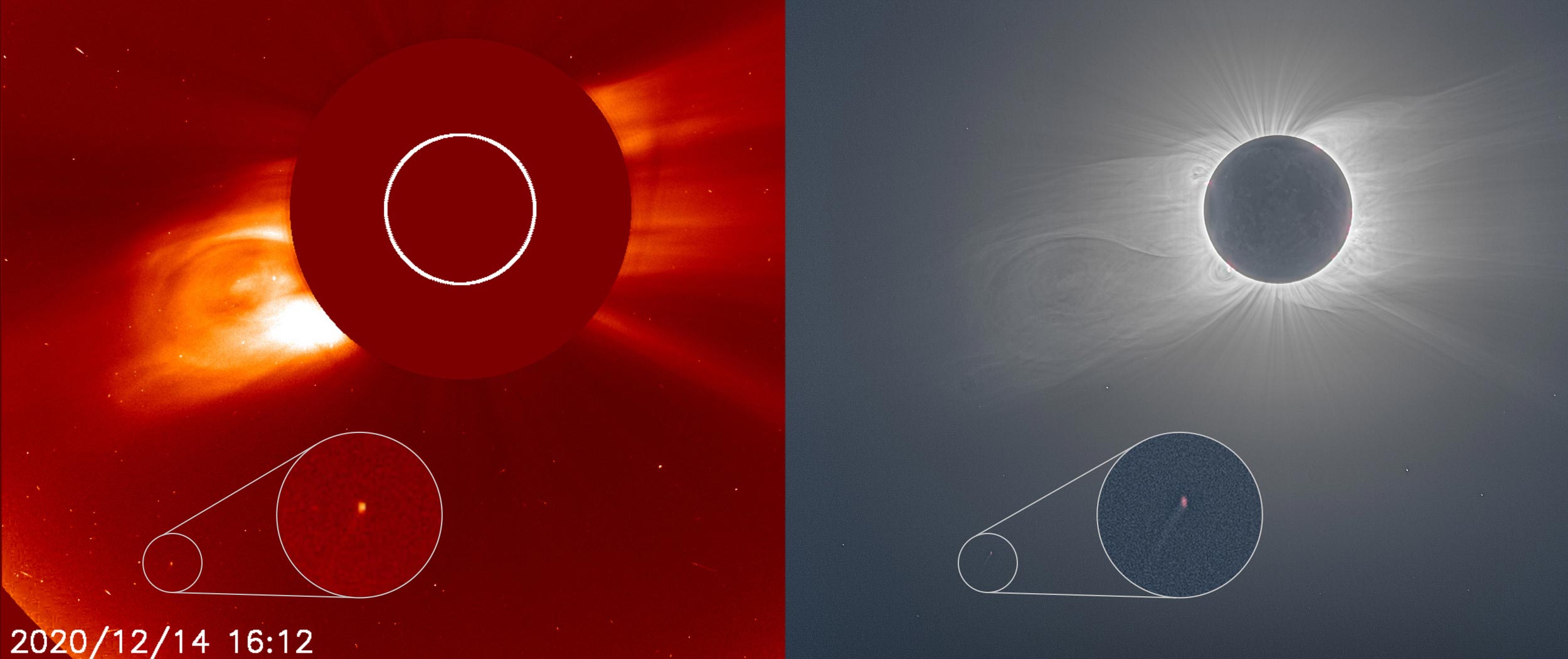
The comet, named C/2020 X3 (SOHO) by the Minor Planet Center, is a “Kreutz” sungrazer. This family of comets originated from a large parent comet that broke up into smaller fragments well over a thousand years ago and continues to orbit around the Sun today. Kreutz sungrazing comets are most commonly found in SOHO images. SOHO’s camera works by mimicking total solar eclipses: A solid occulting disk blocks out the otherwise blinding light of the Sun, revealing dimmer features in its outer atmosphere and other celestial objects like comets. To date, 4,108 comets have been discovered in SOHO images, with this comet being the 3,524th Kreutz sungrazer spotted.
Around the time the eclipse image was taken, the comet was traveling at roughly 450,000 miles (724,000 kilometers) per hour, about 2.7 million miles (4.3 million kilometers) from the Sun’s surface. The comet was around 50 feet (15 meters) in diameter — about the length of a semi-truck. It then disintegrated to dust particles due to intense solar radiation, a few hours before reaching its closest point to the Sun.
Never miss a breakthrough: Join the SciTechDaily newsletter.
Follow us on Google and Google News.
8 Comments
December 20, 1904 Mount Wilson Observatory established today
https://cosmosadvice.com/december-20-1904-mount-wilson-observatory-established-today/
ITS BEAUTIFUL
The images must have been manipulated in large scales otherwise the 15 meter comet shouldn’t be visible at all given the Sun being only that big behind the blocking disk.
You can see for yourself in the images, the coma – which is much larger than the comet nucleus – is clearly visible.
“Although the solid nucleus of comets is generally less than 60 kilometers (37 mi) across, the coma may be thousands or millions of kilometers across, sometimes becoming larger than the Sun.[51] For example, about a month after an outburst in October 2007, comet 17P/Holmes briefly had a tenuous dust atmosphere larger than the Sun.[52] The Great Comet of 1811 also had a coma roughly the diameter of the Sun.[53] Even though the coma can become quite large, its size can decrease about the time it crosses the orbit of Mars around 1.5 astronomical units (220,000,000 km; 140,000,000 mi) from the Sun.[53] At this distance the solar wind becomes strong enough to blow the gas and dust away from the coma, and in doing so enlarging the tail.[53] Ion tails have been observed to extend one astronomical unit (150 million km) or more.[52]”
[“Comet” @ Wikipedia]
I should also note that the coma and tail are the visible parts of a comet AFAIU. They appear to scatter the sunlight effectively, so I doubt you can see much of the nucleus under most circumstances.
yeah I love how the dude who tries to discredit this girl about the comment being manipulated says all these facts and at the end of it it’s like he’s Wikipedia and not even a person like if they’re trying that hard to discredit it I find it highly suspicious and would think that that girl is correct about her assumption however I would say that the comments bigger than what they’re saying and they’re lying further to put so much effort into discrediting her why would someone like that rise up to call her out and say she’s wrong and then not even put a person’s name but put comet at Wikipedia it’s this kind of using some sort of truth to make someone look like they’re lying when they’re telling you they’re honest opinion put someone to go that far out of their way to discredit them makes me get extremely suspicious He’s rich people think they own the world and can just manipulate things around while a stupid people common citizens are supposed to sit back and take it in and be like oh that’s a fact and why does Wikipedia what it why is it the combination of two words Wiccan or Wicca or wikki and pedia or pediaphile or Wikipedia file that too is very odd and suspicious and if I was them I change their name under that circumstance but that’s just me
Nice bot. (*pats head’)
I would love to no how long have we knew about ather life on other planets