
Close Menu
    Facebook X (Twitter) Instagram
    SciTechDaily
    • Biology
    • Chemistry
    • Earth
    • Health
    • Physics
    • Science
    • Space
    • Technology
    Facebook X (Twitter) Pinterest YouTube RSS
    SciTechDaily
    Home»Biology»How the Brain Distinguishes Speech From Noise: New Neural Circuit Identified
    Biology

    How the Brain Distinguishes Speech From Noise: New Neural Circuit Identified

    By Lehigh UniversityDecember 20, 2020No Comments4 Mins Read
    Facebook Twitter Pinterest Telegram LinkedIn WhatsApp Email Reddit
    Share
    Facebook Twitter LinkedIn Pinterest Telegram Email Reddit
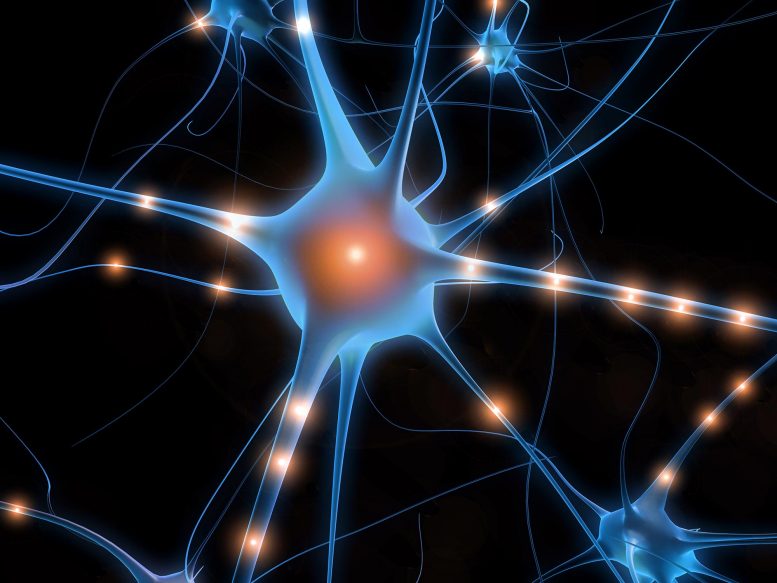
    Active Neuron Illustration
    Scientists have discovered that a group of special brain cells, called neuromodulators, play a big role in how we process sounds. One of these neuromodulators, called acetylcholine, might help our brains tell apart speech from other noises.

    Researchers provide the first physiological evidence that a foundational center of the brain influences how sound is processed, identify a previously unknown neural circuit.

    For the first time, researchers have provided physiological evidence that a pervasive neuromodulation system―a group of neurons that regulate the functioning of more specialized neurons―strongly influences sound processing in an important auditory region of the brain. The neuromodulator, acetylcholine, may even help the main auditory brain circuitry distinguish speech from noise.

    “While the phenomenon of these modulators’ influence has been studied at the level of the neocortex, where the brain’s most complex computations occur, it has rarely been studied at the more fundamental levels of the brain,” says R. Michael Burger, professor of neuroscience.

    Burger and Ph.D. student Chao Zhang―along with collaborators Nichole Beebe and Brett Schofield of Northeast Ohio Medical University and Michael Pecka of Ludwig-Maximilians University Munich―conducted the research. The findings have been described in an article, “Endogenous Cholinergic Signaling Modulates Sound-evoked Responses of the Medial Nucleus of the Trapezoid Body,” published earlier this month in The Journal of Neuroscience. The journal’s editors designated the article as “noteworthy” and it was included in “featured research” for its particular significance to the scientific community.

    “This study will likely bring new attention in the field to the ways in which circuits like this, widely considered a ‘simple’ one, are in fact highly complex and subject to modulatory influence like higher regions of the brain,” says Burger.
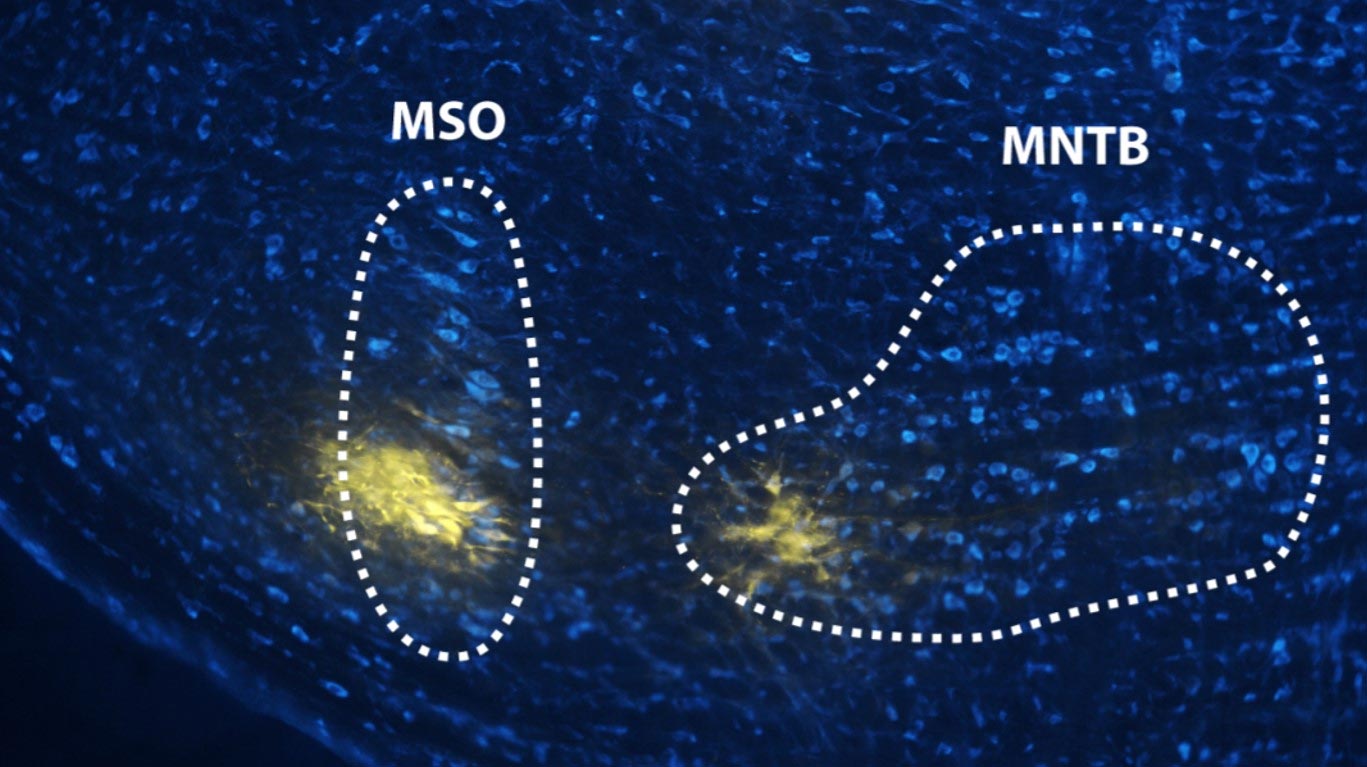
    MNTB Neurons In Vivo Extracellular Recording
    This image shows histological confirmation of recording sites. Fluoro-Gold deposited at the end of separate recordings from MNTB and MSO (dotted areas) are clearly separated and localized to target nuclei, confirming precise targeting to recording sites based on acoustically driven responses. Credit: Chao Zhang, Nichole L. Beebe, Brett R. Schofield, Michael Pecka and R. Michael Burger

    The team conducted electrophysiological experiments and data analysis to demonstrate that the input of the neurotransmitter acetylcholine, a pervasive neuromodulator in the brain, influences the encoding of acoustic information by the medial nucleus of the trapezoid body (MNTB), the most prominent source of inhibition to several key nuclei in the lower auditory system. MNTB neurons have previously been considered computationally simple, driven by a single large excitatory synapse and influenced by local inhibitory inputs. The team demonstrates that in addition to these inputs, acetylcholine modulation enhances neural discrimination of tones from noise stimuli, which may contribute to processing important acoustic signals such as speech. Additionally, they describe novel anatomical projections that provide acetylcholine input to the MNTB.

    Burger studies the circuit of neurons that are “wired together” in order to carry out the specialized function of computing the locations from which sounds emanate in space. He describes neuromodulators as broader, less specific circuits that overlay the more highly-specialized ones.

    “This modulation appears to help these neurons detect faint signals in noise,” says Burger. “You can think of this modulation as akin to shifting an antenna’s position to eliminate static for your favorite radio station.”

    “In this paper, we show that modulatory circuits have a profound effect on neurons in the sound localization circuitry, at very low foundational level of the auditory system,” adds Zhang. 

    In addition, during the course of this study, the researchers identified for the first time a set of completely unknown connections in the brain between the modulatory centers and this important area of the auditory system.

    Burger and Zhang think these findings could shed new light on the contribution of neuromodulation to fundamental computational processes in auditory brainstem circuitry, and that it also has implications for understanding how other sensory information is processed in the brain.

    Reference: “Endogenous Cholinergic Signaling Modulates Sound-evoked Responses of Medial Nucleus of Trapezoid Body” by Chao Zhang, Nichole L. Beebe, Brett R. Schofield, Michael Pecka and R. Michael Burger, 2 December 2020, JNeurosci: The Journal of Neuroscience.
    DOI: 10.1523/JNEUROSCI.1633-20.2020

    Never miss a breakthrough: Join the SciTechDaily newsletter.
    Follow us on Google and Google News.

    Brain Lehigh University Neuroscience Perception Speech
    Share. Facebook Twitter Pinterest LinkedIn Email Reddit

    Related Articles

    Language Impairments Unraveled: How Mutations in a Language Gene Produce Speech Deficits

    How Left Brain Asymmetry Is Related to Reading Ability – Two “Opposing” Theories Are Both Correct

    Brain Region Responsible for Making Sure People Pronounce Words As Intended

    How the Brain Links Smells to Places – Transporting Us Across Time and Space

    Gut and Heart Signals Affect How We See Ourselves: Weak Connections Linked to Body Shame and Weight Preoccupation

    Scientists Discover a New Class of Memory Cells in the Brain – The Closest Thing to a “Grandmother Neuron”

    Scientists Solve Long-Standing Brain Mystery by a Whisker

    “Area X” of Zebra Finch May Provide Insights to Human Speech Disorders

    Neuroscientists Decode Correlation Between Sound and Brain Activity

    Leave A Reply Cancel Reply

    • Facebook
    • Twitter
    • Pinterest
    • YouTube

    Don't Miss a Discovery

    Subscribe for the Latest in Science & Tech!

    Trending News

    Largest-Ever Study Finds Medicinal Cannabis Ineffective for Anxiety, Depression, PTSD

    250-Million-Year-Old Egg Solves One of Evolution’s Biggest Mysteries

    Living With Roommates Might Be Changing Your Gut Microbiome Without You Knowing

    Century-Old Cleaning Chemical Linked to 500% Increased Risk of Parkinson’s Disease

    What if Your Memories Never Happened? Physicists Take a New Look at the Boltzmann Brain Paradox

    One of the Universe’s Largest Stars May Be Getting Ready To Explode

    Scientists Discover Enzyme That Could Supercharge Ozempic-Like Weight Loss Drugs

    Popular Sweetener Linked to DNA Damage – “It’s Something You Should Not Be Eating”

    Follow SciTechDaily
    • Facebook
    • Twitter
    • YouTube
    • Pinterest
    • Newsletter
    • RSS
    SciTech News
    • Biology News
    • Chemistry News
    • Earth News
    • Health News
    • Physics News
    • Science News
    • Space News
    • Technology News
    Recent Posts
    • Challenging the Narrative: New Study Shows U.S. Life Expectancy Is Rising Across All States
    • Mystery Illness Kills 5 in Burundi As Doctors Scramble for Answers
    • Bone-Strengthening Discovery Could Reverse Osteoporosis
    • The Most Elusive Number in Physics Just Got Even More Mysterious
    • Scientists Uncover Hidden Trigger Behind Stem Cell Aging
    Copyright © 1998 - 2026 SciTechDaily. All Rights Reserved.
    • Science News
    • About
    • Contact
    • Editorial Board
    • Privacy Policy
    • Terms of Use

    Type above and press Enter to search. Press Esc to cancel.