
Close Menu
    Facebook X (Twitter) Instagram
    SciTechDaily
    • Biology
    • Chemistry
    • Earth
    • Health
    • Physics
    • Science
    • Space
    • Technology
    Facebook X (Twitter) Pinterest YouTube RSS
    SciTechDaily
    Home»Space»Hubble Space Telescope Releases Images of 30 Celestial Gems For 30th Anniversary
    Space

    Hubble Space Telescope Releases Images of 30 Celestial Gems For 30th Anniversary

    By Vanessa Thomas, NASA's Goddard Space Flight CenterDecember 20, 20202 Comments3 Mins Read
    Facebook Twitter Pinterest Telegram LinkedIn WhatsApp Email Reddit
    Share
    Facebook Twitter LinkedIn Pinterest Telegram Email Reddit

    Hubble Caldwell Catalog

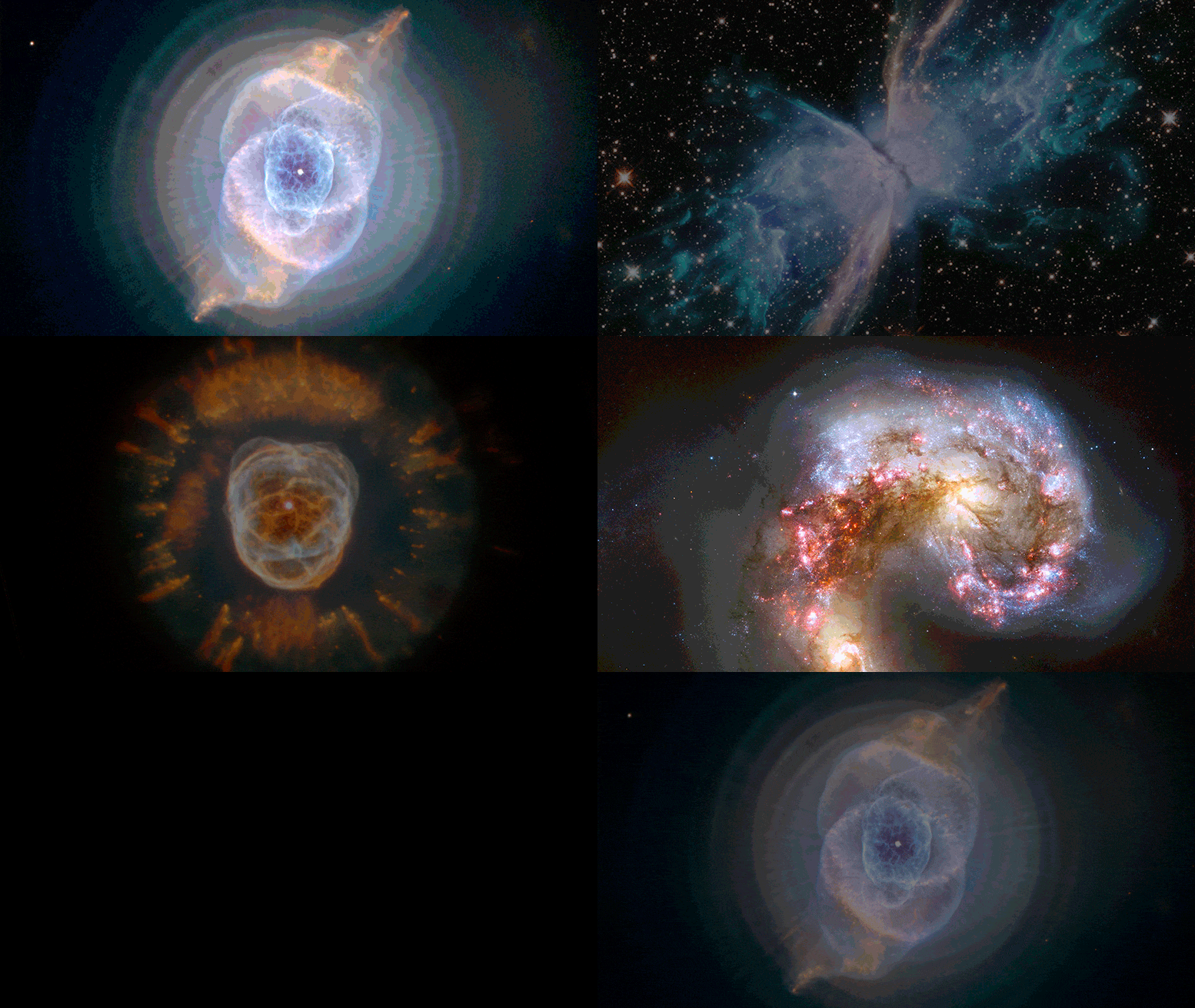
    The Hubble Space Telescope turned 30 this year, and for the occasion, it’s sharing a present with you. NASA has just released dozens of newly processed Hubble images featuring 30 dazzling galaxies, sparkling star clusters, and ethereal nebulae.

    And there’s something extra special about these 30 celestial gems: All of them can be seen through backyard telescopes. Some of them can also be spotted with binoculars or even the naked eye.

    Caldwell 78
    This Hubble image captures Caldwell 78 (or NGC 6541), a globular star cluster roughly 22,000 light-years from Earth. The cluster is bright enough that backyard stargazers in the Southern Hemisphere can easily spot it with binoculars.
    Credit: NASA, ESA, and G. Piotto (Università degli Studi di Padova); Processing: Gladys Kober (NASA/Catholic University of America)

    All of these celestial objects belong to a collection known to amateur astronomers as the Caldwell catalog. Compiled by British amateur astronomer and science communicator Sir Patrick Caldwell-Moore, the catalog was published by Sky & Telescope magazine 25 years ago, in December 1995. It was inspired by the Messier catalog, assembled by French comet-hunter Charles Messier, which includes 110 relatively bright but fuzzy objects in the skies of the Northern Hemisphere that could accidentally be mistaken for comets. Caldwell’s catalog highlights 109 galaxies, star clusters, and nebulae that are not included in Messier’s catalog but are also bright enough to be seen by amateur astronomers. In addition, the Caldwell objects are split between the northern and southern hemisphere skies, providing interesting targets to pursue for amateur astronomers around the world.

    This newly released collection of more than 50 Hubble images feature 30 objects in the Caldwell catalog. (Some of these 30 Caldwell objects appear in more than one new Hubble image.) These images have been taken by Hubble throughout its career and used for scientific research or for engineering tests, but NASA had not fully processed the images for public release until now.

    Because of Hubble’s detailed field of view, some of its pictures do not capture the entirety of a Caldwell object, sometimes instead zooming in on clusters of young stars in the arms of a spiral galaxy, stars on the outskirts of a cluster, or the zombie star at the heart of a nebula. But in other cases, a mosaic of Hubble observations assemble to create a complete or nearly complete portrait of the celestial marvel.

    These new images join Hubble’s existing gallery of Caldwell objects, first published in December 2019. Hubble’s collection now includes 87 of the 109 Caldwell objects. For each listing in Hubble’s Caldwell catalog, a basic star chart shows observers when and where they can find that object in the night sky, and a description suggests what type of observing equipment can be used to view it. The individual articles also explain Hubble’s images for those who prefer to just enjoy the telescope’s exquisite views.

    The Hubble Space Telescope was launched aboard Space Shuttle Discovery in April 1990. After being upgraded five times by crews of spacewalking astronauts, Hubble is today, at 30 years old, even better than when it was launched and continues to make groundbreaking discoveries that challenge and advance our fundamental understanding of the cosmos.

    To see all of the new images in Hubble’s Caldwell catalog, click here.

    Never miss a breakthrough: Join the SciTechDaily newsletter.
    Follow us on Google and Google News.

    Astronomy Hubble Space Telescope NASA NASA Goddard Space Flight Center Popular
    Share. Facebook Twitter Pinterest LinkedIn Email Reddit

    Related Articles

    Historic Discovery: Twin Titans Clash As NASA Unveils Closest Supermassive Black Hole Duo

    The Great Escape: NASA’s Hubble and MAVEN Help Solve Mystery of Mars’ Vanishing Water

    Webb and Hubble Unite: A Breathtaking 3D Journey Through the Pillars of Creation

    Stellar Sleuths: Citizen Scientists and AI Uncover Hidden Asteroids With Hubble

    Stellar Fireworks: Hubble Revisits a Strange Star’s 40-Year Nova Mystery

    Cosmic Geode: Hubble Captures the Birth of a Sun-like Star

    Jupiter Unveiled: Hubble Captures the Giant’s Roaring Storms and Volcanic Moon Io

    Cyclones in Space? See How Hubble Uncovered Extreme Weather on a Distant Planet

    Saturn’s Seasonal Spectacle: Hubble’s Ultra-Sharp Vision Unveils Ring Spoke Phenomenon

    2 Comments

    1. Jacob on December 21, 2020 8:11 am

      Kindly update me on daily basis with beautiful images of the Universe God created. Yehweh (Emmanuel)

      Reply
      • Inge Morgan on December 21, 2020 10:22 am

        Amen!

        Reply
    Leave A Reply Cancel Reply

    • Facebook
    • Twitter
    • Pinterest
    • YouTube

    Don't Miss a Discovery

    Subscribe for the Latest in Science & Tech!

    Trending News

    Breakthrough Bowel Cancer Trial Leaves Patients Cancer-Free for Nearly 3 Years

    Natural Compound Shows Powerful Potential Against Rheumatoid Arthritis

    100,000-Year-Old Neanderthal Fossils in Poland Reveal Unexpected Genetic Connections

    Simple “Gut Reset” May Prevent Weight Gain After Ozempic or Wegovy

    2.8 Days to Disaster: Scientists Warn Low Earth Orbit Could Suddenly Collapse

    Common Food Compound Shows Surprising Power Against Superbugs

    5 Simple Ways To Remember More and Forget Less

    The Atomic Gap That Could Cost the Semiconductor Industry Billions

    Follow SciTechDaily
    • Facebook
    • Twitter
    • YouTube
    • Pinterest
    • Newsletter
    • RSS
    SciTech News
    • Biology News
    • Chemistry News
    • Earth News
    • Health News
    • Physics News
    • Science News
    • Space News
    • Technology News
    Recent Posts
    • After 37 Years, the World’s Longest-Running Soil Warming Experiment Uncovers a Startling Climate Secret
    • NASA Satellite Captures First-Ever High-Res View of Massive Pacific Tsunami
    • ADHD Isn’t Just a Deficit: Study Reveals Powerful Hidden Strengths
    • Scientists Uncover “Astonishing” Hidden Property of Light
    • Scientists Discover Stem Cells That Could Regrow Teeth and Bone
    Copyright © 1998 - 2026 SciTechDaily. All Rights Reserved.
    • Science News
    • About
    • Contact
    • Editorial Board
    • Privacy Policy
    • Terms of Use

    Type above and press Enter to search. Press Esc to cancel.