

Cores of Two Galaxies Are on a Collision Course
For all practical purposes, stars traveling across space never smash into each other. The ratio between a starlike sun’s diameter and its distance to the next neighboring star is about 1:10 million. Galaxies do collide though. The separation between our Milky Way and neighboring Andromeda galaxy is a staggering 2.2 million light-years. That’s a ratio of only 1:20. And there will eventually be a collision and merger between the two giants.
When galaxies collide their black holes merge into one giant black hole. Nearly all galaxies contain supermassive black holes in their centers. The Hubble Space Telescope and the Chandra X-ray Observatory looked in the heart of a pair of colliding galaxies and uncovered twin supermassive black holes waltzing around each other. The black hole duo, engorged with infalling gas, blazes brightly as active galactic nuclei (AGN). They are approximately 300 light-years apart – the closest AGN pair seen in visible-light and X-ray wavelengths.
The closest confirmed pair of supermassive black holes have been observed in tight proximity. These are located approximately 300 light-years apart and were detected using NASA’s Hubble Space Telescope and the Chandra X-ray Observatory. These black holes, buried deep within a pair of colliding galaxies, are fueled by infalling gas and dust, causing them to shine brightly as active galactic nuclei (AGN). Credit: NASA’s Goddard Space Flight Center
NASA’s Hubble, Chandra Find Supermassive Black Hole Duo
Like two Sumo wrestlers squaring off, the closest confirmed pair of supermassive black holes have been observed in tight proximity. These are located approximately 300 light-years apart and were detected using NASA’s Hubble Space Telescope and the Chandra X-ray Observatory. These black holes, buried deep within a pair of colliding galaxies, are fueled by infalling gas and dust, causing them to shine brightly as active galactic nuclei (AGN).
This AGN pair is the closest one detected in the local universe using multiwavelength (visible and X-ray light) observations. While several dozen “dual” black holes have been found before, their separations are typically much greater than what was discovered in the gas-rich galaxy MCG-03-34-64. Astronomers using radio telescopes have observed one pair of binary black holes in even closer proximity than in MCG-03-34-64, but without confirmation in other wavelengths.
AGN binaries like this were likely more common in the early universe when galaxy mergers were more frequent. This discovery provides a unique close-up look at a nearby example, located about 800 million light-years away.
Serendipitous Insights from Hubble and Chandra
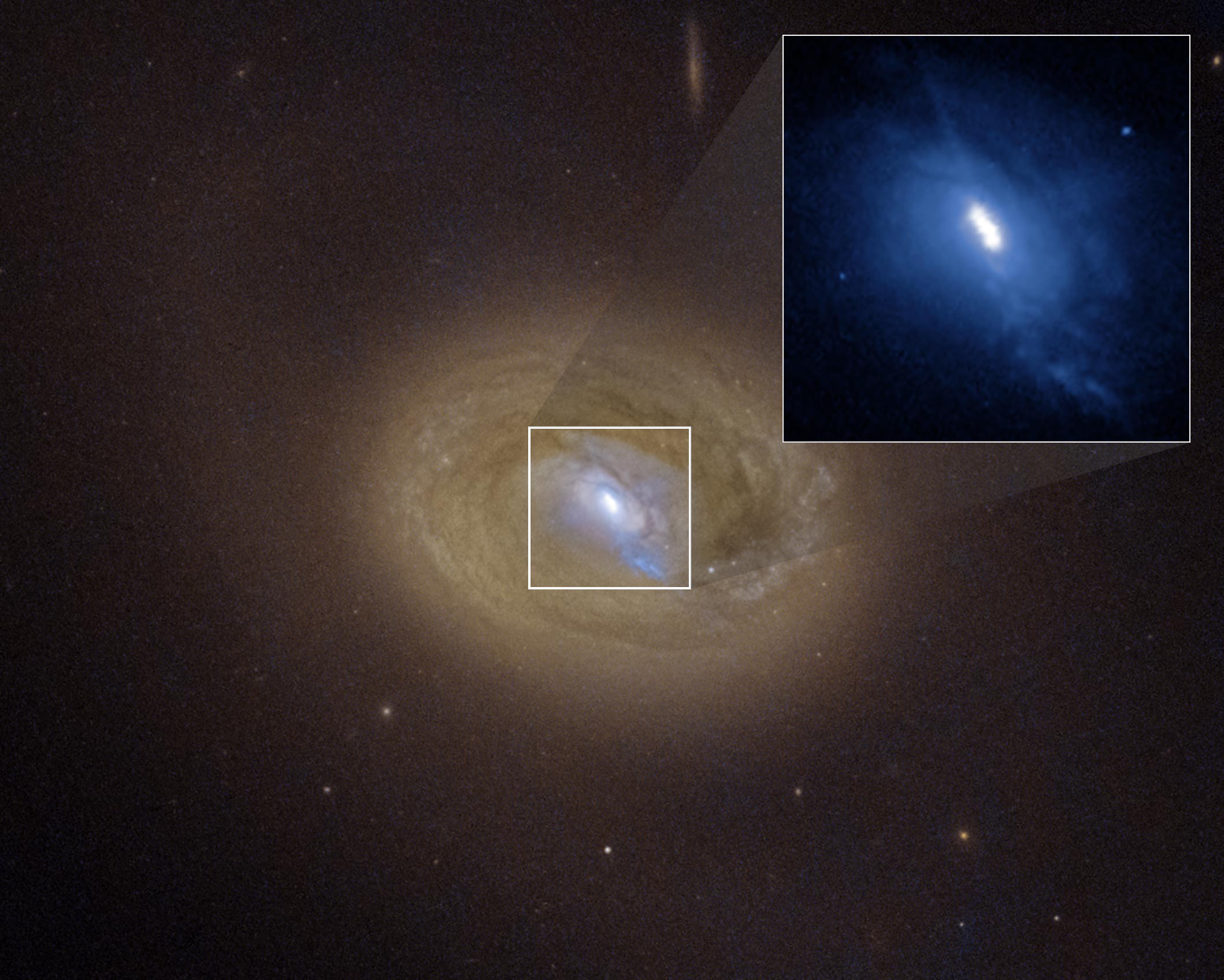
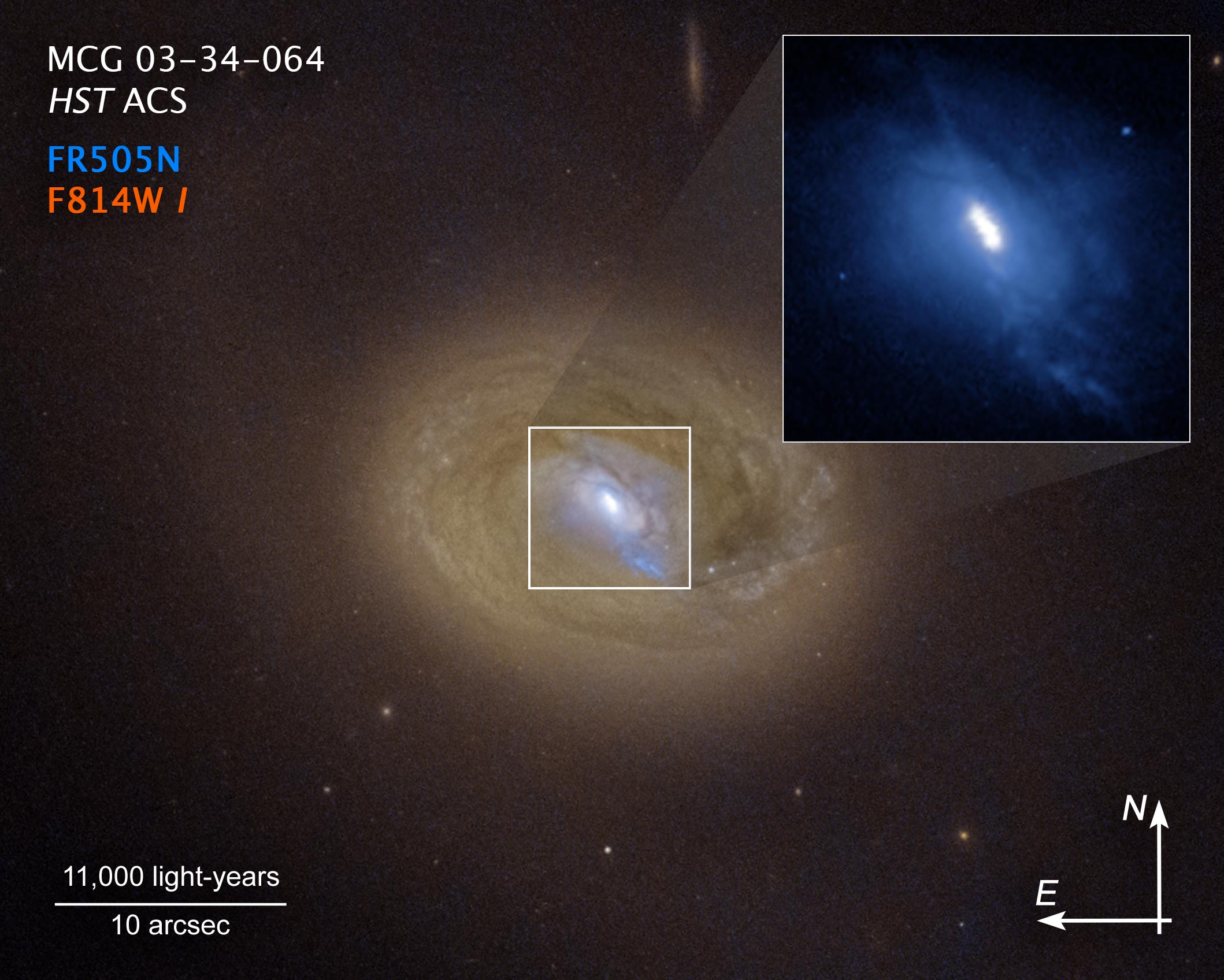
The discovery was serendipitous. Hubble’s high-resolution imaging revealed three optical diffraction spikes nested inside the host galaxy, indicating a large concentration of glowing oxygen gas within a very small area. “We were not expecting to see something like this,” said Anna Trindade Falcão of the Center for Astrophysics | Harvard & Smithsonian in Cambridge, Massachusetts, lead author of the paper published today (September 9) in The Astrophysical Journal. “This view is not a common occurrence in the nearby universe, and told us there’s something else going on inside the galaxy.”
Diffraction spikes are imaging artifacts caused when light from a very small region in space bends around the mirror inside telescopes.
Falcão’s team then examined the same galaxy in X-rays light using the Chandra observatory to drill into what’s going on. “When we looked at MCG-03-34-64 in the X-ray band, we saw two separated, powerful sources of high-energy emission coincident with the bright optical points of light seen with Hubble. We put these pieces together and concluded that we were likely looking at two closely spaced supermassive black holes,” said Falcão.
Interpreting Signals Across Wavelengths
To support their interpretation, the researchers used archival radio data from the Karl G. Jansky Very Large Array near Socorro, New Mexico. The energetic black hole duo also emits powerful radio waves. “When you see bright light in optical, X-rays, and radio wavelengths, a lot of things can be ruled out, leaving the conclusion these can only be explained as close black holes. When you put all the pieces together it gives you the picture of the AGN duo,” said Falcão.
The third source of bright light seen by Hubble is of unknown origin, and more data is needed to understand it. That might be gas that is shocked by energy from a jet of ultra high-speed plasma fired from one of the black holes, like a stream of water from a garden hose blasting into a pile of sand.
“We wouldn’t be able to see all of these intricacies without Hubble’s amazing resolution,” said Falcão.
Future Implications and Ongoing Research
The two supermassive black holes were once at the core of their respective host galaxies. A merger between the galaxies brought the black holes into close proximity. They will continue to spiral closer together until they eventually merge – in perhaps 100 million years – rattling the fabric of space and time as gravitational waves.
The National Science Foundation’s Laser Interferometer Gravitational-Wave Observatory (LIGO) has detected gravitational waves from dozens of mergers between stellar-mass black holes. But the longer wavelengths resulting from a supermassive black hole merger are beyond LIGO’s capabilities. The next-generation gravitational wave detector, called the LISA (Laser Interferometer Space Antenna) mission, will consist of three detectors in space, separated by millions of miles, to capture these longer wavelength gravitational waves from deep space. ESA (European Space Agency) is leading this mission, partnering with NASA and other participating institutions, with a planned launch in the mid-2030s.
Reference: “Resolving a Candidate Dual Active Galactic Nucleus with ∼100 pc Separation in MCG-03-34-64” by Anna Trindade Falcão, T. J. Turner, S. B. Kraemer, J. Reeves, V. Braito, H. R. Schmitt and L. Feuillet, 9 September 2024, The Astrophysical Journal.
DOI: 10.3847/1538-4357/ad6b91
The Chandra X-ray Observatory, managed by NASA’s Marshall Space Flight Center, is a pivotal project in space science, focusing on X-ray astronomy. The scientific operations and flight controls are overseen by the Smithsonian Astrophysical Observatory’s Chandra X-ray Center, based in Cambridge and Burlington, Massachusetts, respectively. The construction of the spacecraft was spearheaded by Northrop Grumman Space Technologies in Redondo Beach, California, serving as the prime contractor.
For more than thirty years, the Hubble Space Telescope has been at the forefront of astronomical discovery, deepening our understanding of the cosmos. This monumental project is a collaborative effort between NASA and the European Space Agency (ESA). The telescope and its mission operations are managed by NASA’s Goddard Space Flight Center, with the Space Telescope Science Institute handling the science operations. This Institute, based in Baltimore, Maryland, and operated by the Association of Universities for Research in Astronomy, works closely with Lockheed Martin Space in Denver, Colorado, which also supports these mission operations.
Never miss a breakthrough: Join the SciTechDaily newsletter.
Follow us on Google and Google News.
4 Comments
Black Hole. Black Hole is the Univerce fastest mode of Transportation. For example. It will take NASA’s Space Rockets Ship 8 mouths from Earth to Mars. In Black Hole this will take about 8 minutes. Inside black hole is like on Earth Roller coaster. Inside black hole is like nothing you ever seen before. You go from point A to point B in no time. The way black hole looks in your picture is terrifies and it is. Is like Tornadoes or Storms on Earth. It’s turned different different speed from different different point. If you can study Tornadoes on Earth you can understand Black Hole / Holes. Thanks. To be continued. M. Luke.
The point A and point B is inside the black hole, which makes for a rather boring trip table. We don’t know what is inside the event horizon, but the oldest models is of a vacuum – nothing to see here.
Extra cool!!!
Lightsaber black hole!!!