
Blast from the Past Caught in Episodes Due to Gravitational Lensing
Light from a star that exploded over 11 billion years ago was captured by the Hubble Space Telescope. It was not just one postcard from the remote past but three messages that chronicle the fading fireball over a period of one week.
For starters, the feeble light from the supernova was amplified by the gravitational field of an enormous foreground galaxy cluster, Abell 370. The gravitational warp in space acts as a cosmic lens, bending and magnifying the light from the more distant supernova, which was located far behind the cluster.
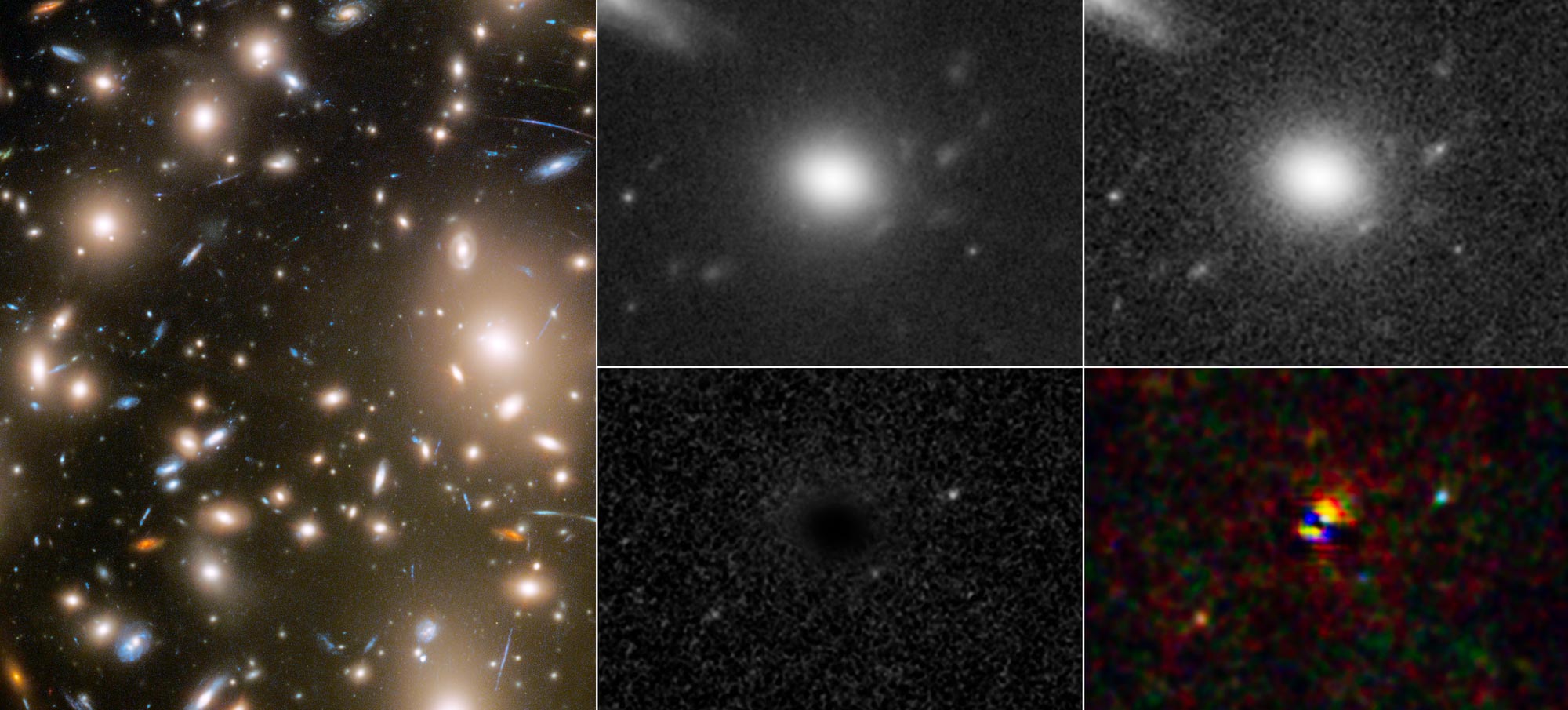
A bonus for astronomers is that not one but three images of the supernova appear in the photo, strung along the cluster. They show the explosion over different times that all arrived at Hubble simultaneously. A clue is that the cooling supernova fireball appears in slightly different colors among the supernova images. The images arrived at different times because the length of the pathways the supernova light followed is different. The later images were delayed due to taking a longer route across “valleys” of warped space.
Through a “trick” of light-bending gravity, the Hubble Space Telescope captured three different moments in the explosion of a very far-off supernova — all in one snapshot! Credit: NASA’s Goddard Space Flight Center
Hubble Captures 3 Faces of Evolving Supernova in Early Universe
NASA’s Hubble Space Telescope captured three different moments in a far-off supernova explosion in a single snapshot. When the star exploded more than 11 billion years ago, the universe was less than a fifth of its current age of 13.8 billion years.
In fact, this is the first detailed look at a supernova so early in the universe’s history. The research could help scientists learn more about the formation of stars and galaxies in the early universe. The supernova images are also special because they show the early stages of a stellar explosion.
“It is quite rare that a supernova can be detected at a very early stage, because that stage is really short,” explained Wenlei Chen, first author of the paper and a postdoctoral researcher in the University of Minnesota School of Physics and Astronomy. “It only lasts for hours to a few days, and it can be easily missed even for a nearby detection. In the same exposure, we are able to see a sequence of the images—like multiple faces of a supernova.”
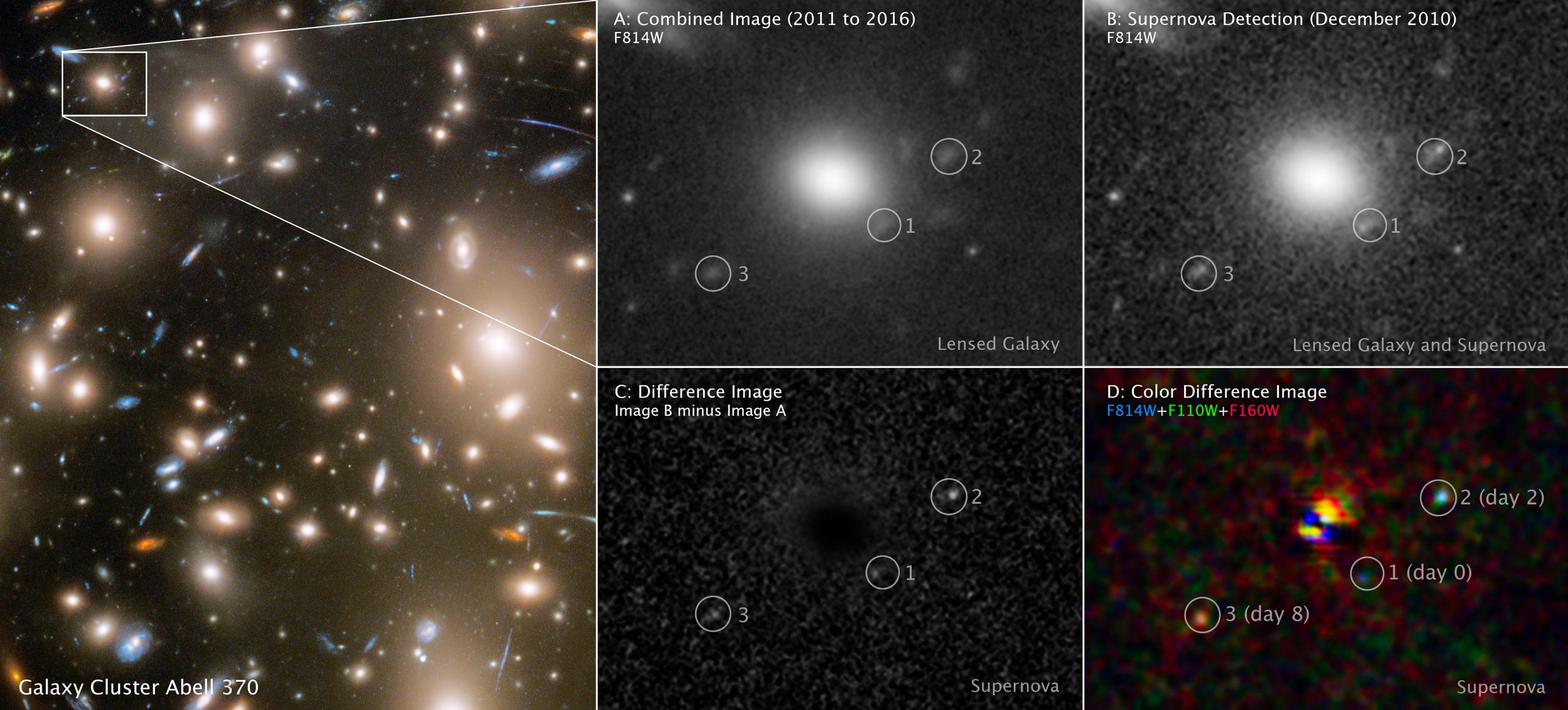
The left panel shows the portion of Abell 370 where the multiple images of the supernova appeared. Panel A, a composite of Hubble observations from 2011 to 2016, shows the locations of the multiply imaged host galaxy after the supernova faded. Panel B, a Hubble picture from December 2010, shows the three images of the host galaxy and the supernova at different phases in its evolution. Panel C, which subtracts the image in Panel B from that in Panel A, shows three different faces of the evolving supernova. Using a similar image subtraction process for multiple filters of data, Panel D shows the different colors of the cooling supernova at three different stages in its evolution.
Credit: NASA, ESA, STScI, Wenlei Chen (UMN), Patrick Kelly (UMN), Hubble Frontier Fields
This was possible through a phenomenon called gravitational lensing, which was first predicted in Einstein’s theory of general relativity. In this case, the immense gravity of the galaxy cluster Abell 370 acted as a cosmic lens, bending and magnifying the light from the more distant supernova located behind the cluster.
The warping also produced multiple images of the explosion over different time periods that all arrived at Earth at the same time and were caught in one Hubble image. That was possible only because the magnified images took different routes through the cluster due both to differences in the length of the pathways the supernova light followed, and to the slowing of time and curvature of space due to gravity.
The Hubble exposure also captured the fading supernova’s rapid change of color, which indicates temperature change. The bluer the color means the hotter the supernova is. The earliest phase captured appears blue. As the supernova cooled its light turned redder.
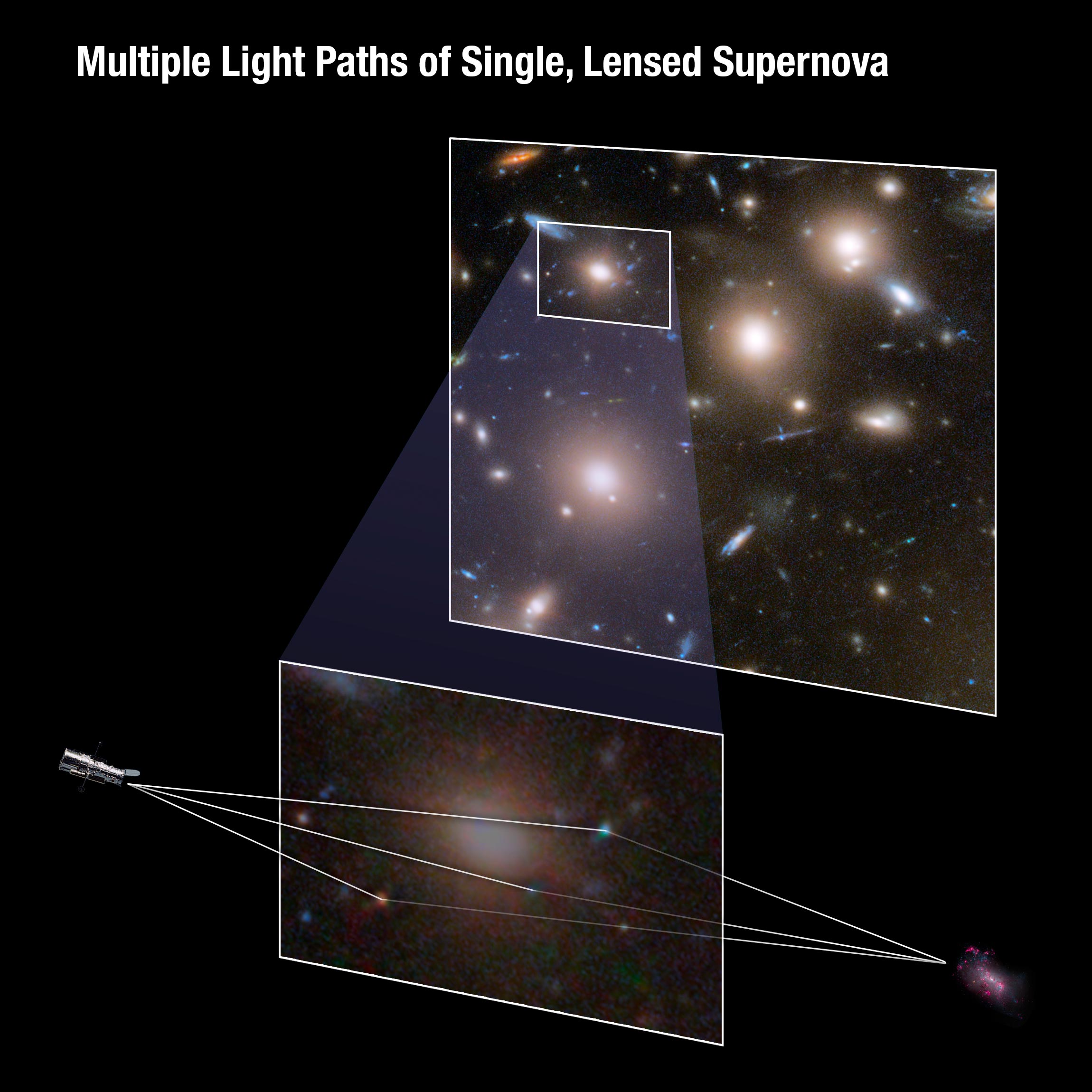
The top box shows a portion of Abell 370. The box-within-the-box marks the area where the distant supernova was multiply lensed. The bottom image is a magnified version of this area with the light paths marked for the three images of the supernova. The right side of the bottom image shows the distant galaxy in which the supernova exploded. The lines show how the light traveled through the gravitational lens, with some of the light taking longer routes across “valleys” of warped space. The warping produced three images of the explosion over different time periods that all arrived at Hubble simultaneously.
Credit: NASA, ESA, Alyssa Pagan (STScI)
“You see different colors in the three different images,” said Patrick Kelly, study leader and an assistant professor in the University of Minnesota’s School of Physics and Astronomy. “You’ve got the massive star, the core collapses, it produces a shock, it heats up, and then you’re seeing it cool over a week. I think that’s probably one of the most amazing things I’ve ever seen!”
This is also the first time astronomers were able to measure the size of a dying star in the early universe. This was based on the supernova’s brightness and rate of cooling, both of which depend on the size of the progenitor star. Hubble observations show that the red supergiant whose supernova explosion the researchers discovered was about 500 times larger than the Sun.
Chen, Kelly, and an international team of astronomers found this supernova by sifting through the Hubble data archives, looking for transient events. Chen wrote machine-learning algorithms to find these events, but this was the only multiply imaged supernova identified.
Chen and Kelly both have time planned for NASA’s James Webb Space Telescope to observe even more distant supernovae. They hope to contribute to a catalog of very far-off supernovae to help astronomers understand if the stars that existed many billions of years ago are different from those in the nearby universe.
Reference: “Shock cooling of a red-supergiant supernova at redshift 3 in lensed images” by Wenlei Chen, Patrick L. Kelly, Masamune Oguri, Thomas J. Broadhurst, Jose M. Diego, Najmeh Emami, Alexei V. Filippenko, Tommaso L. Treu and Adi Zitrin, 9 November 2022, Nature.
DOI: 10.1038/s41586-022-05252-5
The Hubble Space Telescope is a project of international cooperation between NASA and ESA. NASA’s Goddard Space Flight Center in Greenbelt, Maryland, manages the telescope. The Space Telescope Science Institute (STScI) in Baltimore conducts Hubble science operations. STScI is operated for NASA by the Association of Universities for Research in Astronomy, in Washington, D.C.
Never miss a breakthrough: Join the SciTechDaily newsletter.
Follow us on Google and Google News.