
Close Menu
    Facebook X (Twitter) Instagram
    SciTechDaily
    • Biology
    • Chemistry
    • Earth
    • Health
    • Physics
    • Science
    • Space
    • Technology
    Facebook X (Twitter) Pinterest YouTube RSS
    SciTechDaily
    Home»Space»Hubble Telescope Views the Many Galaxies of Abell 370
    Space

    Hubble Telescope Views the Many Galaxies of Abell 370

    By Ann Jenkins / Ray Villard, Space Telescope Science InstituteMay 4, 2017No Comments4 Mins Read
    Facebook Twitter Pinterest Telegram LinkedIn WhatsApp Email Reddit
    Share
    Facebook Twitter LinkedIn Pinterest Telegram Email Reddit
    Galaxy Cluster Abell 370
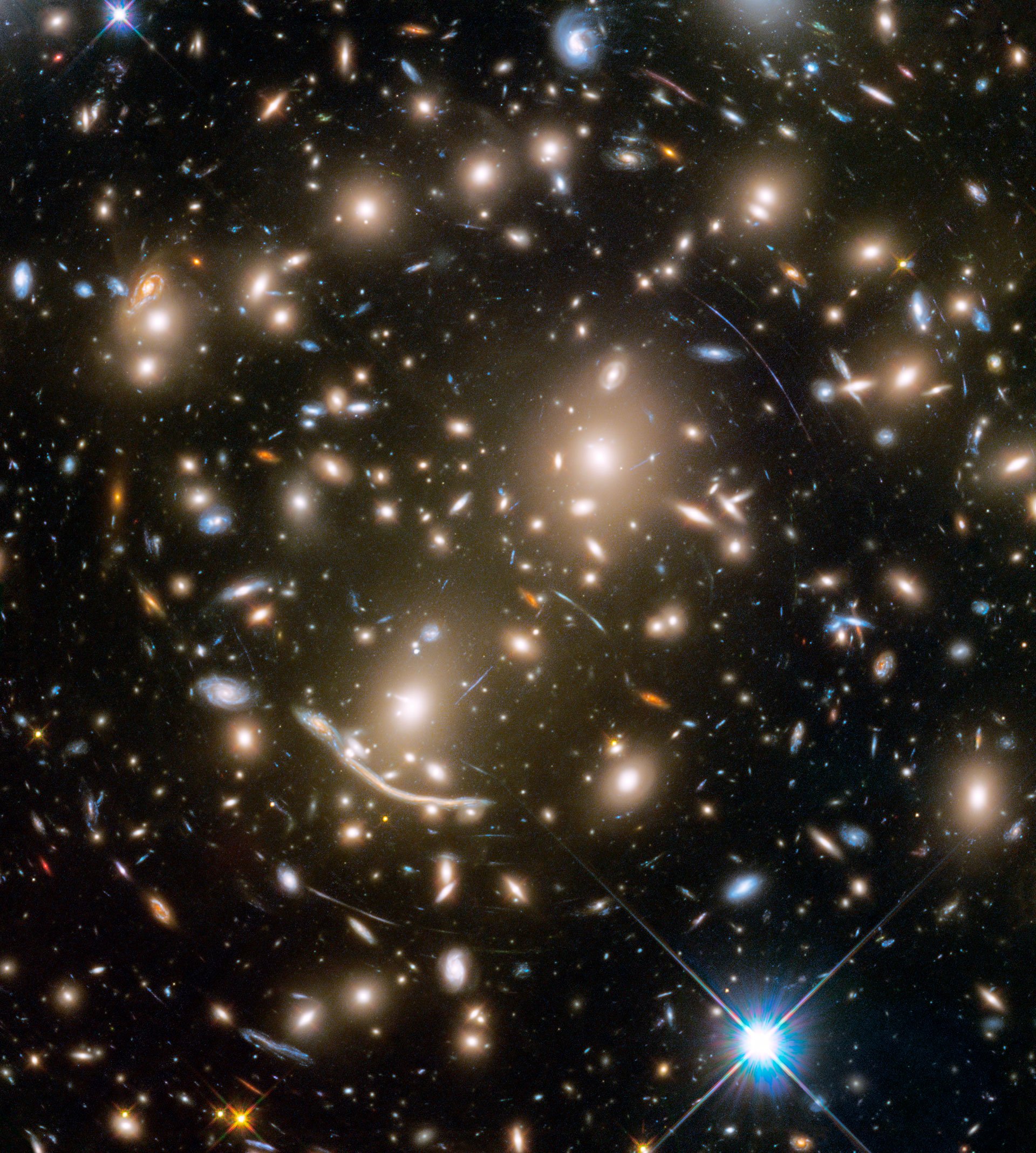
    Galaxy cluster Abell 370 contains several hundred galaxies tied together by the mutual pull of gravity. Photographed in a combination of visible and near-infrared light, the brightest and largest galaxies are the yellow-white, massive, elliptical galaxies containing many hundreds of billions of stars each. Spiral galaxies have younger populations of stars and are bluish. Mysterious-looking arcs of blue light are distorted images of remote galaxies behind the cluster. The cluster acts as a huge lens in space that magnifies and stretches images of background galaxies like a funhouse mirror. Credit: NASA, ESA, and J. Lotz and the HFF Team (STScI)

    Hubble uses the power of gravitational lensing to get a better look at galaxy cluster Abell 370 and its several hundred galaxies that are tied together by the mutual pull of gravity.

    Much like the eclectic group of space rebels in the upcoming film Guardians of the Galaxy Vol. 2, NASA’s Hubble Space Telescope has some amazing superpowers, specifically when it comes to observing innumerable galaxies flung across time and space.

    A stunning example is a galaxy cluster called Abell 370 that contains an astounding assortment of several hundred galaxies tied together by the mutual pull of gravity. That’s a lot of galaxies to be guarding, and just in this one cluster!


    The Hubble Space Telescope is keeping watch over many, many galaxies using the combined superpowers of its incredible optics and a quirk of nature called gravitational lensing.

    Photographed in a combination of visible and near-infrared light, the immense cluster is a rich mix of a variety of galaxy shapes. The brightest and largest galaxies in the cluster are the yellow-white, massive, elliptical galaxies containing many hundreds of billions of stars each. Spiral galaxies — like our Milky Way — have younger populations of stars and are bluish.

    Entangled among the galaxies are mysterious-looking arcs of blue light. These are actually distorted images of remote galaxies behind the cluster. These far-flung galaxies are too faint for Hubble to see directly. Instead, the cluster acts as a huge lens in space that magnifies and stretches images of background galaxies like a funhouse mirror. The massive gravitational field of the foreground cluster produces this phenomenon. The collective gravity of all the stars and other matter trapped inside the cluster warps space and affects light traveling through the cluster, toward Earth.

    Nearly a hundred distant galaxies have multiple images caused by the lensing effect. The most stunning example is “the Dragon,” an extended feature that is probably several duplicated images of a single background spiral galaxy stretched along an arc.
    Gallery of the Hubble Space Telescope Frontier Field
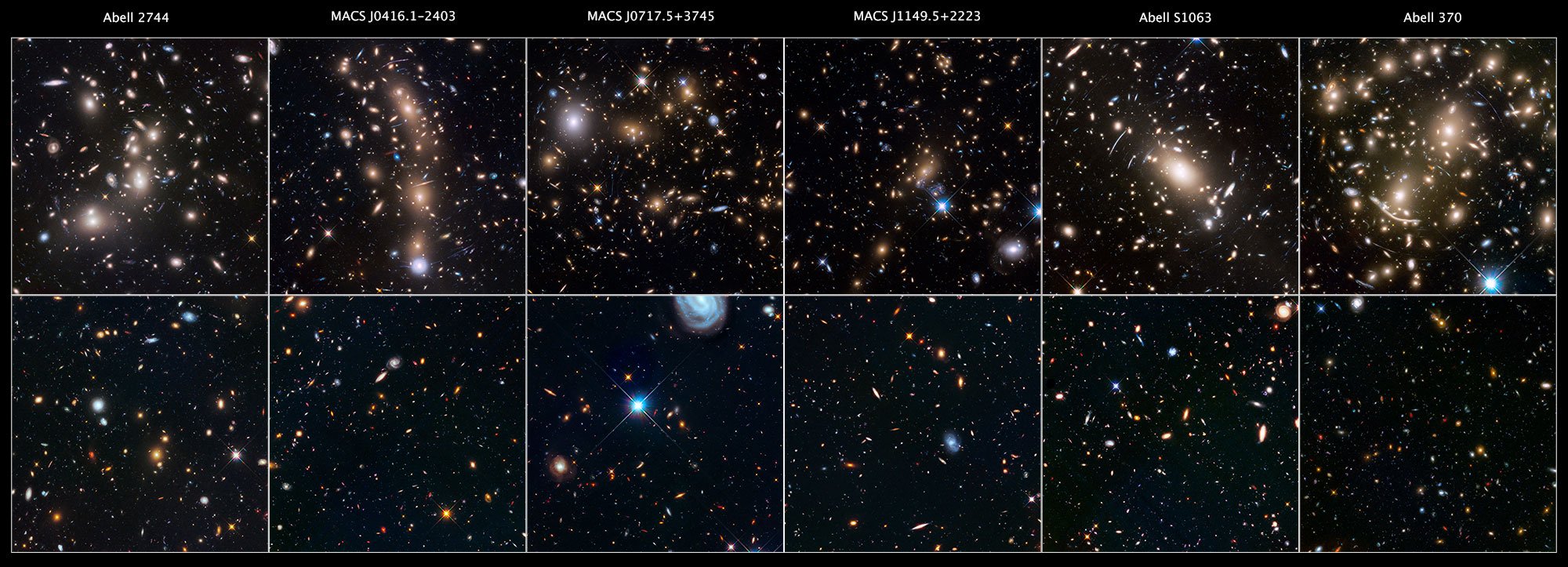
    This is a gallery of the Hubble Space Telescope Frontier Fields. The top six panels are massive galaxy clusters that act as huge lenses in space, magnifying and stretching images of remote galaxies behind each cluster that are too faint for Hubble to see directly. While one of the telescope’s cameras looked at each cluster of galaxies, another camera simultaneously viewed an adjacent patch of sky. This second region is called a “parallel field” — a seemingly sparse portion of sky that provides a deep look into the early universe. Astronomers observed each of the six clusters and six parallel fields in both near-infrared and visible light. This allowed scientists to create more detailed, overlapping, and complete images. Credit: NASA, ESA, STScI, and the HFF team

    Astronomers chose Abell 370 as a target for Hubble because its gravitational lensing effects can be used for probing remote galaxies that inhabited the early universe.

    Abell 370 is located approximately 4 billion light-years away in the constellation Cetus, the Sea Monster. It is the last of six galaxy clusters imaged in the recently concluded Frontier Fields project. This ambitious, community-developed collaboration among NASA’s Great Observatories and other telescopes harnessed the power of massive galaxy clusters and probed the earliest stages of galaxy development. The program reveals galaxies that are 10 to 100 times fainter than any previously observed.

    Never miss a breakthrough: Join the SciTechDaily newsletter.
    Follow us on Google and Google News.

    Astronomy Gravitational Lensing Hubble Space Telescope
    Share. Facebook Twitter Pinterest LinkedIn Email Reddit

    Related Articles

    “Amazingly Lucky” Gravitational Lens Reveals New Insights Into Dark Matter and Dark Energy

    Cosmic Leviathan: Hubble Unveils an Exceptionally Massive Galaxy Cluster

    Hubble Finds Small Galaxy More Than 13 Billion Light-Years Away

    Hubble Discovers the Farthest Lensing Galaxy to Date

    Astronomers Map Galaxy Cluster More Precisely Than Ever Before

    Hubble Uses Gravitational Lensing to Magnifying the Distant Universe

    Space Invaders Appear in Hubble Image Due to Gravitational Lensing

    Hubble Spots Extremely Rare Gravitational Arc

    Quasars Acting as Gravitational Lenses Viewed by Hubble

    Leave A Reply Cancel Reply

    • Facebook
    • Twitter
    • Pinterest
    • YouTube

    Don't Miss a Discovery

    Subscribe for the Latest in Science & Tech!

    Trending News

    New Pill Lowers Stubborn Blood Pressure and Protects the Kidneys

    Humans May Have Hidden Regenerative Powers, New Study Suggests

    Scientists Just Solved the Mystery of Why Crabs Walk Sideways

    Doctors Are Surprised by What This Vaccine Is Doing to the Heart

    This Popular Supplement May Boost Your Brain, Not Just Your Muscles

    Scientists Say This Simple Supplement May Actually Reverse Heart Disease

    Warming Oceans Could Trigger a Dangerous Methane Surge

    This Simple Movement Could Be Secretly Cleaning Your Brain

    Follow SciTechDaily
    • Facebook
    • Twitter
    • YouTube
    • Pinterest
    • Newsletter
    • RSS
    SciTech News
    • Biology News
    • Chemistry News
    • Earth News
    • Health News
    • Physics News
    • Science News
    • Space News
    • Technology News
    Recent Posts
    • This Magnetic Field Trick Creates Entirely New Forms of Matter
    • Astronomers Stunned by Ancient Galaxy With No Spin
    • Physicists May Be on the Verge of Discovering “New Physics” at CERN
    • AI Learns To Work Backward and Reveal Hidden Forces in Nature
    • Scientists Warn of Rising Male Childlessness As Global Fertility Changes
    Copyright © 1998 - 2026 SciTechDaily. All Rights Reserved.
    • Science News
    • About
    • Contact
    • Editorial Board
    • Privacy Policy
    • Terms of Use

    Type above and press Enter to search. Press Esc to cancel.