
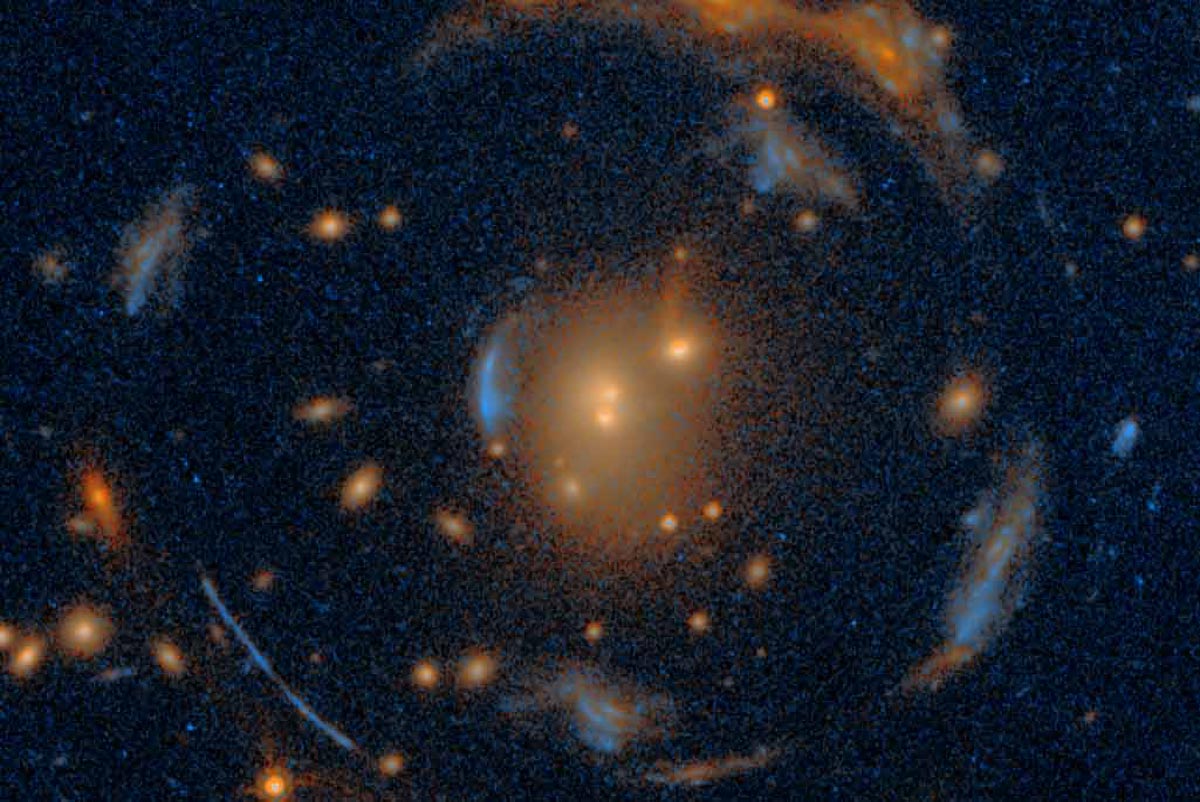
Researchers have discovered an extraordinarily aligned gravitational lens system, dubbed the Carousel Lens, that involves a unique configuration of galaxies spanning billions of light years.
This discovery, powered by data from NASA’s Hubble Space Telescope and the DESI Legacy Imaging Surveys, provides an unprecedented view of the universe’s structure, enhancing our understanding of dark matter and dark energy.
Carousel Lens Discovery
In a rare and extraordinary discovery, astronomers have identified a unique configuration of galaxies that form the most exquisitely aligned gravitational lens found to date. The Carousel Lens is a massive cluster-scale gravitational lens system that will enable researchers to delve deeper into the mysteries of the cosmos, including dark matter and dark energy.
“This is an amazingly lucky ‘galactic line-up’ – a chance alignment of multiple galaxies across a line-of-sight spanning most of the observable universe,” said David Schlegel, a co-author of the study and a senior scientist in Berkeley Lab’s Physics Division. “Finding one such alignment is a needle in the haystack. Finding all of these is like eight needles precisely lined up inside that haystack.”
“This is an amazingly lucky ‘galactic line-up’ – a chance alignment of multiple galaxies across a line-of-sight spanning most of the observable universe.”
David Schlegel
Details of the Carousel Lens
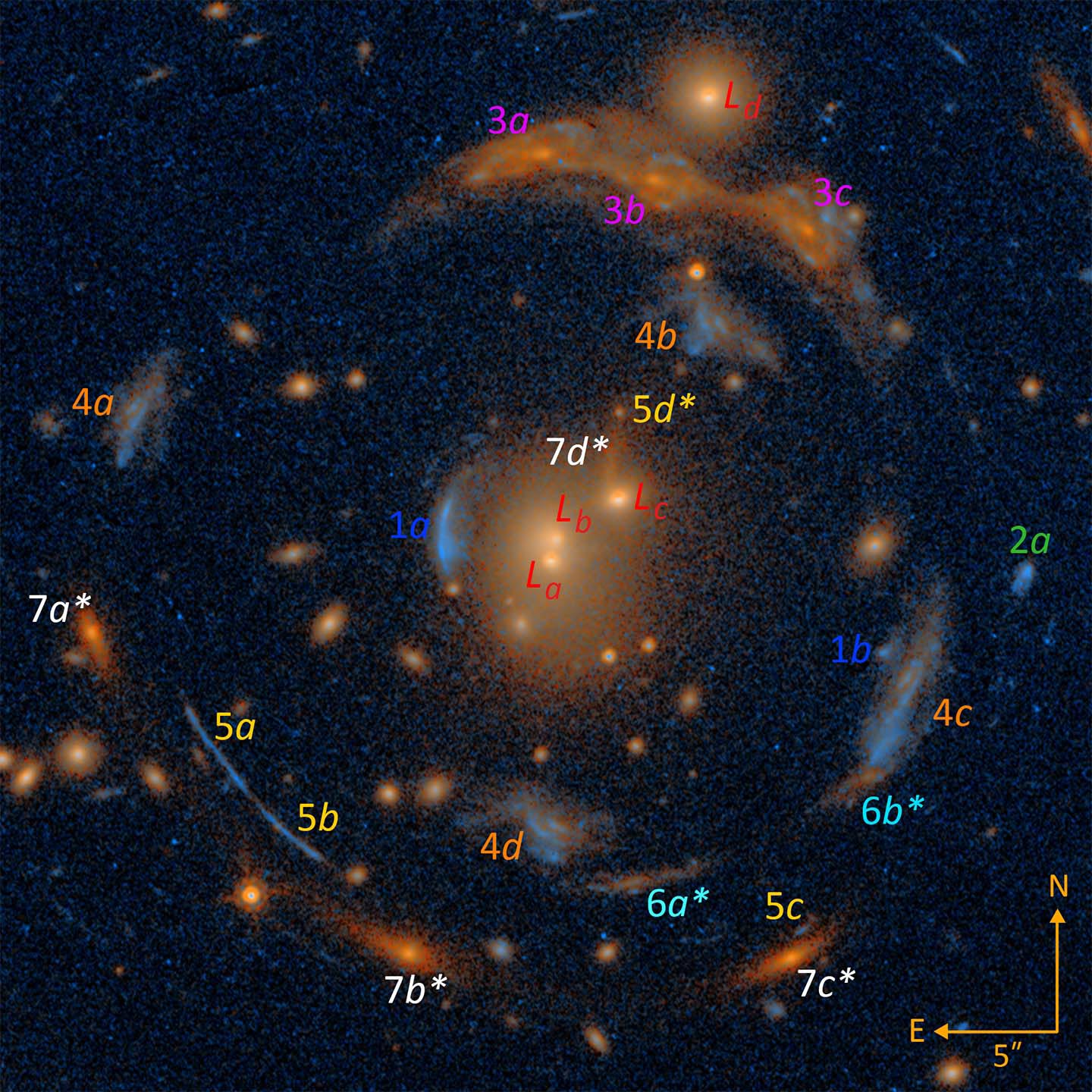
The Carousel Lens is an alignment consisting of one foreground galaxy cluster (the ‘lens’) and seven background galaxies spanning immense cosmic distances and seen through the gravitationally distorted space-time around the lens. In the dramatic image below:
- The lensing cluster, located 5 billion light years away from Earth, is shown by its four brightest and most massive galaxies (indicated by La, Lb, Lc, and Ld), and these constitute the foreground of the image.
- Seven unique galaxies (numbered 1 through 7), appear through the lens. These are located far beyond, at distances from 7.6 to 12 billion light years away from Earth, approaching the limit of the observable universe.
- Each galaxy’s repeated appearances (indicated by each number’s letter index, e.g., a through d) show differences in shape that are curved and stretched into multiple “fun house mirror” iterations caused by the warped space-time around the lens.
- Of particular interest is the discovery of an Einstein Cross – the largest known to date – shown in galaxy number 4’s multiple appearances (indicated by 4a, 4b, 4c, and 4d). This rare configuration of multiple images around the center of the lens is an indication of the symmetrical distribution of the lens’ mass (dominated by invisible dark matter) and plays a key role in the lens-modeling process.
Insights From the Research Process
Light traveling from far-distant space can be magnified and curved as it passes through the gravitationally distorted space-time of nearer galaxies or clusters of galaxies. In rare instances, a configuration of objects aligns nearly perfectly to form a strong gravitational lens. Using an abundance of new data from the Dark Energy Spectroscopic Instrument (DESI) Legacy Imaging Surveys, recent observations from NASA’s Hubble Space Telescope, and the Perlmutter supercomputer at the National Energy Research Scientific Computing Center (NERSC), the research team built on their earlier studies (in May 2020 and February 2021) to identify likely strong lens candidates, laying the groundwork for the current discovery.
Impact and Future Studies
“Our team has been searching for strong lenses and modeling the most valuable systems,” explains Xiaosheng Huang, a study co-author and member of Berkeley Lab’s Supernova Cosmology Project, and a professor of physics and astronomy at the University of San Francisco. “The Carousel Lens is an incredible alignment of seven galaxies in five groupings that line up nearly perfectly behind the foreground cluster lens. As they appear through the lens, the multiple images of each of the background galaxies form approximately concentric circular patterns around the foreground lens, as in a carousel. It’s an unprecedented discovery, and the computational model generated shows a highly promising prospect for measuring the properties of the cosmos, including those of dark matter and dark energy.”
Contributions and Further Applications
The study also involved several Berkeley Lab student researchers, including the lead author, William Sheu, an undergraduate student intern with DESI at the beginning of this study, now a PhD student at UCLA and a DESI collaborator.
The Carousel Lens will enable researchers to study dark energy and dark matter in entirely new ways based on the strength of the observational data and its computational model.
“This is an extremely unusual alignment, which by itself will provide a testbed for cosmological studies,” observes Nathalie Palanque-Delabrouille, director of Berkeley Lab’s Physics Division. “It also shows how the imaging done for DESI can be leveraged for other scientific applications,” such as investigating the mysteries of dark matter and the accelerating expansion of the universe, which is driven by dark energy.
Reference: “The Carousel Lens: A Well-modeled Strong Lens with Multiple Sources Spectroscopically Confirmed by VLT/MUSE” by William Sheu, Aleksandar Cikota, Xiaosheng Huang, Karl Glazebrook, Christopher Storfer, Shrihan Agarwal, David J. Schlegel, Nao Suzuki, Tania M. Barone, Fuyan Bian, Tesla Jeltema, Tucker Jones, Glenn G. Kacprzak, Jackson H. O’Donnell and Keerthi Vasan G. C., 11 September 2024, The Astrophysical Journal.
DOI: 10.3847/1538-4357/ad65d3
Never miss a breakthrough: Join the SciTechDaily newsletter.
Follow us on Google and Google News.
9 Comments
Not unusual that there’s a significant no-arc zone separating an inner lensing arc zone and an outer lensing arc zone. That fits nicely with the idea of giving quantum gravity carriers a galactic-scale stationary longitudinal roll-wave (somersault-type spin) effect where the no-arc zone includes a primary gravity-minimum phase.
There is a hint of a second pro-arc-forming ring at the edge of the photo, making for two concentric anti-lensing-arc zones effectively separating a central lensing-arc-conducive zone and two spaced apart concentric arc-conducive ring zones, in a double-ring target-like pattern. The three arc-conducive zones are presumably considered DM-rich zones. MOND apparently would only explain the inner arc-conducive ring.
There are no reliable sources favoring the interpretation of gravitational frequency shifting as an indication of time-rate shifting, but this article makes me think about how liquified all the midgets of the world would be if they had to take a drink from their little sippy cup every time “space-time” is mentioned in this article.
I mean it’s yet another imperial reinforcement from people who want to be offended every time it’s correctly recognized that gravity is a force that bends light, not time.
A prof in Huntsville is talking about Planck-scale mass dipoles (“gravity without (sic) mass”) forming “topological discontinuities” (new misapplied hot media gimmick word, if you ask me) along the lines of DM-obviating filaments and spheres with lensing potential, but apparently his dipoles are not radiated and they cannot be cold-matter-focused, nor do they roll (longitudinally rotate) at cosmological rates, they’re merely (quasi)-particles apparently cursed by the quantum information flowlessness of general relativity to stand still as if doing gravitational handstands at critical locations.
I doubt he addresses the spin one “topology” of a dipole and whether it matters if there’s a way, like dipole pairing, to make his spin-1 – appearing “topological cracks in reality” into spin 2 entities.
My explanation for the dipole remains similar to what happens with (donor) H and (acceptor) O turning into water and mixing no further, but in the case of a mass dipole the result is massless and thus should be radiate-able and able to at least keep up with light.
FWIW, I’ve mentioned Hebb and Hopfield a lot on this site in conjunction with the topic of “cold focus” (a sort of natural bidirectional retro-reflective “tractor beam” type of effect), and “backpropagation” is a topic I’ve discussed here or elsewhere – these were all big topics for hybrid and neuromorphic computer research way back in the 90’s when my career forced me to examine it. Now, after three decades, they give out physics Nobels this year for the researchers behind it. I could talk about this stuff and gravity for hours.
My coming second and third cosmology books will comprehensively discuss Dark Energy and Dark Matter. Hopefully these cosmological narratives will make the universe and existence significantly more transparent and take much nearer to understanding our ultimate nature and the Crestion Act Physics and Philosophy.
Very good article which is extremely interesting and helpful for physicistsists and writers of scientific research and discoveries.. Dark Matter and Dark Energy will become much less of astounding puzzles once we follow up solving what they are. In fact they rightly nearer to God than can be surmised.