
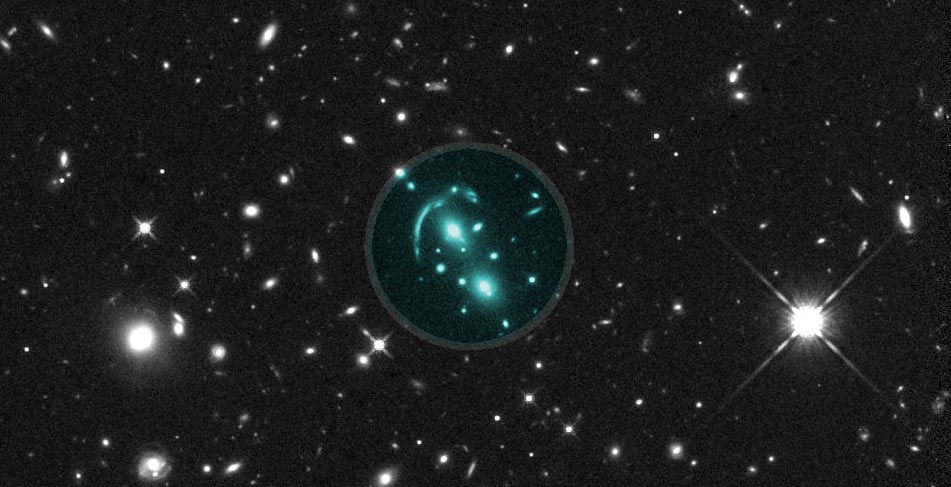
Images collected for dark energy telescope project reveal hundreds of new gravitational lens candidates.
Like crystal balls for the universe’s deeper mysteries, galaxies, and other massive space objects can serve as lenses to more distant objects and phenomena along the same path, bending light in revelatory ways.
Gravitational lensing was first theorized by Albert Einstein more than 100 years ago to describe how light bends when it travels past massive objects like galaxies and galaxy clusters.
These lensing effects are typically described as weak or strong, and the strength of a lens relates to an object’s position and mass, and distance from the light source that is lensed. Strong lenses can have 100 billion times more mass than our sun, causing light from more distant objects in the same path to magnify and split, for example, into multiple images, or to appear as dramatic arcs or rings.
The major limitation of strong gravitational lenses has been their scarcity, with only several hundred confirmed since the first observation in 1979, but that’s changing … and fast.
A new study by an international team of scientists revealed 335 new strong lensing candidates based on a deep dive into data collected for a U.S. Department of Energy-supported telescope project in Arizona called the Dark Energy Spectroscopic Instrument (DESI). The study, published on May 7, 2020, in The Astrophysical Journal, benefited from the winning machine-learning algorithm in an international science competition.
“Finding these objects is like finding telescopes that are the size of a galaxy,” said David Schlegel, a senior scientist in Lawrence Berkeley National Laboratory’s (Berkeley Lab’s) Physics Division who participated in the study. “They’re powerful probes of dark matter and dark energy.”
These newly discovered gravitational lens candidates could provide specific markers for precisely measuring distances to galaxies in the ancient universe if supernovae are observed and precisely tracked and measured via these lenses, for example.
Strong lenses also provide a powerful window into the unseen universe of dark matter, which makes up about 85 percent of the matter in the universe, as most of the mass responsible for lensing effects is thought to be dark matter. Dark matter and the accelerating expansion of the universe, driven by dark energy, are among the biggest mysteries that physicists are working to solve.
In the latest study, researchers enlisted Cori, a supercomputer at Berkeley Lab’s National Energy Research Scientific Computing Center (NERSC), to automatically compare imaging data from the Dark Energy Camera Legacy Survey (DECaLS) – one of three surveys conducted in preparation for DESI – with a training sample of 423 known lenses and 9,451 non-lenses.
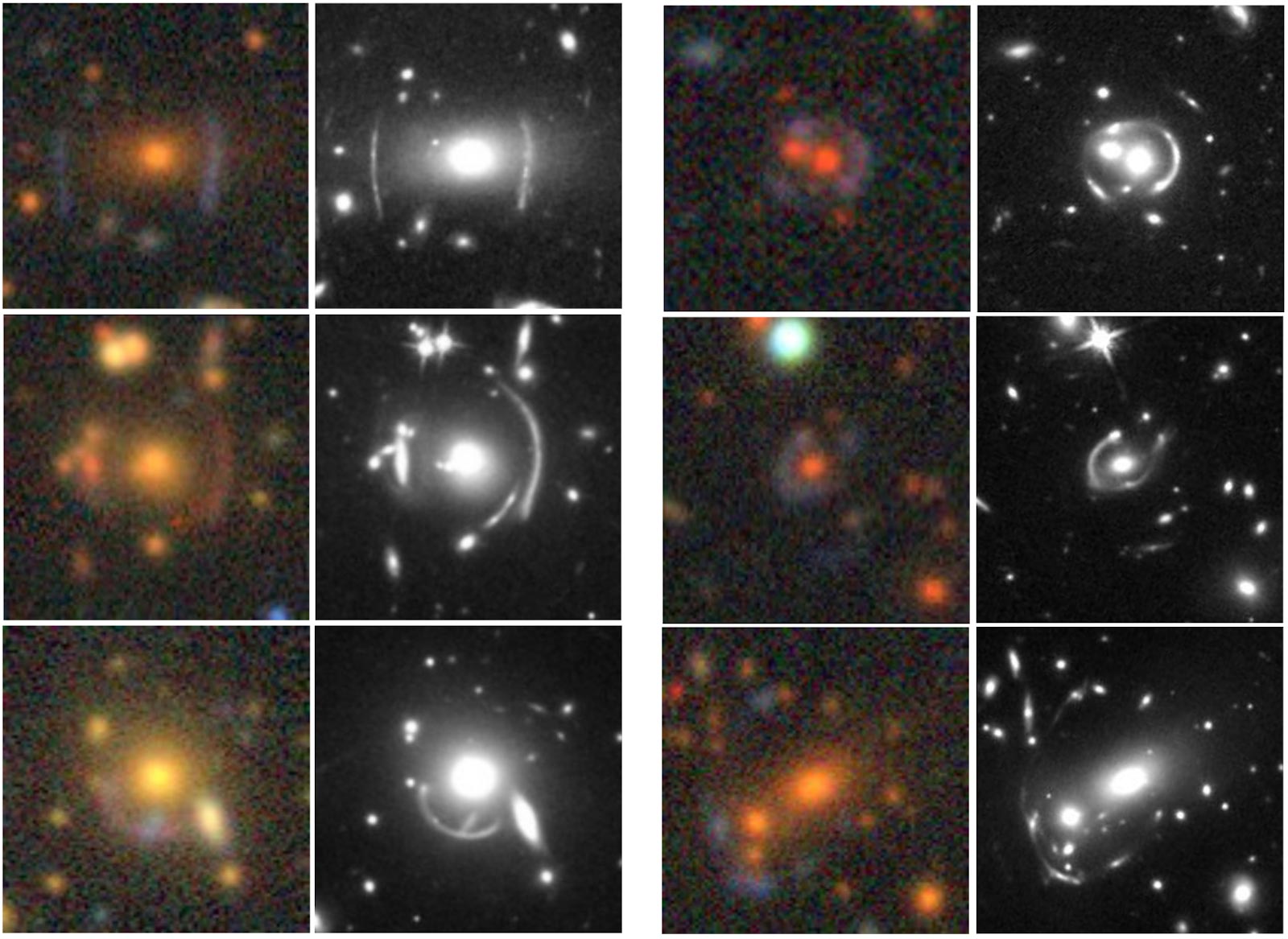
The researchers grouped the candidate strong lenses into three categories based on the likelihood that they are, in fact, lenses: Grade A for the 60 candidates that are most likely to be lenses, Grade B for the 105 candidates with less pronounced features, and Grade C for the 176 candidate lenses that have fainter and smaller lensing features than those in the other two categories.
Xiaosheng Huang, the study’s lead author, noted that the team already succeeded in winning time on the Hubble Space Telescope to confirm some of the most promising lensing candidates revealed in the study, with observing time on the Hubble that began in late 2019.
“The Hubble Space Telescope can see the fine details without the blurring effects of Earth’s atmosphere,” Huang said.
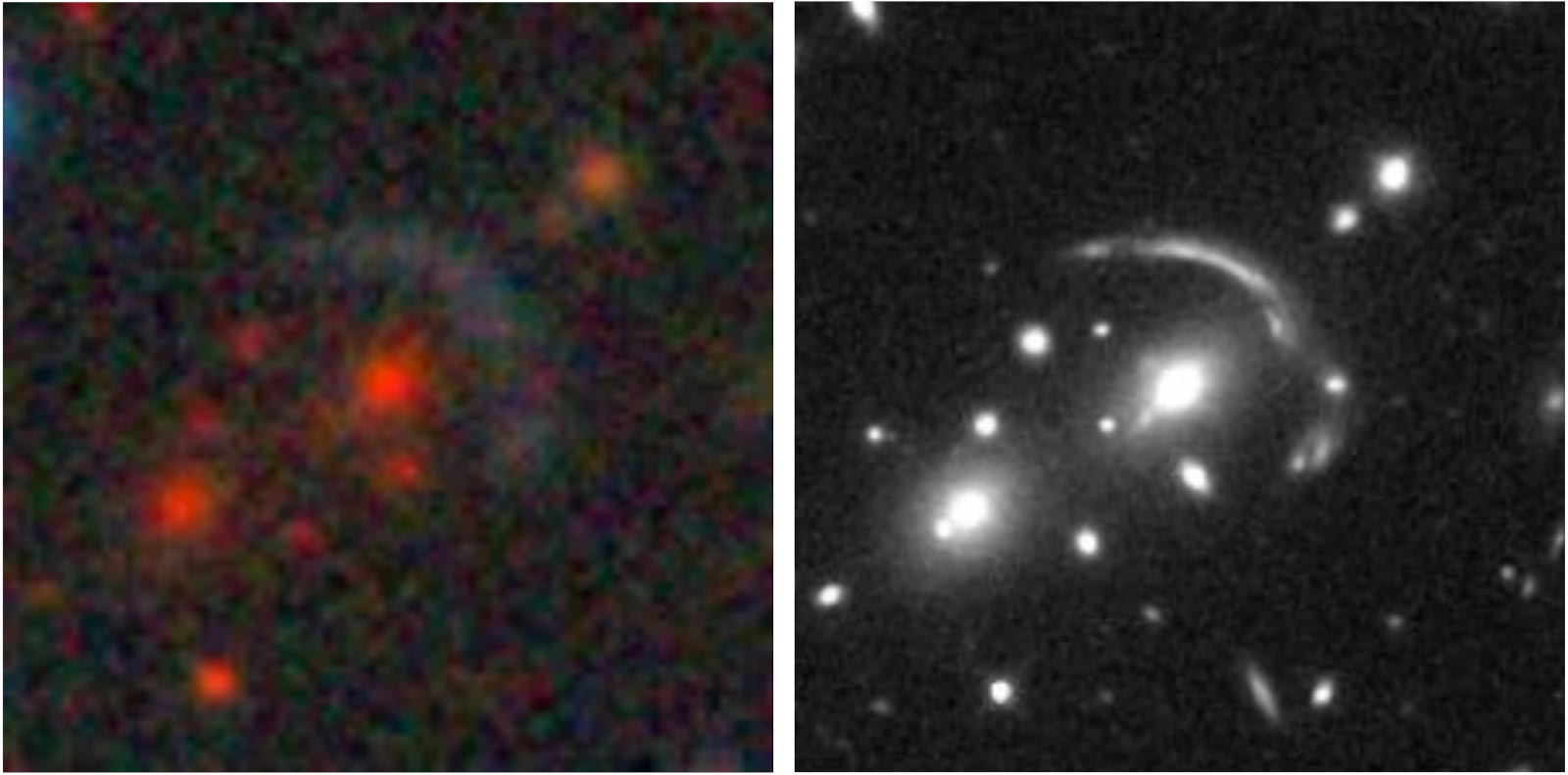
The lens candidates were identified with the assistance of a neural network, which is a form of artificial intelligence in which the computer program is trained to gradually improve its image-matching over time to provide an increasing success rate in identifying lenses. Computerized neural networks are inspired by the biological network of neurons in the human brain.
“It takes hours to train the neural network,” Huang said. “There is a very sophisticated fitting model of ‘What is a lens?’ and ‘What is not a lens?’”
There was some painstaking manual analysis of lensing images to help pick the best images to train the network from tens of thousands of images, Huang noted. He recalled one Saturday during which he sat down with student researchers for the entire day to pore over tens of thousands of images to develop sample lists of lenses and non-lenses.
“We didn’t just select these at random,” Huang said. “We had to augment this set with hand-selected examples that look like lenses but are not lenses,” for example, “and we selected those that could be potentially confusing.”
Student involvement was key in the study, he added. “The students worked diligently on this project and solved many tough problems, all while taking a full load of classes,” he said. One of the students who worked on the study, Christopher Storfer, was later selected to participate in the DOE Science Undergraduate Laboratory Internship (SULI) program at Berkeley Lab.
Researchers have already improved upon the algorithm that was used in the latest study to speed up the identification of possible lenses. While an estimated 1 in 10,000 galaxies acts as a lens, the neural network can eliminate most of the non-lenses. “Rather than going through 10,000 images to find one, now we have just a few tens,” he said.
The neural network was originally developed for The Strong Gravitational Lens Finding Challenge, a programming competition that ran from November 2016 to February 2017 that motivated the development of automated tools for finding strong lenses.
With a growing body of observational data, and new telescope projects like DESI and the Large Synoptic Survey Telescope (LSST) that is now scheduled to start up in 2023, there is a heated competition to mine this data using sophisticated artificial intelligence tools, Schlegel said.
“That competition is good,” he said. A team based in Australia, for example, also found many new lensing candidates using a different approach. “About 40 percent of what they found we didn’t,” and likewise the study that Schlegel participated in found many lensing candidates that the other team hadn’t.
Huang said the team has expanded its search for lenses in other sources of sky-imaging data, and the team is also considering whether to plug into a broader set of computing resources to expedite the hunt.
“The goal for us is to reach 1,000” new lensing candidates, Schlegel said.
Reference: “Finding Strong Gravitational Lenses in the DESI DECam Legacy Survey” by X. Huang, C. Storfer, V. Ravi, A. Pilon, M. Domingo, D. J. Schlegel, S. Bailey, A. Dey, R. R. Gupta, D. Herrera, S. Juneau, M. Landriau, D. Lang, A. Meisner, J. Moustakas, A. D. Myers, E. F. Schlafly, F. Valdes, B. A. Weaver, J. Yang and C. Yèche, 7 May 2020, The Astrophysical Journal.
DOI: 10.3847/1538-4357/ab7ffb
NERSC is a DOE Office of Science User Facility.
Never miss a breakthrough: Join the SciTechDaily newsletter.
Follow us on Google and Google News.
1 Comment
Fantastic.. And good luck !