
Close Menu
    Facebook X (Twitter) Instagram
    SciTechDaily
    • Biology
    • Chemistry
    • Earth
    • Health
    • Physics
    • Science
    • Space
    • Technology
    Facebook X (Twitter) Pinterest YouTube RSS
    SciTechDaily
    Home»Space»Gravitational Lenses: Spyglasses Into the Universe
    Space

    Gravitational Lenses: Spyglasses Into the Universe

    By ESA/HubbleOctober 21, 20221 Comment4 Mins Read
    Facebook Twitter Pinterest Telegram LinkedIn WhatsApp Email Reddit
    Share
    Facebook Twitter LinkedIn Pinterest Telegram Email Reddit
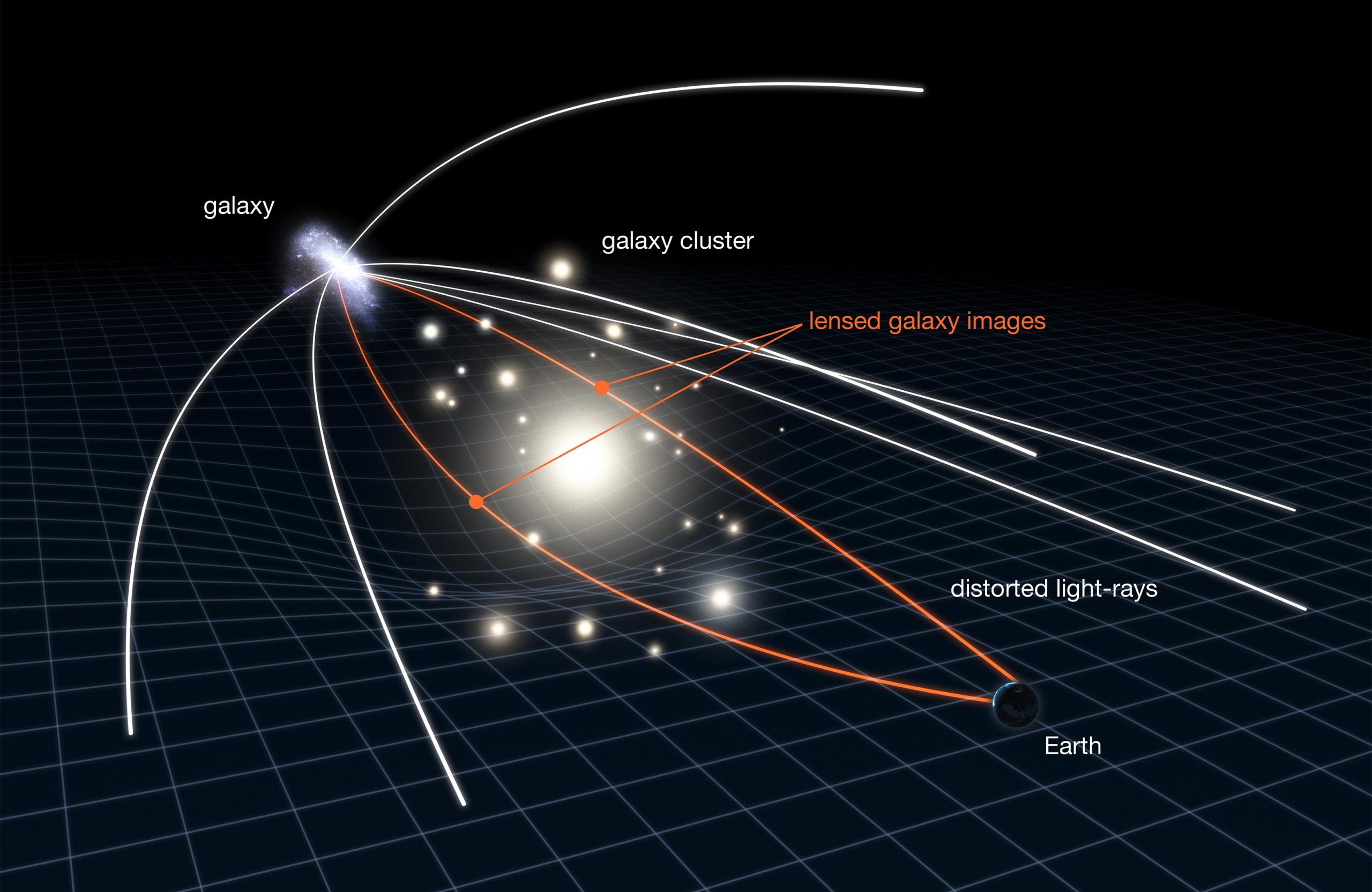
    Gravitational Lensing in Action
    This illustration depicts a phenomenon known as gravitational lensing, which is used by astronomers to study very distant and very faint galaxies. Note that the scale has been greatly exaggerated in this diagram. In reality, the distant galaxy is much further away and much smaller.
    Lensing clusters are clusters of elliptical galaxies whose gravity is so strong that they bend the light from the galaxies behind them. This produces distorted, and often multiple images of the background galaxy. But despite this distortion, gravitational lenses allow for greatly improved observations as gravity bends the light’s path towards Hubble, amplifying the light and making otherwise invisible objects observable.
    Credit: NASA, ESA & L. Calçada

    Hubble Space Telescope has played a crucial role in observing gravitational lensing, enabling the study of distant galaxies, dark matter, and dark energy. 

    Light does not always travel in straight lines. As Einstein predicted in his Theory of General Relativity, massive objects will deform the fabric of space itself. When light passes one of these massive objects, such as a cluster of galaxies, its path is changed slightly.

    This effect, called gravitational lensing, is only visible in rare cases and only the best telescopes can observe the related phenomena.
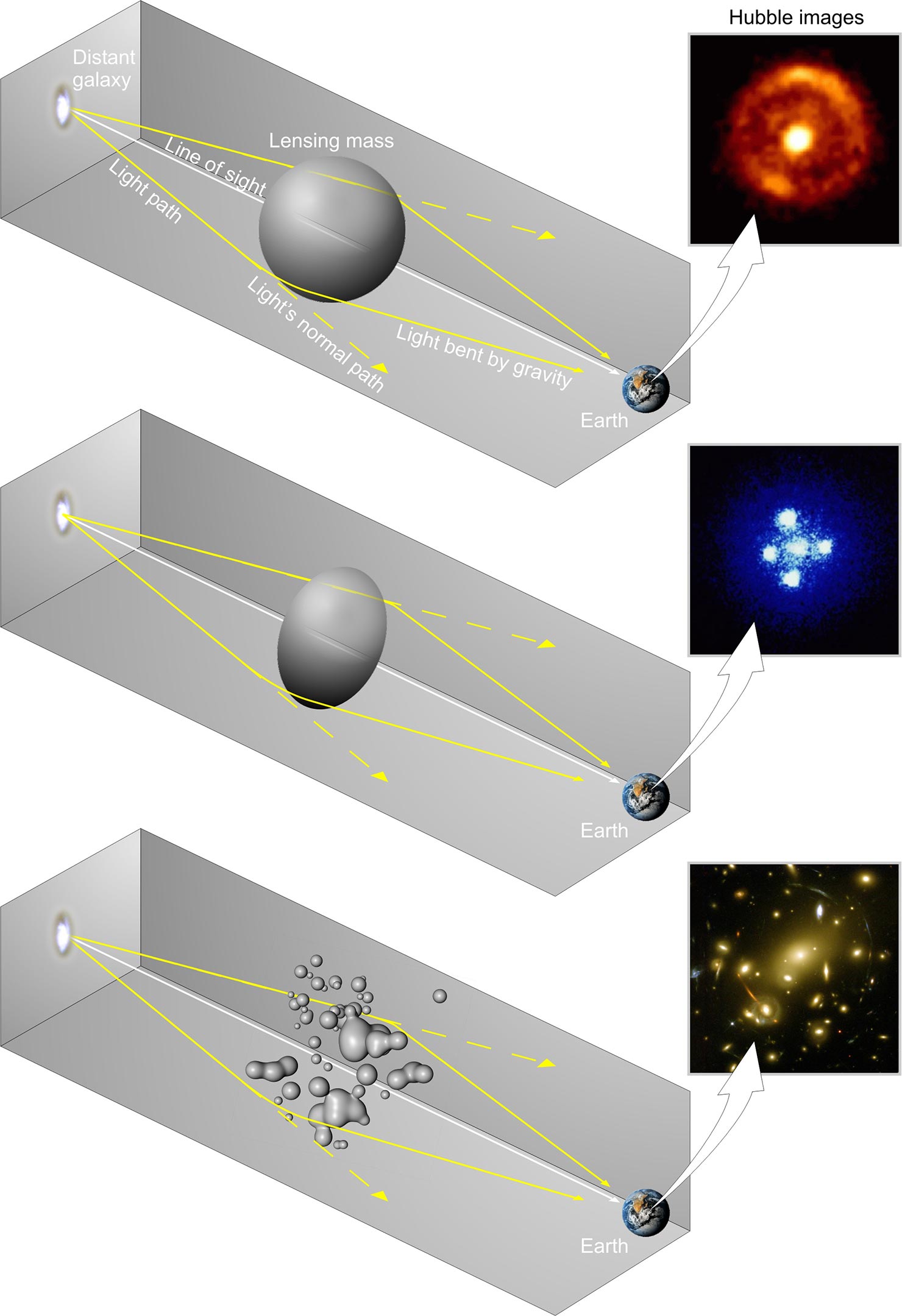
    Different Types of Gravitational Lenses
    Gravitational lenses produce different shaped images depending on the shape of the lensing body. If the lens is spherical then the image appears as an Einstein ring (in other words as a ring of light) (top); if the lens is elongated then the image is an Einstein cross (it appears split into four distinct images) (middle), and if the lens is a galaxy cluster, like Abell 2218, then arcs and arclets (banana-shaped images) of light are formed (bottom). Credit: European Space Agency

    Hubble’s sensitivity and high resolution allow it to see faint and distant gravitational lenses that cannot be detected with ground-based telescopes whose images are blurred by the Earth’s atmosphere. The gravitational lensing results in multiple images of the original galaxy each with a characteristically distorted banana-like shape or even into rings.
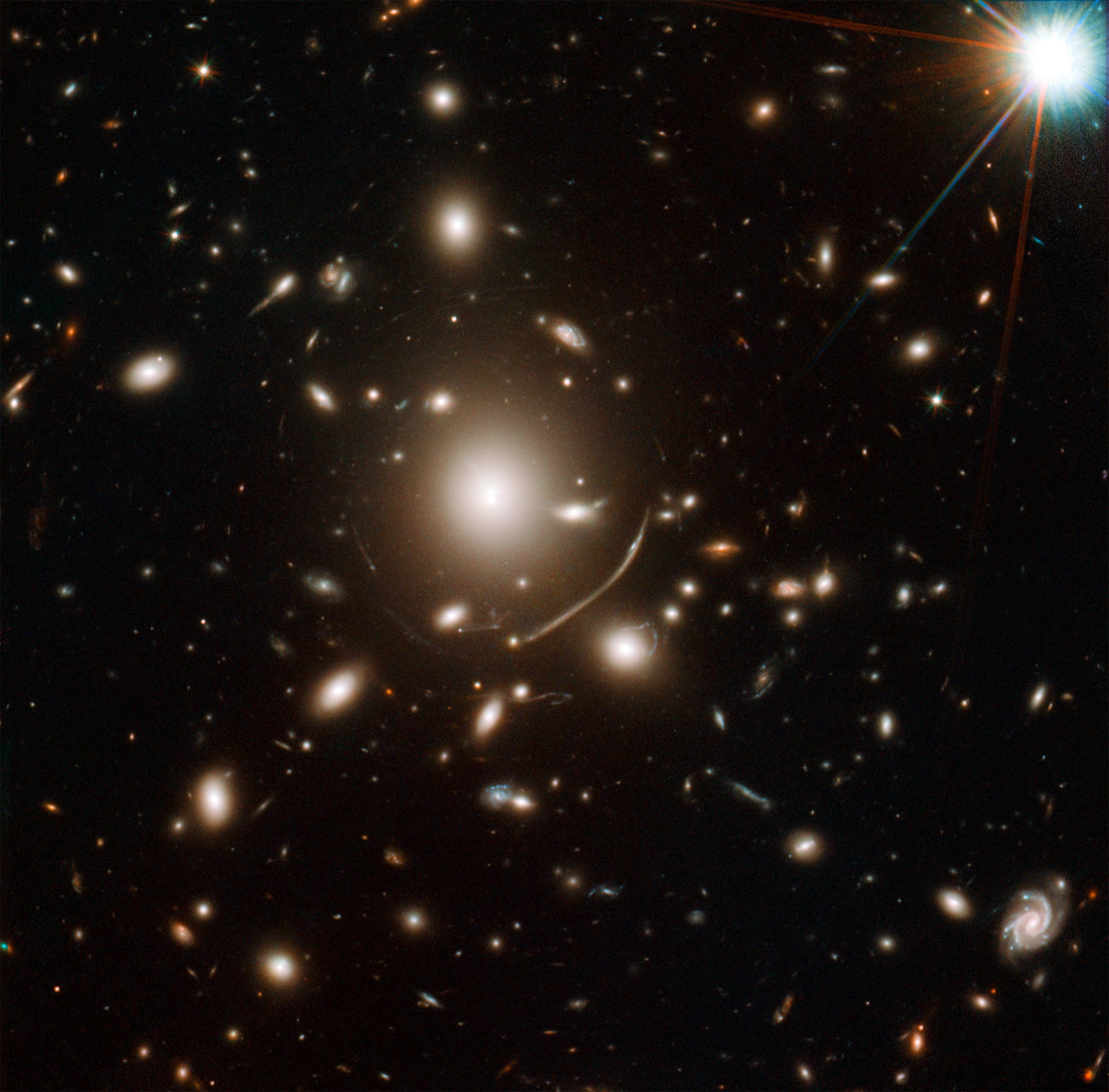
    Lensing Cluster Abell 383
    The giant galaxy cluster in the center of this image contains so much dark matter mass that its gravity bends the light of more distant objects. This means that for very distant galaxies in the background, the cluster’s gravitational field acts as a sort of magnifying glass, bending and concentrating the distant object’s light towards Hubble. These gravitational lenses are one tool astronomers can use to extend Hubble’s vision beyond what it would normally be capable of observing. This way some of the very first galaxies in the Universe can be studied by astronomers. The lensing effect can also be used to determine the distribution of matter — both ordinary and dark matter — within the cluster. Credit: NASA, ESA, J. Richard (CRAL) and J.-P. Kneib (LAM), Acknowledgment: Marc Postman (STScI)

    Hubble was the first telescope to resolve details within these multiple banana-shaped arcs. Thanks to its sharp vision, it can reveal the shape and internal structure of the lensed background galaxies directly. In this way one can easily match the different arcs coming from the same background object — be it a galaxy or even a supernova — by eye.

    Gravitational lensing can be used to ‘weigh’ clusters because the amount of lensing depends on the total mass of the cluster. This has substantially improved our understanding of the distribution of the ‘hidden’ dark matter in galaxy clusters and hence in the Universe as a whole. The effect of gravitational lensing also allowed a first step towards revealing the mystery of the dark energy.

    As gravitational lenses function as magnification glasses it is possible to use them to study distant galaxies from the early Universe, which otherwise would be impossibly faint to see due to their great distance from Earth.

    The article on the composition of the Universe has more details on Hubble’s work on dark matter.

    “When we first observed the galaxy cluster Abell 2218 with Hubble in 1995 we mainly aimed at studying the cluster and its galaxies. But we got a surprise. The images showed dozens and dozens of gravitationally lensed arcs. When we showed these ultrasharp images to our colleagues they could immediately see the importance of using gravitational lensing as a cosmological tool.”

    Richard Ellis, Astronomer, University of Cambridge and California Institute of Technology

    Never miss a breakthrough: Join the SciTechDaily newsletter.
    Follow us on Google and Google News.

    Astronomy Astrophysics European Space Agency Gravitational Lensing
    Share. Facebook Twitter Pinterest LinkedIn Email Reddit

    Related Articles

    Cosmic Leviathan: Hubble Unveils an Exceptionally Massive Galaxy Cluster

    Astronomy & Astrophysics 101: Gravitational Lensing

    Hubble Reveals Some of the Earliest Known Galaxies

    Planck Spots a Bridge of Hot Gas Connecting Galaxy Clusters

    Hubble Views Abell 2261, An Elliptical Galaxy With an Unusually Large Core

    Satellites Monitor the Colliding Winds of O-Type Stars

    Herschel Discovers Water Vapor in a Molecular Cloud on the Verge of Star Formation

    Planck Satellite Observations May Help Solve the Mystery of Dark Matter

    Hubble Captures Image of Compact Blue Dwarf Galaxy UGC 5497

    1 Comment

    1. bhakta_joe on October 24, 2022 3:10 am

      I am still chuckling at the PBS Spacetime episode on this, where this point in space was referred to as “The Locus of Focus Hocus Pocus” 🙂

      Reply
    Leave A Reply Cancel Reply

    • Facebook
    • Twitter
    • Pinterest
    • YouTube

    Don't Miss a Discovery

    Subscribe for the Latest in Science & Tech!

    Trending News

    Scientists Discover How Coffee Impacts Memory, Mood, and Gut Health

    Why Did the Neanderthals Disappear? Scientists Reveal Humans Had a Hidden Advantage

    Physicists Propose Strange Experiment Where Time Goes Quantum

    Magnesium Magic: New Drug Melts Fat Even on a High-Fat, High-Sugar Diet

    Weight-Loss Drugs Like Ozempic May Come With an Unexpected Cost

    Mezcal “Worm” in a Bottle Mystery: DNA Testing Reveals a Surprise

    New Research Reveals That Your Morning Coffee Activates an Ancient Longevity Switch

    This Is What Makes You Irresistible to Mosquitoes

    Follow SciTechDaily
    • Facebook
    • Twitter
    • YouTube
    • Pinterest
    • Newsletter
    • RSS
    SciTech News
    • Biology News
    • Chemistry News
    • Earth News
    • Health News
    • Physics News
    • Science News
    • Space News
    • Technology News
    Recent Posts
    • Quantum Breakthrough Turns Simple Forces Into Powerful New Interactions
    • Blue Origin’s New Moon Lander Passes a Crucial Test for NASA Missions
    • NASA Fires Up Record-Breaking Plasma Thruster for Future Mars Missions
    • This Popular Supplement May Boost Your Brain, Not Just Your Muscles
    • What Happened in Childhood Could Be Causing Your Gut Issues Today
    Copyright © 1998 - 2026 SciTechDaily. All Rights Reserved.
    • Science News
    • About
    • Contact
    • Editorial Board
    • Privacy Policy
    • Terms of Use

    Type above and press Enter to search. Press Esc to cancel.