
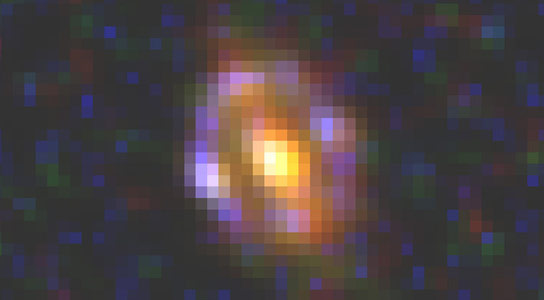
Astronomers have detected the most distant gravitational lens yet, a lensing mass so distant that the light, after having been deflected, has traveled 9.4 billion years to reach us.
A team of astronomers led by Arjen van der Wel from the Max Planck Institute for Astronomy (MPIA) has found the most distant gravitational lens yet – a galaxy that, as predicted by Albert Einstein’s general theory of relativity, deflects and intensifies the light of an even more distant object. The discovery provides a rare opportunity to directly measure the mass of a distant galaxy. But it also poses a mystery: Lenses of this kind should be exceedingly rare! Given this and recent other finds, astronomers either have been phenomenally lucky – or, more likely, they have underestimated substantially the number of small, very young galaxies in the early universe.
Light is affected by gravity, and light passing a distant galaxy will be deflected as a result. Since the first find in 1979, numerous such gravitational lenses have been discovered. In addition to providing tests of Einstein’s theory of general relativity, gravitational lenses have proved to be valuable tools. Notably, one can determine the mass of the matter that is bending the light – including the mass of the still-enigmatic Dark Matter, which does not emit or absorb light and can only be detected via its gravity. Also, the lens magnifies the background light source, acting as a natural telescope that allows astronomers a more detailed look at distant galaxies than what is normally possible.
Gravitational lenses consist of two objects: One that is further away and supplies the light, and the other, the lensing mass or gravitational lens, which sits between us and the distant light source, and whose gravity deflects the light. When the observer, the lens, and the distant light source are precisely aligned, the observer sees an Einstein ring: a perfect circle of light that is the projected and greatly magnified image of the distant light source.
Now, astronomers have found the most distant gravitational lens yet. MPIA’s Arjen van der Wel explains: “The discovery was completely by chance. I had been reviewing observations from an earlier project with the goal of measuring masses of old, distant galaxies by looking at the motion of their stars. Among the galaxy spectra” – the rainbow-like split of a galaxy’s light into myriads of different shades of color – I noticed a galaxy that was decidedly odd. It looked like an extremely young galaxy, and at an even larger distance than I was aiming for. It shouldn’t even have been part of our observing program!
Van der Wel followed up the spectra, which were taken with the Large Binocular Telescope in Arizona, by looking at images taken with the Hubble Space Telescope as part of the CANDELS and COSMOS surveys. The object looked like an old galaxy, a plausible target for the original observing program, but with some irregular features which, he suspected, meant that he was looking at a gravitational lens. Combining the available images and removing the haze of the lensing galaxy’s collection of stars, the result was very clear: an almost perfect Einstein ring, indicating a gravitational lens with very precise alignment of the lens and the background light source (0.01 arcseconds).
The lensing mass is so distant that the light, after having been deflected, has traveled 9.4 billion years to reach us (redshift z = 1.53; compare this with the total age of the universe of 13.8 billion years). The previous record holder was found thirty years ago, and it took less than 8 billion years for its light to reach us (z ∼ 1).
Not only is this a new record, the object also serves an important purpose: The amount of distortion caused by the lensing galaxy allows for a direct measurement of its mass. This provides an independent test for astronomers’ usual methods of estimating distant galaxy masses – which rely on extrapolation from their nearby cousins. Fortunately for astronomers, their usual methods pass the test.
But the discovery also poses a puzzle. Gravitational lenses are the result of a chance alignment. In this case, the alignment is very precise. To make matters worse, the magnified object is a so-called star-bursting dwarf galaxy: a comparatively light galaxy (only about 100 million solar masses’ worth of stars), but extremely young (about 10 – 40 million years old) and producing new stars at an enormous rate. The chances for such peculiar galaxies to be gravitationally lensed are very small. Yet this is the second star-bursting dwarf galaxy found to be lensed. Either the astronomers have been phenomenally lucky. Or starbursting dwarf galaxies are much more common than previously thought, forcing astronomers to re-think their models of galaxy evolution.
Van der Wel concludes: “This has been a weird and interesting discovery. It was a completely serendipitous find, it combines two rather disparate topics I have been working on – massive, old galaxies, and young, starbursting dwarfs –, and it has the potential to start a new chapter in our description of galaxy evolution in the early universe.”
Reference: “Discovery of a Quadruple Lens in CANDELS with a Record Lens Redshift z=1.53” by A. van der Wel, G. van de Ven, M. Maseda, H. W. Rix, G. H. Rudnick, A. Grazian, S. L. Finkelstein, D. C. Koo, S. M. Faber, H. C. Ferguson, A. M. Koekemoer, N. A. Grogin and D. D. Kocevski, 18 October 2013, The Astrophysical Journal Letters.
DOI: 10.1088/2041-8205/777/1/L17
arXiv:1309.2826
Never miss a breakthrough: Join the SciTechDaily newsletter.
Follow us on Google and Google News.
5 Comments
What would happen if a black hole “swallowed up” an entire galaxy, and how might this be observed? Have such things been looked for? I suspect such objects would offer some gravitational lensing on it’s own.
I think that seeing with all the advancements in science it the last 50 years. We will start to find more and more strange and wonderful things as we look into the stars. Think of all the new discovers we have made in the last 10 years, and this one we have here. Who knows what we will find tomorrow as we look into the sky.
I love these articles, but whoever writes the constantly misuses the word “further” to mean “farther.” The worss have entirely different roots. Please use farther when referring to distance. Further. Eans, in adition too. Sorry, but in an esteemed publication like this I expect proper grammar.
Thanks for your feedback. Like you, I use farther when referring to distance when I write, however, further is also correct. According to my dictionary further and farther can be used interchangeably when referring to distance.
Also remember that we have an International audience and authorship. I believe that in America it is most common to use farther when referring to a physical distance (but use further for a metaphorical or figurative distance), but in Britain it seems that further is generally preferred over farther for any sense of the word.
The article says that a baby galaxy at a far off distance had been detected by gravitational lensing by some dark matter or black hole in between. But the comments unnecessarily got diverted to ‘further’ and ‘farther’ reducing it to an English high school class. Our universe is at least 13 billion light years old and if the light has travelled 9.4 billion light years in the experiment, we can be happy to look farther in the Universe something close to the Big Bang epoch.Thank You.