
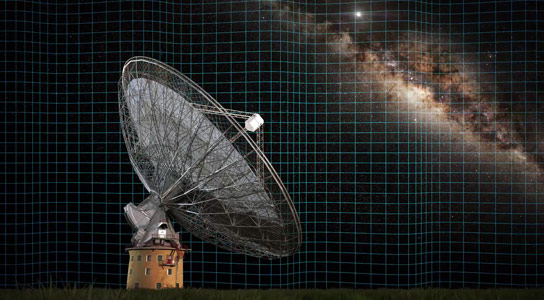
Using data from the CSIRO Parkes Radio Telescope, astronomers use gravitational waves to better understand the growth of massive black holes.
Supermassive black holes: every large galaxy’s got one. But here’s a real conundrum: how did they grow so big?
A paper in today’s issue of Science pits the front-running ideas about the growth of supermassive black holes against observational data — a limit on the strength of gravitational waves, obtained with CSIRO’s Parkes radio telescope in eastern Australia.
“This is the first time we’ve been able to use information about gravitational waves to study another aspect of the Universe — the growth of massive black holes,” co-author Dr Ramesh Bhat from the Curtin University node of the International Center for Radio Astronomy Research (ICRAR) said.
“Black holes are almost impossible to observe directly, but armed with this powerful new tool we’re in for some exciting times in astronomy. One model for how black holes grow has already been discounted, and now we’re going to start looking at the others.”
The study was jointly led by Dr. Ryan Shannon, a Postdoctoral Fellow with CSIRO, and Mr. Vikram Ravi, a PhD student co-supervised by the University of Melbourne and CSIRO.
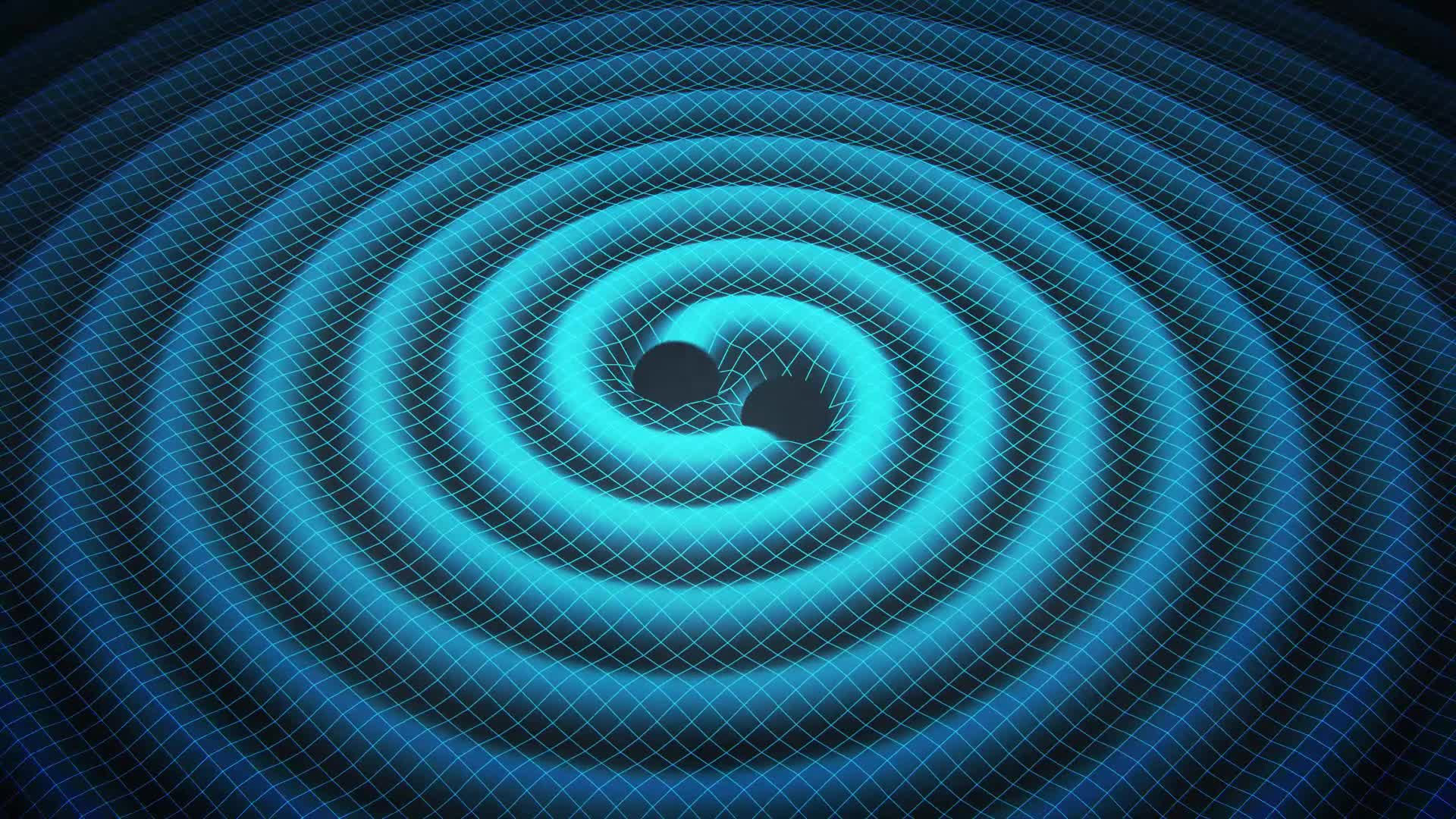
Einstein predicted gravitational waves — ripples in space-time, generated by massive bodies changing speed or direction, bodies like pairs of black holes orbiting each other.
When galaxies merge, their central black holes are doomed to meet. They first waltz together then enter a desperate embrace and merge.
“When the black holes get close to meeting they emit gravitational waves at just the frequency that we should be able to detect,” Dr Bhat said.
Played out again and again across the Universe, such encounters create a background of gravitational waves, like the noise from a restless crowd.
Astronomers have been searching for gravitational waves with the Parkes radio telescope and a set of 20 small, spinning stars called pulsars.
Pulsars act as extremely precise clocks in space. The arrival time of their pulses on Earth are measured with exquisite precision, to within a tenth of a microsecond.
When the waves roll through an area of space-time, they temporarily swell or shrink the distances between objects in that region, altering the arrival time of the pulses on Earth.
The Parkes Pulsar Timing Array (PPTA), and an earlier collaboration between CSIRO and Swinburne University, together provide nearly 20 years’ worth of timing data. This isn’t long enough to detect gravitational waves outright, but the team say they’re now in the right ballpark.
“The PPTA results are showing us how low the background rate of gravitational waves is,” said Dr Bhat.
“The strength of the gravitational wave background depends on how often supermassive black holes spiral together and merge, how massive they are, and how far away they are. So if the background is low, that puts a limit on one or more of those factors.”
Armed with the PPTA data, the researchers tested four models of black-hole growth. They effectively ruled out black holes gaining mass only through mergers, but the other three models are still a possibility.
Dr Bhat also said the Curtin University-led Murchison Widefield Array (MWA) radio telescope will be used to support the PPTA project in the future.
“The MWA’s large view of the sky can be exploited to observe many pulsars at once, adding valuable data to the PPTA project as well as collecting interesting information on pulsars and their properties,” Dr Bhat said.
Reference: “Gravitational-Wave Limits from Pulsar Timing Constrain Supermassive Black Hole Evolution” by R. M. Shannon, V. Ravi, W. A. Coles, G. Hobbs, M. J. Keith, R. N. Manchester, J. S. B. Wyithe, M. Bailes, N. D. R. Bhat, S. Burke-Spolaor, J. Khoo, Y. Levin, S. Osłowski, J. M. Sarkissian, W. van Straten, J. P. W. Verbiest and J.-B. Wang, 18 October 2013, Science.
DOI: 10.1126/science.1238012
arXiv:1310.4569
Never miss a breakthrough: Join the SciTechDaily newsletter.
Follow us on Google and Google News.