
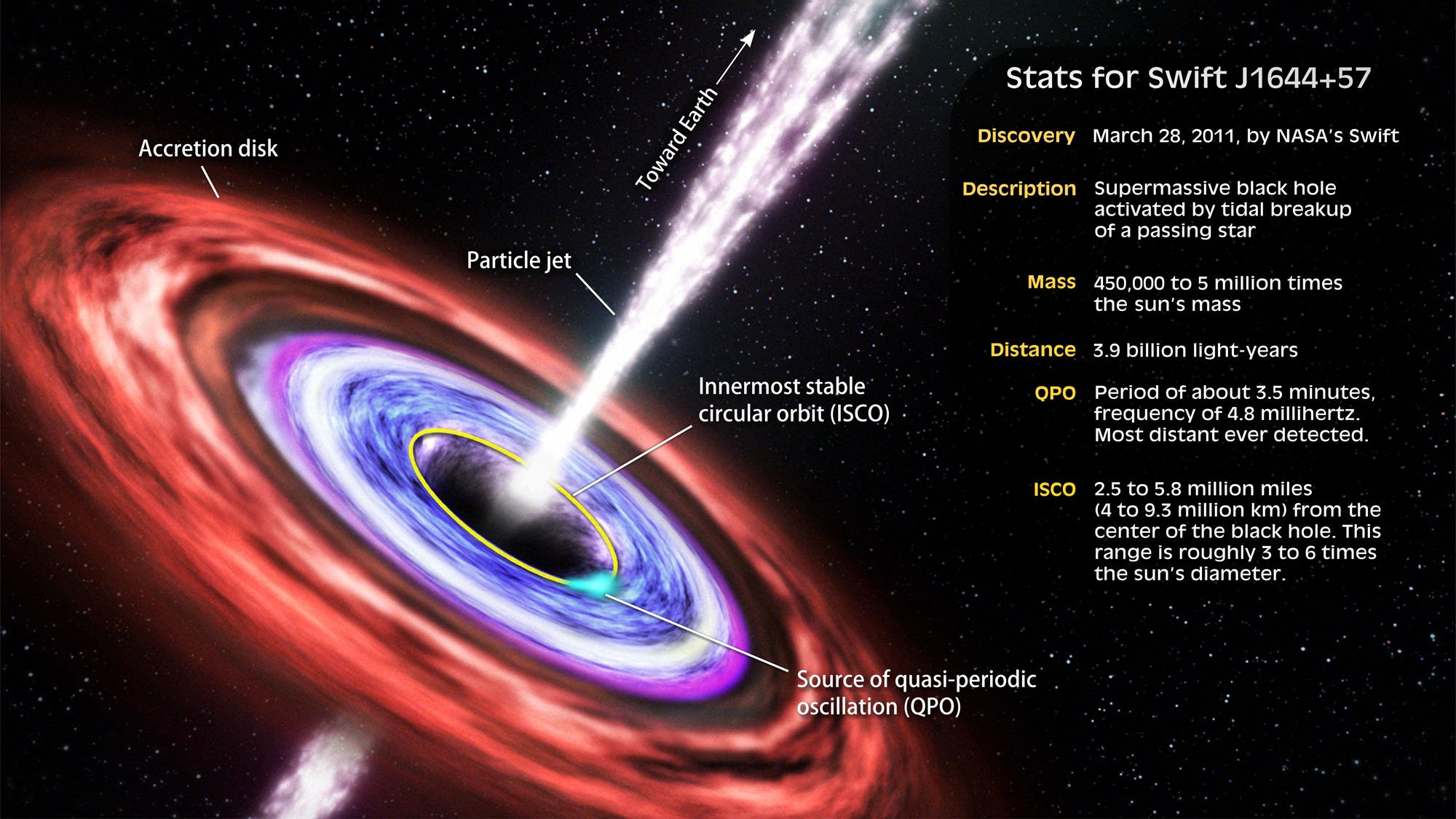
A newly published study describes the X-ray signal, called a quasi-periodic oscillation or QPO, that was observed the days following the last years discovery of Swift J1644+57, a quiescent black hole in a distant galaxy that erupted after shredding and consuming a passing star.
Last year, astronomers discovered a quiescent black hole in a distant galaxy that erupted after shredding and consuming a passing star. Now researchers have identified a distinctive X-ray signal observed in the days following the outburst that comes from matter on the verge of falling into the black hole.
This tell-tale signal, called a quasi-periodic oscillation or QPO, is a characteristic feature of the accretion disks that often surround the most compact objects in the universe — white dwarf stars, neutron stars, and black holes. QPOs have been seen in many stellar-mass black holes, and there is tantalizing evidence for them in a few black holes that may have middleweight masses between 100 and 100,000 times the sun’s.
On March 28, 2011, NASA’s Swift detected intense X-ray flares thought to be caused by a black hole devouring a star. In one model, illustrated here, a sun-like star on an eccentric orbit plunges too close to its galaxy’s central black hole. About half of the star’s mass feeds an accretion disk around the black hole, which in turn powers a particle jet that beams radiation toward Earth. Credit: NASA’s Goddard Space Flight Center/Conceptual Image Lab
Until the new finding, QPOs had been detected around only one supermassive black hole — the type containing millions of solar masses and located at the centers of galaxies. That object is the Seyfert-type galaxy REJ 1034+396, which at a distance of 576 million light-years lies relatively nearby.
“This discovery extends our reach to the innermost edge of a black hole located billions of light-years away, which is really amazing. This gives us an opportunity to explore the nature of black holes and test Einstein’s relativity at a time when the universe was very different than it is today,” said Rubens Reis, an Einstein Postdoctoral Fellow at the University of Michigan in Ann Arbor. Reis led the team that uncovered the QPO signal using data from the orbiting Suzaku and XMM-Newton X-ray telescopes, a finding described in a paper published today in Science Express.
The X-ray source known as Swift J1644+57 — after its astronomical coordinates in the constellation Draco — was discovered on March 28, 2011, by NASA’s Swift satellite. It was originally assumed to be a more common type of outburst called a gamma-ray burst, but its gradual fade-out matched nothing that had been seen before. Astronomers soon converged on the idea that what they were seeing was the aftermath of a truly extraordinary event — the awakening of a distant galaxy’s dormant black hole as it shredded and gobbled up a passing star. The galaxy is so far away that light from the event had to travel 3.9 billion years before reaching Earth.
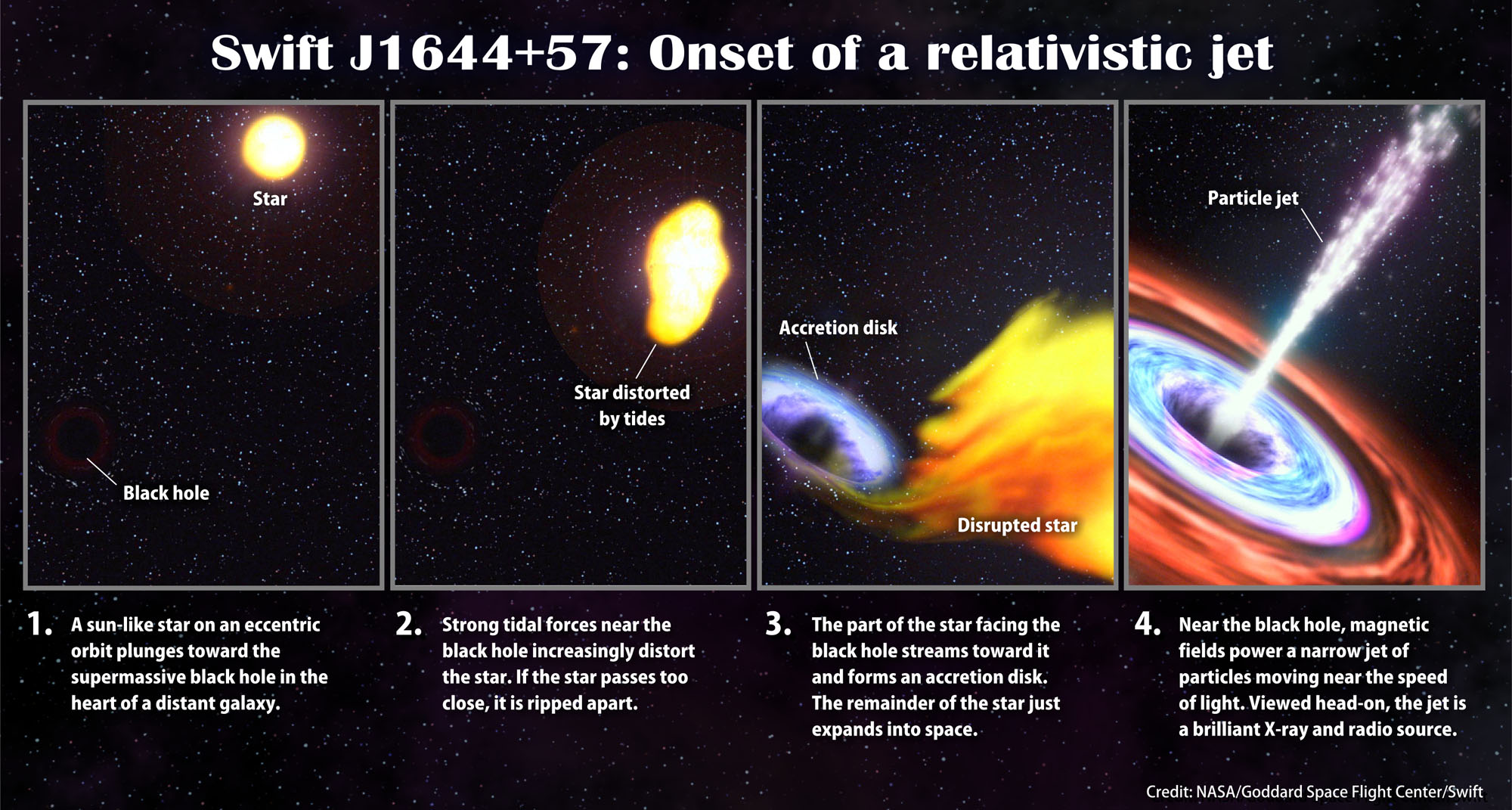
The star experienced intense tides as it reached its closest point to the black hole and was quickly torn apart. Some of its gas fell toward the black hole and formed a disk around it. The innermost part of this disk was rapidly heated to temperatures of millions of degrees, hot enough to emit X-rays. At the same time, through processes still not fully understood, oppositely directed jets perpendicular to the disk formed near the black hole. These jets blasted matter outward at velocities greater than 90 percent the speed of light along the black hole’s spin axis. One of these jets just happened to point straight at Earth.
Nine days after the outburst, Reis, Strohmayer and their colleagues observed Swift J1644+57 using Suzaku, an X-ray satellite operated by the Japan Aerospace Exploration Agency with NASA participation. About ten days later, they then began a longer monitoring campaign using the European Space Agency’s XMM-Newton observatory.
“Because matter in the jet was moving so fast and was angled nearly into our line of sight, the effects of relativity boosted its X-ray signal enough that we could catch the QPO, which otherwise would be difficult to detect at so great a distance,” said Tod Strohmayer, an astrophysicist and co-author of the study at NASA’s Goddard Space Flight Center in Greenbelt, Maryland.
As hot gas in the innermost disk spirals toward a black hole, it reaches a point astronomers refer to as the innermost stable circular orbit (ISCO). Any closer to the black hole and gas rapidly plunges into the event horizon, the point of no return. The inward spiraling gas tends to pile up around the ISCO, where it becomes tremendously heated and radiates a flood of X-rays. The brightness of these X-rays varies in a pattern that repeats at a nearly regular interval, creating the QPO signal.
The data show that Swift J1644+57’s QPO cycled every 3.5 minutes, which places its source region between 2.2 and 5.8 million miles (4 to 9.3 million km) from the center of the black hole, the exact distance depending on how fast the black hole is rotating. To put this in perspective, the maximum distance is only about 6 times the diameter of our sun. The distance from the QPO region to the event horizon also depends on rotation speed, but for a black hole spinning at the maximum rate theory allows, the horizon is just inside the ISCO.
“QPOs send us information from the very brim of the black hole, which is where the effects of relativity become most extreme,” Reis said. “The ability to gain insight into these processes over such a vast distance is a truly beautiful result and holds great promise.”
Reference: “A 200-Second Quasi-Periodicity After the Tidal Disruption of a Star by a Dormant Black Hole” by R. C. Reis, J. M. Miller, M. T. Reynolds, K. Gültekin, D. Maitra, A. L. Kingand and T. E. Strohmayer, 2 August 2012, Science.
DOI: 10.1126/science.1223940
Never miss a breakthrough: Join the SciTechDaily newsletter.
Follow us on Google and Google News.