
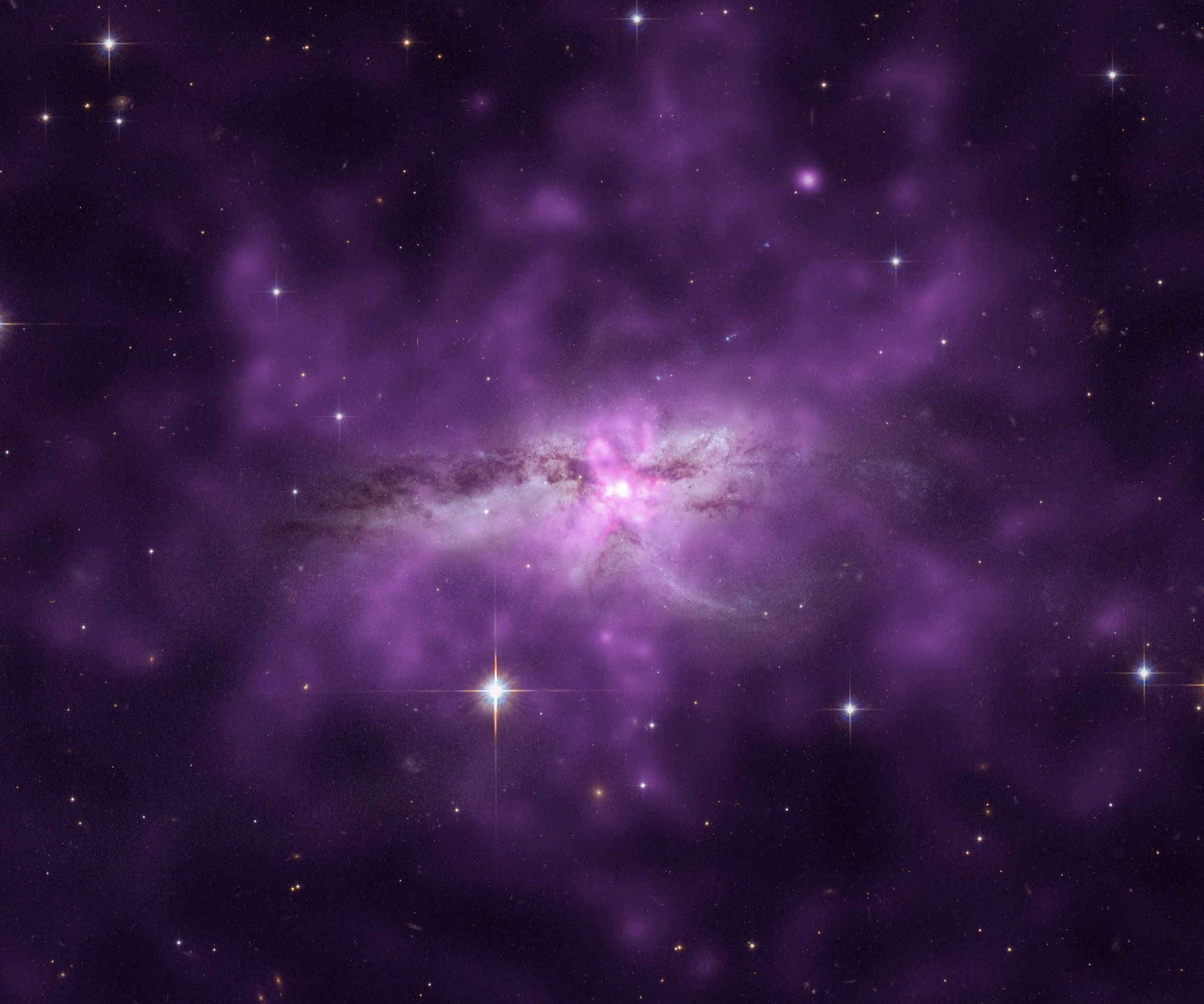
A burst of star formation that lasted for at least 200 million years may be responsible for a cloud of hot gas, which contains the mass of 10 billion Suns, spans 300,000 light-years, and radiates at more than 7 million degrees, that is surrounding two merging spiral galaxies.
Scientists have used Chandra to make a detailed study of an enormous cloud of hot gas enveloping two large, colliding galaxies. This unusually large reservoir of gas contains as much mass as 10 billion Suns, spans about 300,000 light-years, and radiates at a temperature of more than 7 million degrees.
This giant gas cloud, which scientists call a “halo,” is located in the system called NGC 6240. Astronomers have long known that NGC 6240 is the site of the merger of two large spiral galaxies similar in size to our own Milky Way. Each galaxy contains a supermassive black hole at its center. The black holes are spiraling toward one another, and may eventually merge to form a larger black hole.
Two large galaxies are colliding and scientists have used Chandra to make a detailed study of an enormous cloud of hot gas that surrounds them. This unusually large reservoir of gas contains as much mass as about 10 billion Suns, spans about 300,000 light years, and radiates at a temperature of more than 7 million degrees. This giant gas cloud, which scientists call a “halo,” is located in the system known as NGC 6240. As the galaxies – each about the size and shape of our Milky Way — merge, the gas contained in individual galaxy has been violently stirred up. This caused a baby boom of new stars that has lasted for at least 200 million years. During this burst of stellar birth, some of the most massive stars raced through their evolution and exploded relatively quickly as supernovas. According to researchers, this created new hot gas enriched with important elements — such as oxygen, neon, and magnesium — that expanded into and mixed with cooler gas that was already there. In the future, the two spiral galaxies will probably form one young elliptical galaxy over the course of millions of years. It is unclear, however, how much of the hot gas can be retained by this newly formed galaxy, or if it will be lost to surrounding space. Regardless, the collision in NGC 6240 offers the opportunity to witness a relatively nearby version of an event that was common in the early Universe. Credit: NASA/CXC/J. DePasquale
Another consequence of the collision between the galaxies is that the gas contained in each individual galaxy has been violently stirred up. This caused a baby boom of new stars that has lasted for at least 200 million years. During this burst of stellar birth, some of the most massive stars raced through their evolution and exploded relatively quickly as supernovas.
The scientists involved with this study argue that this rush of supernova explosions dispersed relatively high amounts of important elements such as oxygen, neon, magnesium, and silicon into the hot gas of the newly combined galaxies. According to the researchers, the data suggest that this enriched gas has slowly expanded into and mixed with cooler gas that was already there.
During the extended baby boom, shorter bursts of star formation have occurred. For example, the most recent burst of star formation lasted for about five million years and occurred about 20 million years ago in Earth’s timeframe. However, the authors do not think that the hot gas was produced just by this shorter burst.
The Universe is enormous and full of empty space. Light from the nearest star outside our solar system has to travel through empty black space for 4.2 years before it reaches our eyes, even though light moves faster than anything else in the Universe and we live in a very densely populated region of space! Yet somehow, despite all this empty space, galaxies crashing into each other is a fairly common sight. One such collision has been caught in this cosmic picture; which shows the enormous cloud of hot gas surrounding two large colliding galaxies called NGC 6240. Credit: NASA/CXC/April Jubett
What does the future hold for observations of NGC 6240? Most likely the two spiral galaxies will form one young elliptical galaxy over the course of millions of years. It is unclear, however, how much of the hot gas can be retained by this newly formed galaxy, rather than lost to surrounding space. Regardless, the collision offers the opportunity to witness a relatively nearby version of an event that was common in the early Universe when galaxies were much closer together and merged more often.
In this new composite image of NGC 6240, the X-rays from Chandra that reveal the hot gas cloud are colored purple. These data have been combined with optical data from the Hubble Space Telescope, which shows long tidal tails from the merging galaxies, extending to the right and bottom of the image.
A paper describing these new results on NGC 6240 is available online and appeared in the March 10, 2013 issue of The Astrophysical Journal
Reference “The Exceptional Soft X-ray Halo of the Galaxy Merger NGC 62400” by Emanuele Nardini, Junfeng Wang, Giuseppina Fabbiano, Martin Elvis, Silvia Pellegrini, Guido Risaliti, Margarita Karovska and Andreas Zezas, 27 February 2013, The Astrophysical Journal.
DOI: 10.1088/0004-637X/765/2/141
The authors in this study were Emanuele Nardini (Harvard-Smithsonian Center for Astrophysics, or CfA, Cambridge, MA and currently at Keele University, UK), Junfeng Wang (CfA and currently at Northwestern University, Evanston, IL), Pepi Fabbiano (CfA), Martin Elvis (CfA), Silvia Pellegrini (University of Bologna, Italy), Guido Risalti (INAF-Osservatorio Astrofisico di Arcetri, Italy and CfA), Margarita Karovska (CfA), and Andreas Zezas (University of Crete, Greece, and CfA).
NASA’s Marshall Space Flight Center in Huntsville, Alabama, manages the Chandra program for NASA’s Science Mission Directorate in Washington. The Smithsonian Astrophysical Observatory controls Chandra’s science and flight operations from Cambridge, Massachusetts.
Never miss a breakthrough: Join the SciTechDaily newsletter.
Follow us on Google and Google News.