
Close Menu
    Facebook X (Twitter) Instagram
    SciTechDaily
    • Biology
    • Chemistry
    • Earth
    • Health
    • Physics
    • Science
    • Space
    • Technology
    Facebook X (Twitter) Pinterest YouTube RSS
    SciTechDaily
    Home»Space»Spherical Phase of Planetary Nebula Abell 30
    Space

    Spherical Phase of Planetary Nebula Abell 30

    By SciTechDailyNovember 19, 2012No Comments3 Mins Read
    Facebook Twitter Pinterest Telegram LinkedIn WhatsApp Email Reddit
    Share
    Facebook Twitter LinkedIn Pinterest Telegram Email Reddit
    planetary nebula Abell 30
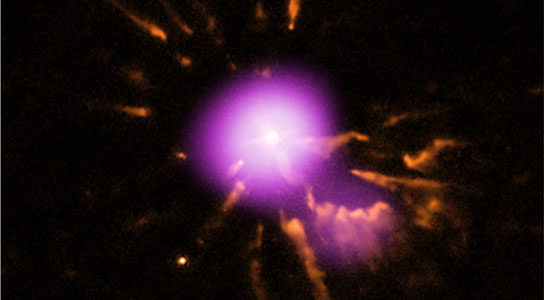
    The planetary nebula Abell 30 resides 5,500 light-years away from Earth.

    These new images of the planetary nebula Abell 30, which is located 5,500 light-years away from Earth, show one of the clearest views ever obtained of a special phase of evolution for these objects.

    A new study of A30 was published The Astrophysical Journal. The images are composites containing X-ray data from NASA’s Chandra X-ray Observatory in purple and Hubble Space Telescope’s data showing optical emission from oxygen ions in orange. The larger view contains data from Kitt Peak National Observatory and ESA’s XMM-Newton with oxygen once again in orange, hydrogen in green and blue, and X-ray emissions in purple.

    Abell 30
    The inset image on the right is a close-up view of A30 showing X-ray data from NASA’s Chandra X-ray Observatory in purple and Hubble Space Telescope data showing optical emission from oxygen ions in orange. On the left is a larger view showing optical and X-ray data from the Kitt Peak National Observatory and ESA’s XMM-Newton, respectively, where the optical data shows emission from oxygen (orange) and hydrogen (green and blue), and X-ray emission is colored purple. A planetary nebula is formed in the late stage of the evolution of a sun-like star, after it expands to become a red giant. In the case of A30, a planetary nebula formed but then the star briefly reverted to being a red giant. The evolution of the planetary nebula then restarted, making it reborn, a special phase of evolution that is rarely seen. Credit: Inset X-ray (NASA/CXC/IAA-CSIC/M.Guerrero et al); Inset Optical (NASA/STScI); Widefield X-ray (ESA/XMM-Newton); Widefield Optical (NSF/NOAO/KPNO)

    A planetary nebula — so called because it looks like a planet when viewed with a small telescope — is formed in the late stage of the evolution of a sun-like star. After having steadily produced energy for several billion years through the nuclear fusion of hydrogen into helium in its central region, or core, the star undergoes a series of energy crises related to the depletion of hydrogen and subsequent contraction of the core. These crises culminate in the star expanding a hundred-fold to become a red giant.

    Eventually, the outer envelope of the red giant is ejected and moves away from the star at a relatively sedate speed of less than 100,000 miles per hour. The star meanwhile is transformed from a cool giant into a hot, compact star that produces intense ultraviolet radiation and a fast wind of particles moving at about 6 million miles per hour. The interaction of the UV radiation and the fast wind with the ejected red giant envelope creates the planetary nebula, shown by the large spherical shell in the bigger image.

    In rare cases, nuclear fusion reactions in the region surrounding the star’s core heat the outer envelope of the star so much that it temporarily becomes a red giant again. The sequence of events — envelope ejection followed by a fast stellar wind — is repeated on a much faster scale than before, and a small-scale planetary nebula is created inside the original one. In a sense, the planetary nebula is reborn.

    Never miss a breakthrough: Join the SciTechDaily newsletter.
    Follow us on Google and Google News.

    Astronomy Astrophysics Chandra X-ray Observatory Galaxy Evolution NASA Nebula Popular
    Share. Facebook Twitter Pinterest LinkedIn Email Reddit

    Related Articles

    Astronomers Build Incredible 3D Visualization of Exploded Star Using NASA’s Great Observatories [Video]

    Chandra Reveals Why Giant Elliptical Galaxies Have Few Young Stars

    Data Reveals Dormant Black Hole Amidst Stellar Chaos

    NASA Data Suggests Black Holes Abundant Among the Earliest Stars

    Chandra Reveals an Enormous Cloud of Hot Gas Enveloping Two Colliding Galaxies

    One of the Most Efficient Star Making Galaxies Ever Observed

    Astronomers Discover Earliest Starburst Galaxy Ever Observed

    The Newly Discovered Phoenix Cluster Is Breaking Cosmic Records

    Data Reveals Swift J1644+57’s QPO Cycle

    Leave A Reply Cancel Reply

    • Facebook
    • Twitter
    • Pinterest
    • YouTube

    Don't Miss a Discovery

    Subscribe for the Latest in Science & Tech!

    Trending News

    Popular Sugar-Free Sweetener Linked to Liver Disease, Study Warns

    What Is Hantavirus? The Deadly Disease Raising Alarm Worldwide

    Scientists Just Discovered How the Universe Builds Monster Black Holes

    Scientists Unveil New Treatment Strategy That Could Outsmart Cancer

    A Simple Vitamin May Hold the Key to Treating Rare Genetic Diseases

    Scientists Think the Real Fountain of Youth May Be Hiding in Your Gut

    Ravens Don’t Follow Wolves, They Predict Them

    This Common Knee Surgery May Be Doing More Harm Than Good

    Follow SciTechDaily
    • Facebook
    • Twitter
    • YouTube
    • Pinterest
    • Newsletter
    • RSS
    SciTech News
    • Biology News
    • Chemistry News
    • Earth News
    • Health News
    • Physics News
    • Science News
    • Space News
    • Technology News
    Recent Posts
    • Popular Supplement Ingredient Linked to Shorter Lifespan in Men
    • Scientists May Have Found a Way To Repair Nerve Damage in Multiple Sclerosis
    • GLP-1 Weight Loss Linked To Dramatically Lower Risk of Sleep Apnea, Kidney Disease and More
    • Scientists Uncover the Surprising Source of Strange Clouds Near the Milky Way’s Supermassive Black Hole
    • This Dazzling Green Snake Was Hiding in Plain Sight for Decades
    Copyright © 1998 - 2026 SciTechDaily. All Rights Reserved.
    • Science News
    • About
    • Contact
    • Editorial Board
    • Privacy Policy
    • Terms of Use

    Type above and press Enter to search. Press Esc to cancel.