
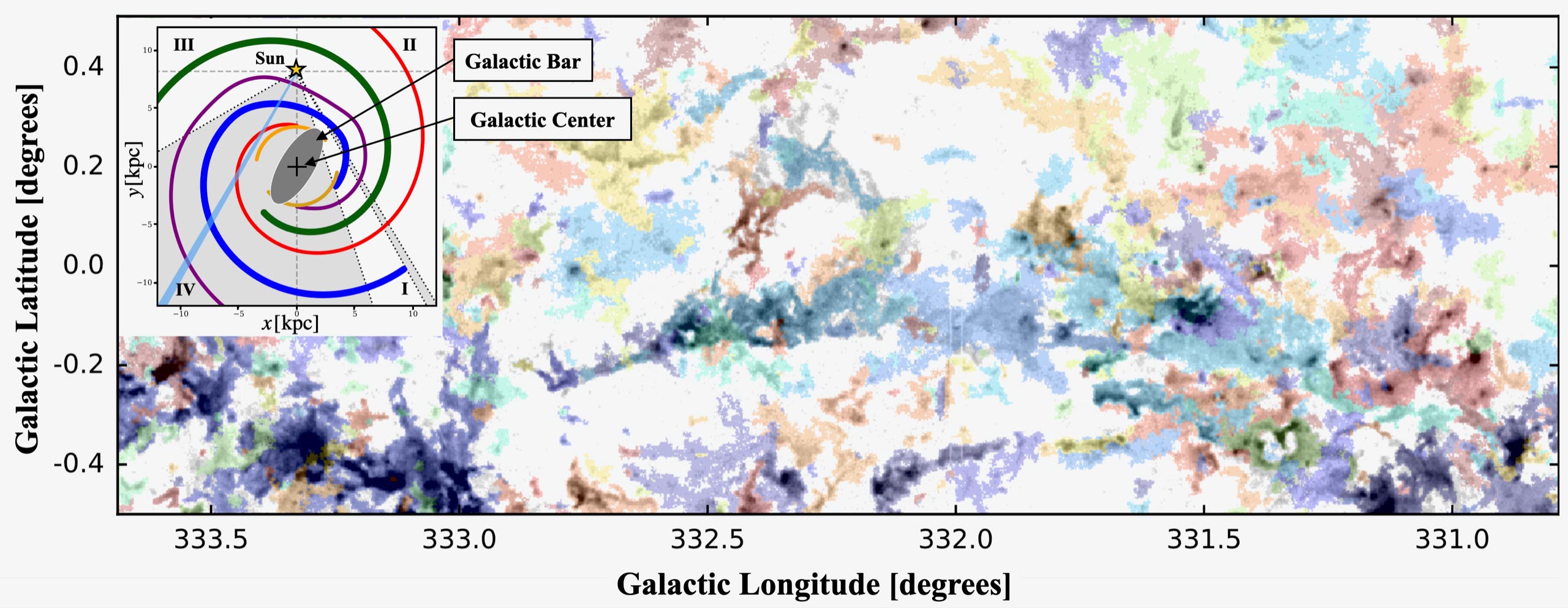
Survey of the sky pushes the boundaries of what we know about the structure of our galaxy.
Scientists from Cardiff University have helped produce a brand-new, three-dimensional survey of our galaxy, allowing them to peer into the inner structure and observe its star-forming processes in unprecedented detail.
The large-scale survey, called SEDIGISM (Structure, Excitation and Dynamics of the Inner Galactic Interstellar Medium), has revealed a wide range of structures within the Milky Way, from individual star-forming clumps to giant molecular clouds and complexes, that will allow astronomers to start pushing the boundaries of what we know about the structure of our galaxy.
Unveiling the Structure of the Milky Way
SEDIGISM has been unveiled through the publication of three separate papers in the Monthly Notices of the Royal Astronomical Society, authored by an international team of over 50 astronomers.
“With the publication of this unprecedentedly detailed map of cold clouds in our Milky Way, a huge observational effort comes to fruition”, says Frederic Schuller from the Max Planck Institute for Radio Astronomy (MPIfR), lead author of one of the three publications, presenting the data release.
Dr. Ana Duarte Cabral, a Royal Society University Research Fellow from Cardiff University’s School of Physics and Astronomy, was lead author on one of the papers and has provided a catalog of over 10,000 clouds of molecular gas in our Milky Way.
The Milky Way, named after its hazy appearance from Earth, is a spiral galaxy with an estimated diameter between 170,000 and 200,000 light-years which contains between 100–400 billion stars.
The Milky Way consists of a core region that is surrounded by a warped disk of gas and dust that provides the raw materials from which new stars are formed.
For Dr. Duarte Cabral, the new catalog of gas clouds will allow scientists to probe exactly how the spiral structure of our own Milky Way affects the life cycle of clouds, their properties, and ultimately the star formation that goes on within them.
“What is most exciting about this survey is that it can really help pin down the global galactic structure of the Milky Way, providing an astounding 3D view of the inner galaxy,” she said.
“With this survey we really have the ability to start pushing the boundaries of what we know about the global effects of the galactic structures and dynamics, in the distribution of molecular gas and star formation, because of the improved sensitivity, resolution, and the 3D view.”
How Molecular Gas Clouds Shape the Galaxy
The catalog of molecular gas clouds was created by measuring the rare isotope of the carbon monoxide molecule, 13CO, using the extremely sensitive 12-meter Atacama Pathfinder Experiment telescope on the Chajnantor plateau in Chile.
This allowed the team to produce more precise estimates of the mass of the gas clouds and discern information about their velocity, therefore providing a truly three-dimensional picture of the galaxy.
Dr. Duarte Cabral and colleagues are already beginning to tease out information from the vast amount of data at their disposal.
“The survey revealed that only a small proportion, roughly 10%, of these clouds have dense gas with ongoing star formation,” said James Urquhart from the University of Kent, the lead author of the third publication.
Challenging Previous Views of the Milky Way
Similarly, the results from the work led by Dr. Duarte Cabral suggest that the structure of the Milky Way is not that well defined and that the spiral arms are not that clear. They have also shown that the properties of clouds do not seem to be dependent on whether a cloud is located in a spiral arm or an inter-arm region, where they expected very different physics to be playing a role.
“Our results are already showing us that the Milky Way may not be a strong grand design type of spiral galaxy as we thought, but perhaps more flocculent in nature,” Dr. Duarte Cabral continued.
“This survey can be used by anyone that wants to study the kinematics or physical properties of individual molecular clouds or even make statistical studies of larger samples of clouds, and so in itself has a huge legacy value for the star formation community.”
References:
“The SEDIGISM survey: molecular clouds in the inner Galaxy” by A Duarte-Cabral, D Colombo, J S Urquhart, A Ginsburg, D Russeil, F Schuller, L D Anderson, P J Barnes, M T Beltrán, H Beuther, S Bontemps, L Bronfman, T Csengeri, C L Dobbs, D Eden, A Giannetti, J Kauffmann, M Mattern, S-N X Medina, K M Menten, M-Y Lee, A R Pettitt, M Riener, A J Rigby, A Traficante, V S Veena, M Wienen, F Wyrowski, C Agurto, F Azagra, R Cesaroni, R Finger, E Gonzalez, T Henning, A K Hernandez, J Kainulainen, S Leurini, S Lopez, F Mac-Auliffe, P Mazumdar, S Molinari, F Motte, E Muller, Q Nguyen-Luong, R Parra, J-P Perez-Beaupuits, F M Montenegro-Montes, T J T Moore, S E Ragan, A Sánchez-Monge, A Sanna, P Schilke, E Schisano, N Schneider, S Suri, L Testi, K Torstensson, P Venegas, K Wang and A Zavagno, 11 September 2020, Monthly Notices of the Royal Astronomical Society.
DOI: 10.1093/mnras/staa2480
“The SEDIGISM survey: First Data Release and overview of the Galactic structure” by F Schuller, J S Urquhart, T Csengeri, D Colombo, A Duarte-Cabral, M Mattern, A Ginsburg, A R Pettitt, F Wyrowski, L Anderson, F Azagra, P Barnes, M Beltran, H Beuther, S Billington, L Bronfman, R Cesaroni, C Dobbs, D Eden, M-Y Lee, S-N X Medina, K M Menten, T Moore, F M Montenegro-Montes, S Ragan, A Rigby, M Riener, D Russeil, E Schisano, A Sanchez-Monge, A Traficante, A Zavagno, C Agurto, S Bontemps, R Finger, A Giannetti, E Gonzalez, A K Hernandez, T Henning, J Kainulainen, J Kauffmann, S Leurini, S Lopez, F Mac-Auliffe, P Mazumdar, S Molinari, F Motte, E Muller, Q Nguyen-Luong, R Parra, J-P Perez-Beaupuits, P Schilke, N Schneider, S Suri, L Testi, K Torstensson, V S Veena, P Venegas, K Wang and M Wienen, 11 September 2020, Monthly Notices of the Royal Astronomical Society.
DOI: 10.1093/mnras/staa2369
“SEDIGISM-ATLASGAL: dense gas fraction and star formation efficiency across the Galactic disc” by J S Urquhart, C Figura, J R Cross, M R A Wells, T J T Moore, D J Eden, S E Ragan, A R Pettitt, A Duarte-Cabral, D Colombo, F Schuller, T Csengeri, M Mattern, H Beuther, K M Menten, F Wyrowski, L D Anderson, P J Barnes, M T Beltrán, S J Billington, L Bronfman, A Giannetti, J Kainulainen, J Kauffmann, M-Y Lee, S Leurini, S-N X Medina, F M Montenegro-Montes, M Riener, A J Rigby, A Sánchez-Monge, P Schilke, E Schisano, A Traficante and M Wienen, 11 September 2020, Monthly Notices of the Royal Astronomical Society.
DOI: 10.1093/mnras/staa2512
Never miss a breakthrough: Join the SciTechDaily newsletter.
Follow us on Google and Google News.