
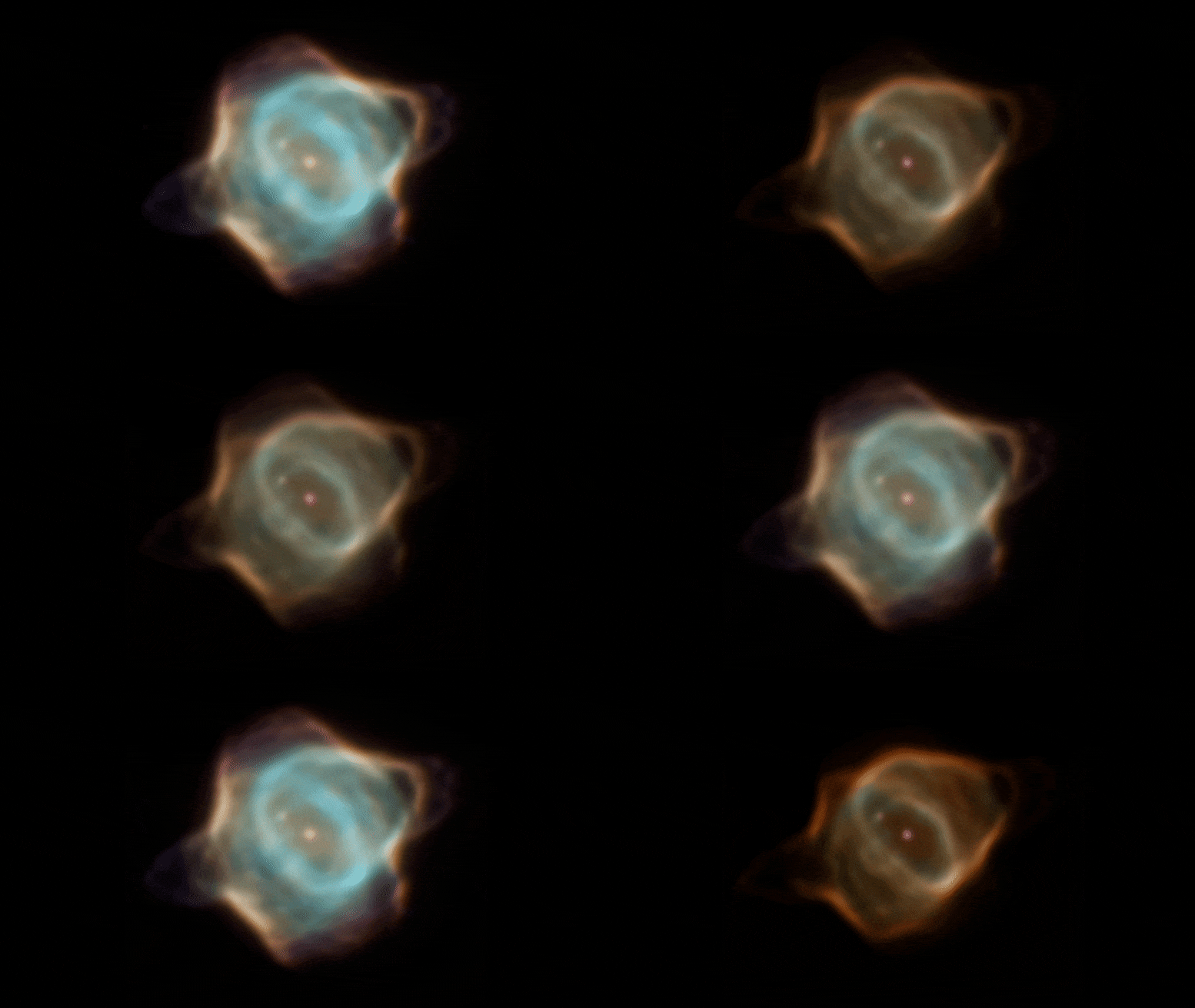
The Stingray Nebula is fading rapidly due to the cooling of its central star, SAO 244567, which may have briefly reignited helium fusion.
Stars are rather patient. They can live for billions of years, and they typically make slow transitions — sometimes over many millions of years — between the different stages of their lives.
So when a previously typical star’s behavior rapidly changes in a few decades, astronomers take note and get to work.
Such is the case with a star known as SAO 244567, which lies at the center of Hen 3-1357, commonly known as the Stingray Nebula. The Stingray Nebula is a planetary nebula — an expanse of material sloughed off from a star as it enters a new phase of old age and then heated by that same star into colorful displays that can last for up to a million years.
The Stingray Nebula: The Youngest Known Planetary Nebula
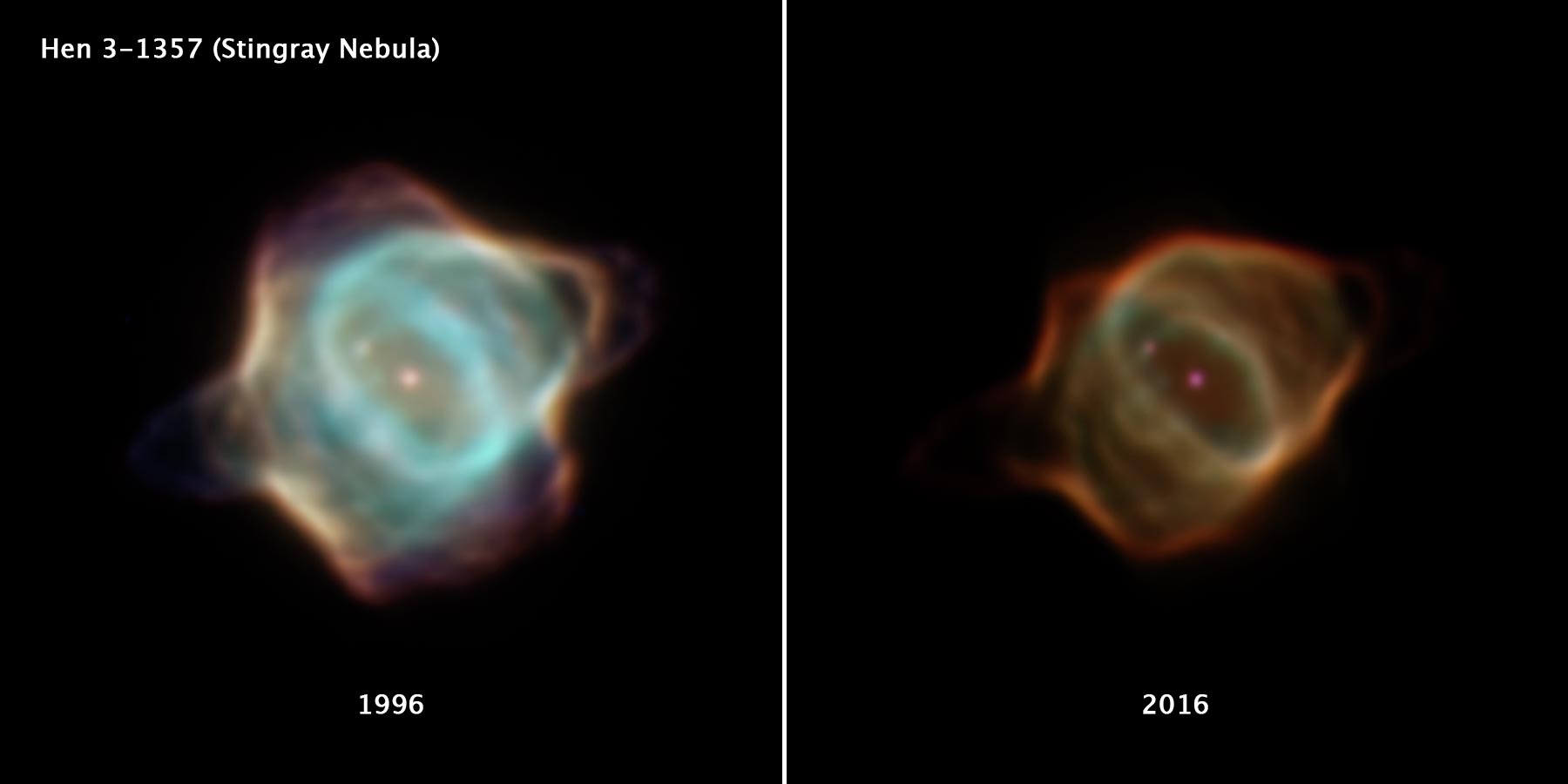
The tiny Stingray Nebula unexpectedly appeared in the 1980s and was first imaged by scientists in the 1990s using NASA’s Hubble Space Telescope. It is by far the youngest planetary nebula in our sky. A team of astronomers recently analyzed a more recent image of the nebula, taken in 2016 by Hubble, and found something unexpected: As they report in a paper accepted to the Astrophysical Journal, the Stingray Nebula has faded significantly and changed shape over the course of just 20 years.
If dimming continues at current rates, in 20 or 30 years the Stingray Nebula will be barely perceptible, and was likely already fading when Hubble obtained the first clear images of it in 1996, according to lead author Bruce Balick, an emeritus professor of astronomy at UW.
“This is an unprecedented departure from typical behavior for a planetary nebula,” said Balick. “Over time, we would expect it to imperceptibly brighten and expand, which could easily go unnoticed in a century or more. But here we’re seeing the Stingray nebula fade significantly in an incredibly compressed time frame of just 20 years. Moreover, its brightest inner structure has contracted — not expanded — as the nebula fades.”
The Role of SAO 244567 in the Nebula’s Evolution
Planetary nebulae form after most stars, including stars like our own sun, swell into red giants as they exhaust hydrogen fuel. At the end of the red giant phase, the star then expels large amounts of its outer material as it gradually — over the course of a million years — transforms into a small, compact white dwarf. The sloughed-off material expands outward for several thousand years while the star heats the material, which eventually becomes ionized and glows.
Balick and his co-authors, Martín Guerrero at the Institute of Astrophysics of Andalusia in Spain and Gerardo Ramos-Larios at the University of Guadalajara in Mexico, compared Hubble images of the Stingray Nebula taken in 1996 and 2016. Hen 3-1357 changed shape markedly over 20 years, losing the sharp, sloping edges that gave the Stingray Nebula its name. Its colors have faded overall and once-prominent blue expanses of gas near its center are largely gone.
“In a planetary nebula, the star is really the center of all the activity,” said Balick. “The material around it is directly responsive to the energy from its parent star.”
A Dramatic Drop in Ionized Emissions
The team analyzed light spectra from Hen 3-1357 emitted by chemical elements in the nebula. Emission levels of hydrogen, nitrogen, sulfur, and oxygen all dropped between 1996 and 2016, particularly oxygen, which dropped by a factor of 900. The resulting fade in color and the nebula’s change in shape are likely connected to the cooling of its parent star — from a peak of about 107,500 degrees Fahrenheit (59,700 degrees Celsius) in 2002 to just under 90,000 degrees Fahrenheit (50,000 degrees Celsius) in 2015 — which means it is giving off less ultraviolet ionizing radiation that heats the expelled gas and makes it glow.
“Like a doused forest fire, the smoke wanes more slowly than the flames that created it,” said Balick. “Even so, we were amazed when the Hubble images revealed how quickly the nebula was fading. It took a month of work to believe it.”
A Brief Helium Fusion Burst?
Astronomers have yet to understand why SAO 244567 made the Stingray Nebula light up and then fade almost as quickly. One theory, posited by a team led by Nicole Reindl at the University of Potsdam, is that the star underwent a brief burst of fresh helium fusion around its core, which stirred up its outer layers and caused its surface to both shrink and heat.
If so, then as its outer layers settle back down, the star may return to a more typical transition from red giant to white dwarf. Only future observations of the star and its nebula can confirm this.
“Unfortunately, the best tool to follow future changes in the Stingray Nebula, the Hubble Space Telescope, is near the end of its life as well,” said Balick. “We can hope, but the odds aren’t good for Hubble’s survival as its three remaining gyroscopes start to fail. It’s a good race to the finish.”
Read Hubble Captures Unprecedented Fading of Stingray Nebula for more on this research.
The Hubble Space Telescope is an international partnership between NASA and the European Space Agency, or ESA, and managed by NASA’s Goddard Space Flight Center in Maryland. The Space Telescope Science Institute is responsible for Hubble science operations. The research was also funded by the European Union and the National Council of Science and Technology in Mexico.
Never miss a breakthrough: Join the SciTechDaily newsletter.
Follow us on Google and Google News.
1 Comment
Maybe the Hubble’s lens needs cleaning.