
Close Menu
    Facebook X (Twitter) Instagram
    SciTechDaily
    • Biology
    • Chemistry
    • Earth
    • Health
    • Physics
    • Science
    • Space
    • Technology
    Facebook X (Twitter) Pinterest YouTube RSS
    SciTechDaily
    Home»Space»Glycolaldehyde Discovered in the Material around a Newly Developing Star
    Space

    Glycolaldehyde Discovered in the Material around a Newly Developing Star

    By Harvard-Smithsonian Center for AstrophysicsSeptember 8, 20121 Comment2 Mins Read
    Facebook Twitter Pinterest Telegram LinkedIn WhatsApp Email Reddit
    Share
    Facebook Twitter LinkedIn Pinterest Telegram Email Reddit
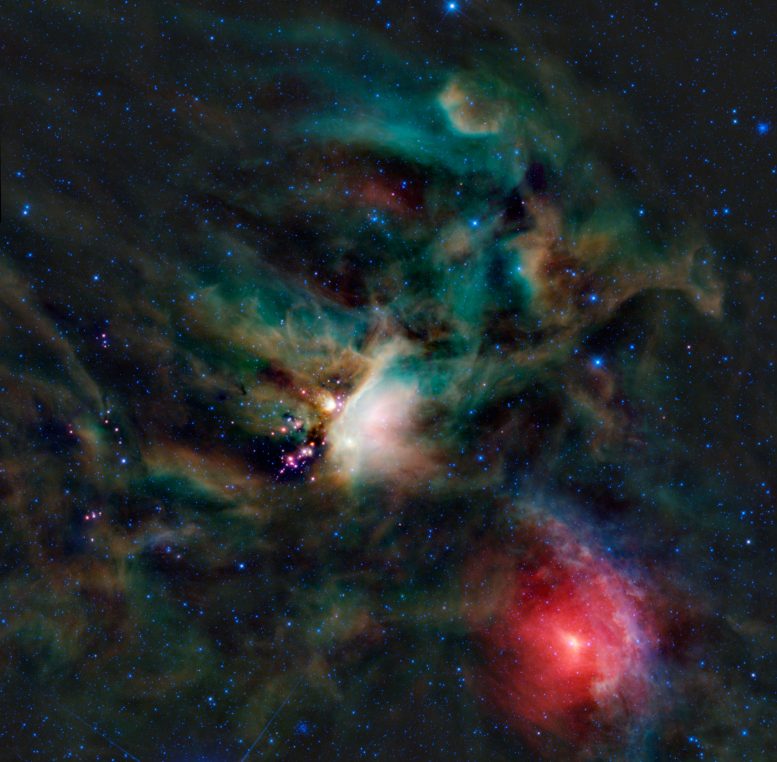
    star forming region in the constellation of Ophiuchus
    A false-color infrared image of the star forming region in the constellation of Ophiuchus. Recent observations have detected simple sugar, glycolaldehyde, around one of the faint, young reddish protostars in the region. Credit: NASA-WISE

    A newly published study details the discovery of glycolaldehyde, a simple sugar, in the material around a newly developing star that is roughly the size of the Sun.

    Astronomers have detected about 180 molecules in interstellar space, from simple ones like carbon monoxide (one atom of carbon and one of oxygen) to complex species like buckminsterfullerene (sixty atoms of carbon) or anthracene (fourteen atoms of carbon and ten of hydrogen). These chemicals are found in a wide variety of environments in the galaxy, and in principle can provide the backbone for the subsequent production of the molecules essential to life.

    The search for molecules associated with life however, for example, simple sugars, has been less successful. The simplest sugar is glycolaldehyde (HCOCH2OH). It has been spotted in only two extreme places so far: a massive dense molecular cloud near the galactic center, and a dense core of gas and dust that is forming massive stars. It has not even been found in solar system comets, which are thought to contain samples of material dating from the early solar nebula.

    A new paper in The Astrophysical Journal Letters reports discovering glycolaldehyde in the material around a newly developing star of approximately solar mass. CfA astronomer Tyler Bourke and five colleagues used the new Atacama Large Millimeter Array (ALMA) facility in Chile to observe the protostar IRAS16293-2422, located about 400 light-years away. They find thirteen different lines characteristic of this molecule, and their analysis finds that the gas is warm (about 200-300 kelvin) and probably part of a large system of material flowing in towards the star as it grows and develops a system of planets.

    Although the exact mechanism(s) that produce the glycolaldehyde are uncertain, the new results help confirm that molecules associated with life exist in normal environments around young, solar-mass stars. The team notes that the new facility will enable astronomers to study this sugar in other places and begin to tell a more complete story of how the rich chemistry found on Earth developed.

    Reference: “Detection of the Simplest Sugar, Glycolaldehyde, in a Solar-Type Protostar With ALMA” by, 29 August 2012, The Astrophysical Journal Letters.
    DOI: 10.1088/2041-8205/757/1/L4

    Never miss a breakthrough: Join the SciTechDaily newsletter.
    Follow us on Google and Google News.

    Astronomy Astrophysics Harvard-Smithsonian Center for Astrophysics
    Share. Facebook Twitter Pinterest LinkedIn Email Reddit

    Related Articles

    X-Ray Emission From Mysterious Dark Matter

    Analyzing Dust Storm Sequences on Mars

    Intriguing Remains of a Rare Stellar Explosion Discovered in Milky Way Center

    Puzzling Astrophysics of Quasars in the Early Universe

    Four Exoplanets – Including a Super-Earth Planet – Discovered by High School Students

    Massive Rotating Stars in the Pleiades Cluster

    Astronomers Discover First Cloudless, Jupiter-Like Planet – “Smoking Gun Evidence”

    Chandra X-ray Observatory Studies Extraordinary Magnetar [Video]

    Chandra Studies Extraordinary Magnetar: Fastest Spinning and Possibly the Youngest Magnetar Known

    1 Comment

    1. Madanatopal.V.C. on September 9, 2012 12:31 am

      Glycolaldehyde discovered in Ophiucus constellation clearly speaks out the fact that Planet chemistry should be divided into another branch called extra- stellar chemistry where molecules like water cloud, oxygen, methane, ammonia, carbon-di-oxide etc are formed in the space itself with the help of high gamma radiation backround found in cosmos. An entire galaxy is initially filled with gases like nebula Andromeda, where some Hydrogen undergoes fusion like Sun and the non-stellar Hydrogen forms different molecules as an oort cloud hurling around the stars to impact on the planets surrounding them forming different planetary atmospheres. Our own Milky way galaxy cannibalises its neighbours like Nebula Andromeda cannibalising its neigbouring galaxies first drawing the gases in the inter-stellar space and then the stars. That is why most galaxies are gaseous predominantly. Mollecules of life like amino acids should have only extra-stellar origin. Thank you.

      Reply
    Leave A Reply Cancel Reply

    • Facebook
    • Twitter
    • Pinterest
    • YouTube

    Don't Miss a Discovery

    Subscribe for the Latest in Science & Tech!

    Trending News

    Could Low Vitamin D Be Making Your Pain Worse?

    Scientists Discover Once-Weekly Workout That Melts Belly Fat Surprisingly Effectively

    Scientists Just Tested a Thruster Powerful Enough for Human Missions to Mars

    Doctors Say Your Ice Pack Might Be Making Injuries Worse

    Scientists Discover 43-Foot Sea Reptile Twice the Size of a Great White Shark

    Bees and Birds Are Drinking Alcohol From Flowers

    Scientists Discover How Obesity May Trigger Alzheimer’s Disease

    Scientists Confirm Alcohol Causes Widespread Health Damage

    Follow SciTechDaily
    • Facebook
    • Twitter
    • YouTube
    • Pinterest
    • Newsletter
    • RSS
    SciTech News
    • Biology News
    • Chemistry News
    • Earth News
    • Health News
    • Physics News
    • Science News
    • Space News
    • Technology News
    Recent Posts
    • Archaeologists Discover Mysterious Artificial Island Older Than Stonehenge in Scotland
    • Magnon Breakthrough Could Shrink Quantum Computers to the Size of a Penny
    • NASA Finds a “Goldilocks” Giant Planet Wrapped in Methane
    • Are There Aliens on the Famous Exoplanet K2-18b? Scientists Just Scanned It for Signals
    • Scientists Have Found a Way To Feed Immune Cells Without Fueling Cancer
    Copyright © 1998 - 2026 SciTechDaily. All Rights Reserved.
    • Science News
    • About
    • Contact
    • Editorial Board
    • Privacy Policy
    • Terms of Use

    Type above and press Enter to search. Press Esc to cancel.