
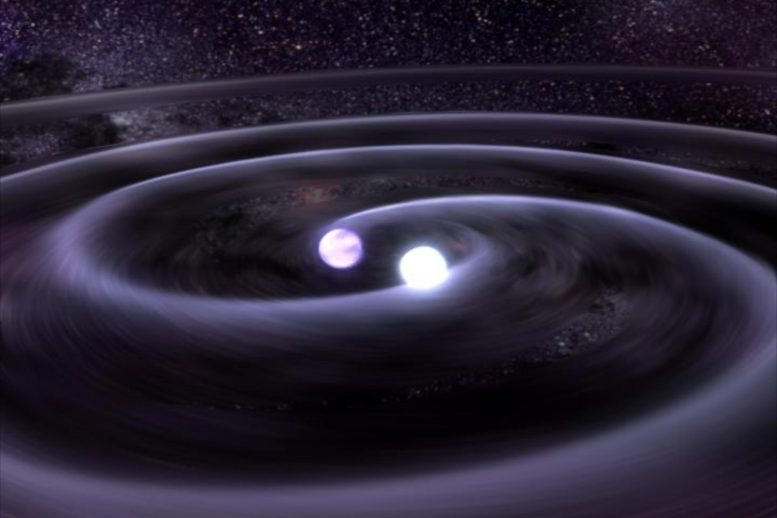
Discovered last year in system J0651, two white dwarf stars are so close together that they make a complete orbit in less than 13 minutes and now astronomers have detected gravitational waves at optical wavelengths in light from them.
Gravitational waves, much like the recently discovered Higgs boson, are notoriously difficult to observe. Scientists first detected these ripples in the fabric of space-time indirectly, using radio signals from a pulsar-neutron star binary system. The find, which required exquisitely accurate timing of the radio signals, garnered its discoverers a Nobel Prize. Now a team of astronomers has detected the same effect at optical wavelengths, in light from a pair of eclipsing white dwarf stars.
“This result marks one of the cleanest and strongest detections of the effect of gravitational waves,” said team member Warren Brown of the Smithsonian Astrophysical Observatory (SAO).
The team discovered the white dwarf pair last year. (White dwarfs are the remnant cores of stars like our Sun.) The system, called SDSS J065133.338+284423.37 (J0651 for short), contains two white dwarf stars so close together — one-third of the Earth-moon distance — that they make a complete orbit in less than 13 minutes.
“Every six minutes the stars in J0651 eclipse each other as seen from Earth, which makes for an unparalleled and accurate clock some 3,000 light-years away,” said study lead author J.J. Hermes, a graduate student working with Professor Don Winget at The University of Texas at Austin.
Einstein’s theory of general relativity predicts that moving objects create subtle ripples in the fabric of space-time, called gravitational waves. Gravitational waves should carry away energy, causing the stars to inch closer together and orbit each other faster and faster. The team was able to detect this effect in J0651.
“Compared to April 2011, when we discovered this object, the eclipses now happen six seconds sooner than expected,” said team member Mukremin Kilic of The University of Oklahoma.
“This is a general relativistic effect you could measure with a wristwatch,” added SAO’s Warren Brown.
J0651 will provide an opportunity to compare future direct, space-based detection of gravitational waves with those inferred from the orbital decay, providing important benchmark tests of our understanding of the workings of gravity.
The team expects that the period will shrink more and more each year, with eclipses happening more than 20 seconds sooner than otherwise expected by May 2013. The stars will eventually merge, in two million years. Future observations will continue to measure the orbital decay of this system, and attempt to understand how tides affect the merger of such stars.
The team’s results will be published in The Astrophysical Journal Letters.
Reference: “Rapid Orbital Decay in the 12.75-Minute Binary White Dwarf J0651+2844” by J. J. Hermes, Mukremin Kilic, Warren R. Brown, D. E. Winget, Carlos Allende Prieto, A. Gianninas, Anjum S. Mukadam, Antonio Cabrera-Lavers and Scott J. Kenyon, 7 September 2012, The Astrophysical Journal Letters.
DOI: 10.1088/2041-8205/757/2/L21
Headquartered in Cambridge, Mass., the Harvard-Smithsonian Center for Astrophysics (CfA) is a joint collaboration between the Smithsonian Astrophysical Observatory and the Harvard College Observatory. CfA scientists, organized into six research divisions, study the origin, evolution and ultimate fate of the universe.
Never miss a breakthrough: Join the SciTechDaily newsletter.
Follow us on Google and Google News.