
Close Menu
    Facebook X (Twitter) Instagram
    SciTechDaily
    • Biology
    • Chemistry
    • Earth
    • Health
    • Physics
    • Science
    • Space
    • Technology
    Facebook X (Twitter) Pinterest YouTube RSS
    SciTechDaily
    Home»Space»Origins of Type Ia Supernovae
    Space

    Origins of Type Ia Supernovae

    By Harvard-Smithsonian Center for AstrophysicsMarch 20, 2012No Comments3 Mins Read
    Facebook Twitter Pinterest Telegram LinkedIn WhatsApp Email Reddit
    Share
    Facebook Twitter LinkedIn Pinterest Telegram Email Reddit
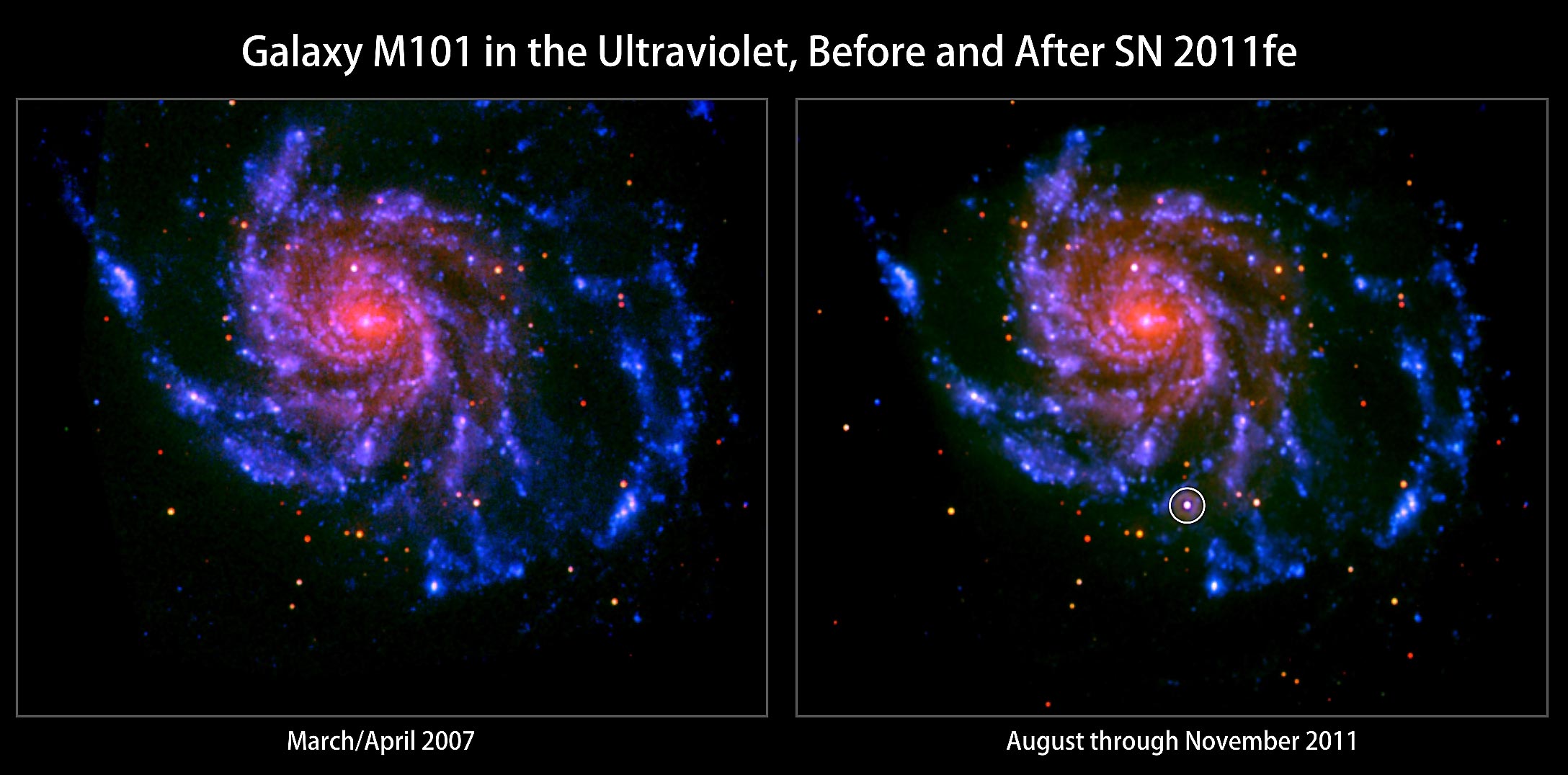
    Galaxy M101 Before and After SN 2011fe
    These images from Swift’s Ultraviolet/Optical Telescope (UVOT) show the nearby spiral galaxy M101 before and after the appearance of SN 2011fe (circled, right), which was discovered on August 24, 2011. At a distance of 21 million light-years, it was the nearest Type Ia supernova since 1986. Left: View constructed from images taken in March and April 2007. Right: The supernova was so bright that most UVOT exposures were short, so this view includes imagery from August through November 2011 to better show the galaxy. Credit: NASA/Swift/Peter Brown, University of Utah

    While studying SN 2011fe and using X-ray and ultraviolet observations from NASA’s Swift satellite, researchers were able to provide new insights into the origins of Type Ia supernovae.

    An exploding star known as a Type Ia supernova plays a key role in our understanding of the universe. Studies of Type Ia supernovae led to the discovery of dark energy, which garnered the 2011 Nobel Prize in Physics. Yet the cause of this variety of exploding star remains elusive.

    All evidence points to a white dwarf that feeds off its companion star, gaining mass, growing unstable, and ultimately detonating. But does that white dwarf draw material from a Sun-like star, an evolved red giant star, or from a second white dwarf? Or is something more exotic going on? Clues can be collected by searching for “cosmic crumbs” left over from the white dwarf’s last meal.

    In two comprehensive studies of SN 2011fe — the closest Type Ia supernova in the past two decades — there is new evidence that indicates that the white dwarf progenitor was a particularly picky eater, leading scientists to conclude that the companion star was not likely to be a Sun-like star or an evolved giant.

    “It’s hard to understand how a white dwarf could eat itself to death while showing such good table manners,” said Alicia Soderberg of the Harvard-Smithsonian Center for Astrophysics (CfA).

    Soderberg and her colleagues examined SN 2011fe with a suite of instruments in wavelengths ranging from X-rays to radio. They saw no sign of stellar material recently devoured by the white dwarf. Instead, the explosion occurred in a remarkably clean environment.

    “This white dwarf was a tidy eater,” said Laura Chomiuk of the CfA, lead author of one of the two papers.

    Additional studies using NASA’s Swift satellite, which examined a large number of more distant Type Ia supernovae, appear to rule out giant stars as companions for the white-dwarf progenitors. Those results were described in a NASA press release.

    Taken together, these studies suggest that Type Ia supernovae likely originate from a more exotic scenario, possibly the explosive merger of two white dwarfs.

    “This is an exciting time in Type Ia supernova research since it brings us closer to solving one of the longest-standing mysteries in the life cycles of stars,” said Raffaella Margutti of the CfA, lead author of the second paper.

    The two papers on SN 2011fe are available online at http://arxiv.org/abs/1201.0994 and http://arxiv.org/abs/1202.0741.

    Never miss a breakthrough: Join the SciTechDaily newsletter.
    Follow us on Google and Google News.

    Astronomy Astrophysics Galaxy Harvard-Smithsonian Center for Astrophysics Supernova White Dwarf
    Share. Facebook Twitter Pinterest LinkedIn Email Reddit

    Related Articles

    4,000 Supernovae May Change Everything We Know About Dark Energy

    Resurrected in Space: The Incredible Story of the 1181 “Zombie Star”

    Extreme Weight Loss: Shocking Supernova Discovery Challenges the Standard Theory of Stellar Evolution

    AI Discovers Secret Equation for “Weighing” Colossal Clusters of Galaxies

    Astronomers Observe a Cosmic Particle Accelerator As Never Before

    A Cosmic Powder Keg: When a Stable Star Explodes

    Fragments of Titanium Found Blasting Out of a Famous Supernova

    How Do the Most Massive Stars Explode? Bubbles With Titanium Trigger Titanic Explosions

    Intriguing Remains of a Rare Stellar Explosion Discovered in Milky Way Center

    Leave A Reply Cancel Reply

    • Facebook
    • Twitter
    • Pinterest
    • YouTube

    Don't Miss a Discovery

    Subscribe for the Latest in Science & Tech!

    Trending News

    First-of-Its-Kind Discovery: Homer’s Iliad Found Embedded in a 1,600-Year-Old Egyptian Mummy

    Beyond Inflammation: Scientists Uncover New Cause of Persistent Rheumatoid Arthritis

    A Simple Molecule Could Unlock Safer, Easier Weight Loss

    Scientists Just Built a Quantum Battery That Charges Almost Instantly

    Researchers Unveil Groundbreaking Sustainable Solution to Vitamin B12 Deficiency

    Millions of People Have Osteopenia Without Realizing It – Here’s What You Need To Know

    Researchers Discover Boosting a Single Protein Helps the Brain Fight Alzheimer’s

    World-First Study Reveals Human Hearts Can Regenerate After a Heart Attack

    Follow SciTechDaily
    • Facebook
    • Twitter
    • YouTube
    • Pinterest
    • Newsletter
    • RSS
    SciTech News
    • Biology News
    • Chemistry News
    • Earth News
    • Health News
    • Physics News
    • Science News
    • Space News
    • Technology News
    Recent Posts
    • Scientists Flip Immune System “Switch,” Uncover Surprising Path To Stop Gut Inflammation
    • Magnesium Magic: New Drug Melts Fat Even on a High-Fat, High-Sugar Diet
    • Weight-Loss Drugs Like Ozempic May Come With an Unexpected Cost
    • After Decades, MIT Researchers Capture the First 3D Atomic View of a Mysterious Material
    • Your Favorite Fishing Spot Is Turning Brown – and the Fish Are Changing
    Copyright © 1998 - 2026 SciTechDaily. All Rights Reserved.
    • Science News
    • About
    • Contact
    • Editorial Board
    • Privacy Policy
    • Terms of Use

    Type above and press Enter to search. Press Esc to cancel.