
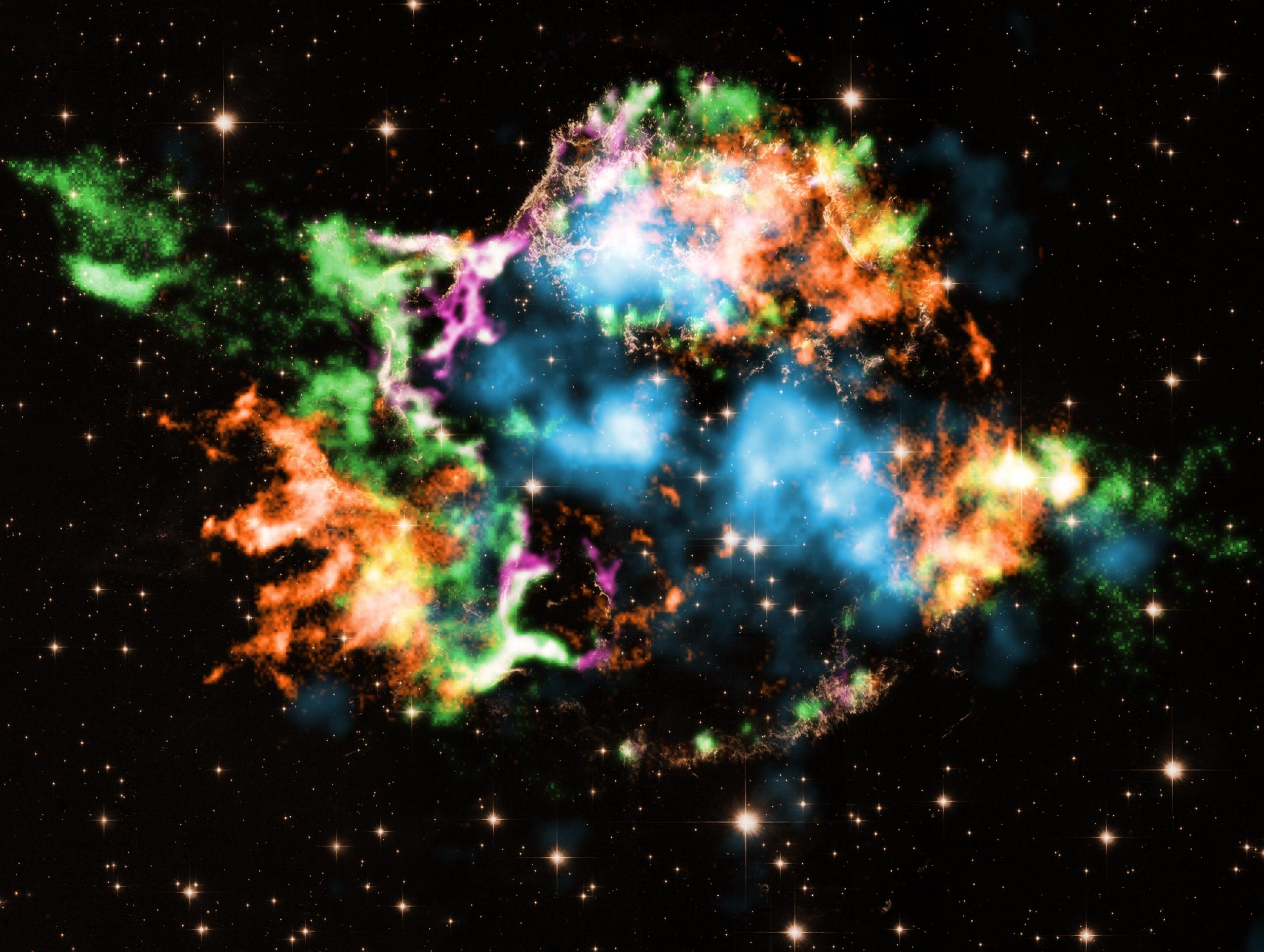
Chandra observations of the Cas A supernova remnant revealed stable titanium bubbles consistent with neutrino-driven explosion models. This evidence helps explain how massive stars explode and produce elements like titanium.
Scientists have found fragments of titanium blasting out of a famous supernova. This discovery, made with NASA’s Chandra X-ray Observatory, could be a major step in pinpointing exactly how some giant stars explode.
This work is based on Chandra’s observations of the remains of a supernova called Cassiopeia A (Cas A), located in our galaxy about 11,000 light-years from Earth. This is one of the youngest known supernova remnants, with an age of about 350 years.
For years, scientists have struggled to understand how massive stars — those with masses over about 10 times that of the Sun — explode when they run out of fuel. This result provides an invaluable new clue.
“Scientists think most of the titanium that is used in our daily lives — such as in electronics or jewelry — is produced in a massive star’s explosion,” said Toshiki Sato of Rikkyo University in Japan, who led the study that appears in the journal Nature. “However, until now scientists have never been able to capture the moment just after stable titanium is made.”
When the nuclear power source of a massive star runs out, the center collapses under gravity and forms either a dense stellar core called a neutron star or, less often, a black hole. When a neutron star is created, the inside of the collapsing massive star bounces off the surface of the stellar core, reversing the implosion.
The heat from this cataclysmic event produces a shock wave — similar to a sonic boom from a supersonic jet — that races outwards through the rest of the doomed star, producing new elements by nuclear reactions as it goes. However, in many computer models of this process, energy is quickly lost and the shock wave’s journey outwards stalls, preventing the supernova explosion.
Recent three-dimensional computer simulations suggest that neutrinos — very low-mass subatomic particles — made in the creation of the neutron star play a crucial role in driving bubbles that speed away from the neutron star. These bubbles continue driving the shock wave forward to trigger the supernova explosion.
With the new study of Cas A, the team discovered powerful evidence for such a neutrino-driven explosion. In the Chandra data, they found that finger-shaped structures pointing away from the explosion site contain titanium and chromium, coinciding with iron debris previously detected with Chandra. The conditions required for the creation of these elements in nuclear reactions, such as the temperature and density, match those of bubbles in simulations that drive the explosions.
Stable vs. Unstable Titanium
The titanium that was found by Chandra in Cas A and that is predicted by these simulations is a stable isotope of the element, meaning that the number of neutrons its atoms contain implies that it does not change by radioactivity into a different, lighter element. Previously astronomers had used NASA’s NuSTAR telescope to discover an unstable isotope of titanium in different locations in Cas A. Every 60 years about half of this titanium isotope transforms into scandium and then calcium.
“We have never seen this signature of titanium bubbles in a supernova remnant before, a result that was only possible with Chandra’s incredibly sharp images,” said co-author Keiichi Maeda of Kyoto University in Japan. “Our result is an important step in solving the problem of how these stars explode as supernovae.”
Deep Origins: Titanium Launched From the Star’s Core
“When the supernova happened, titanium fragments were produced deep inside the massive star. The fragments penetrated the surface of the massive star, forming the rim of the supernova remnant, Cas A,” said co-author Shigehiro Nagataki of the RIKEN Cluster for Pioneering Research in Japan.
These results strongly support the idea of a neutrino-driven explosion to explain at least some supernovae.
“Our research could be the most important observational result probing the role of neutrinos in exploding massive stars since the detection of neutrinos from Supernova 1987A,” said co-author Takashi Yoshida of Kyoto University in Japan.
Astronomers used over a million and half seconds, or over 18 days, of Chandra observing time from the supernova Cassiopeia A (Cas A) taken between 2000 and 2018. The amount of stable titanium produced in Cas A exceeds the total mass of the Earth.
For more on this research, read How Do the Most Massive Stars Explode? Bubbles With Titanium Trigger Titanic Explosions.
Reference: “High-entropy ejecta plumes in Cassiopeia A from neutrino-driven convection” by Toshiki Sato, Keiichi Maeda, Shigehiro Nagataki, Takashi Yoshida, Brian Grefenstette, Brian J. Williams, Hideyuki Umeda, Masaomi Ono and John P. Hughes, 21 April 2021, Nature.
DOI: 10.1038/s41586-021-03391-9
These results have been published in the April 22, 2021 issue of Nature. In addition to Sato, Maeda, Nagataki and Yoshida, the authors of the paper are Brian Grefenstette (California Institute of Technology in Pasadena, California), Brian J. Williams (NASA Goddard Space Flight Center in Greenbelt, Maryland), Hideyuki Umeda (University of Tokyo in Japan), Masaomi Ono (RIKEN Cluster for Pioneering Research in Japan), and Jack Hughes (Rutgers University in Piscataway, New Jersey).
NASA’s Marshall Space Flight Center manages the Chandra program. The Smithsonian Astrophysical Observatory’s Chandra X-ray Center controls science from Cambridge Massachusetts and flight operations from Burlington, Massachusetts.
Never miss a breakthrough: Join the SciTechDaily newsletter.
Follow us on Google and Google News.