
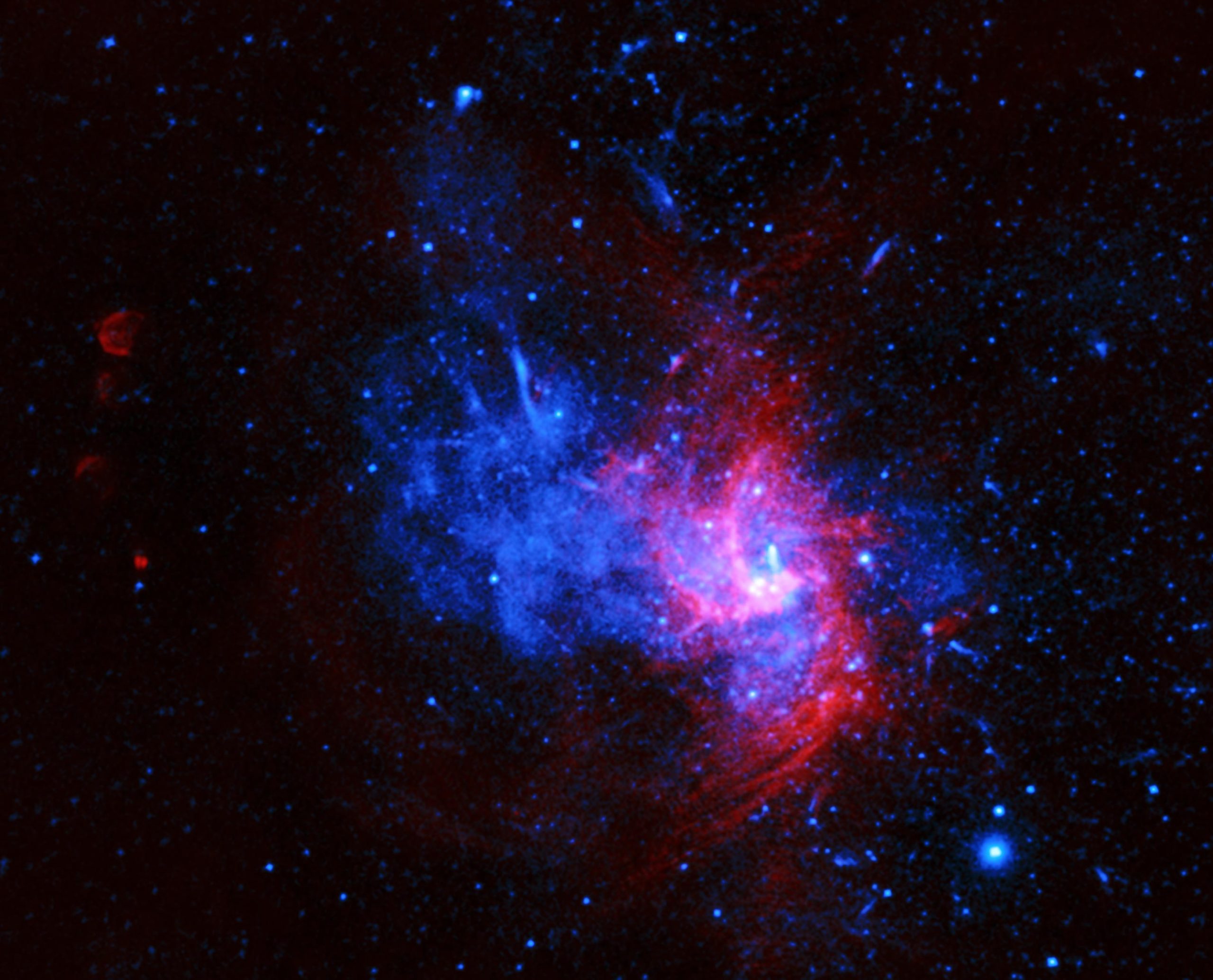
A new study of Sagittarius A East near the Milky Way’s center reveals it may be a rare Type Iax supernova remnant.
- Scientists have discovered the first evidence for a rare type of stellar explosion, or supernova in the Milky Way.
- This intriguing object lies near the center of our galaxy in a supernova remnant called Sagittarius A East (Sgr A East).
- Chandra data revealed that Sgr A East may belong to a special group of Type Ia supernovas.
- This result helps astronomers understand the different ways that white dwarf stars can explode.
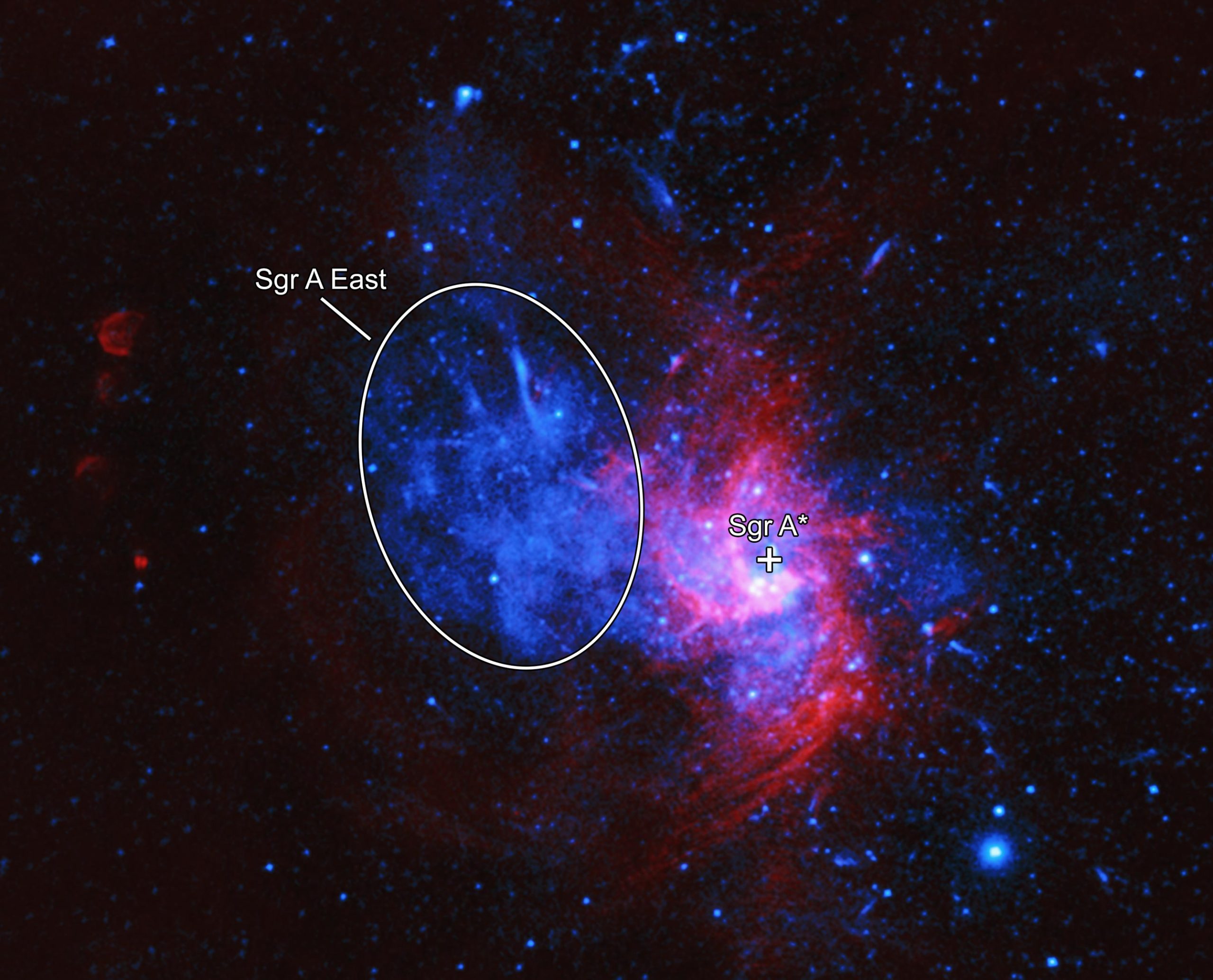
Astronomers have found evidence for an unusual type of supernova near the center of the Milky Way galaxy. This composite image contains data from NASA’s Chandra X-ray Observatory (blue) and the NSF’s Very Large Array (red) of the supernova remnant called Sagittarius A East, or Sgr A East for short. This object is located very close to the supermassive black hole in the Milky Way’s center, and likely overruns the disk of material surrounding the black hole.
Researchers were able to use Chandra observations targeting the supermassive black hole and the region around it for a total of about 35 days to study Sgr A East and find the unusual pattern of elements in the X-ray signature, or spectrum. An ellipse on the annotated version of the images outlines the region of the remnant where the Chandra spectra were obtained.
The X-ray spectrum of Sgr A East show that it is a strong candidate for the remains of a so-called Type Iax supernova, a special class of Type Ia supernova explosions that are used to accurately measure distances across space and study the expansion of the Universe.
Astronomers are still debating the cause of Type Iax supernova explosions, but the leading theory is that they involve thermonuclear reactions that travel much more slowly through the star than in normal Type Ia supernovas. This relatively slow walk of the blast leads to weaker explosions and, hence, different amounts of elements produced in the explosion. The researchers found this distinctive pattern of elements in the Chandra observations of Sgr A East.
In other galaxies, scientists observe that Type Iax supernovas occur at a rate that is about one third that of Type Ia supernovas. In the Milky Way, there have been three confirmed Type Ia supernova remnants and two candidates that are younger than 2,000 years. If Sgr A East is younger than 2,000 years and is a Type Iax supernova, this study suggests that our Galaxy is in alignment with respect to the relative numbers of Type Iax supernovas seen in other galaxies.
Previous studies had argued that Sgr A East was the remnant from the collapse of a massive star, which is a wholly different category of supernova, although a normal Type Ia supernova had not been ruled out. The latest study conducted with this deep Chandra data argue against both the massive star and the normal Type Ia interpretations.
These results will be published on Wednesday February 10th, 2021 in The Astrophysical Journal. The authors of the paper are Ping Zhao (Nanjing University in China, and previously at the University of Amsterdam), Shing-Chi Leung (California Institute of Technology), Zhiyuan Li (Nanjing University), Ken’ichi Nomoto (The University of Tokyo in Japan), Jacco Vink (University of Amsterdam), and Yang Chen (Nanjing University).
Reference: “Chemical Abundances in Sgr A East: Evidence for a Type Iax Supernova Remnant” by Ping Zhou, Shing-Chi Leung, Zhiyuan Li, Ken’ichi Nomoto, Jacco Vink and Yang Chen, 10 February 2021, The Astrophysical Journal.
DOI: 10.3847/1538-4357/abbd45
arXiv: 2006.15049
NASA’s Marshall Space Flight Center manages the Chandra program. The Smithsonian Astrophysical Observatory’s Chandra X-ray Center controls science from Cambridge Massachusetts and flight operations from Burlington, Massachusetts.
Never miss a breakthrough: Join the SciTechDaily newsletter.
Follow us on Google and Google News.