
Close Menu
    Facebook X (Twitter) Instagram
    SciTechDaily
    • Biology
    • Chemistry
    • Earth
    • Health
    • Physics
    • Science
    • Space
    • Technology
    Facebook X (Twitter) Pinterest YouTube RSS
    SciTechDaily
    Home»Space»New ESO Image of Spiral Galaxy Messier 33
    Space

    New ESO Image of Spiral Galaxy Messier 33

    By European Southern ObservatoryAugust 6, 2014No Comments3 Mins Read
    Facebook Twitter Pinterest Telegram LinkedIn WhatsApp Email Reddit
    Share
    Facebook Twitter LinkedIn Pinterest Telegram Email Reddit
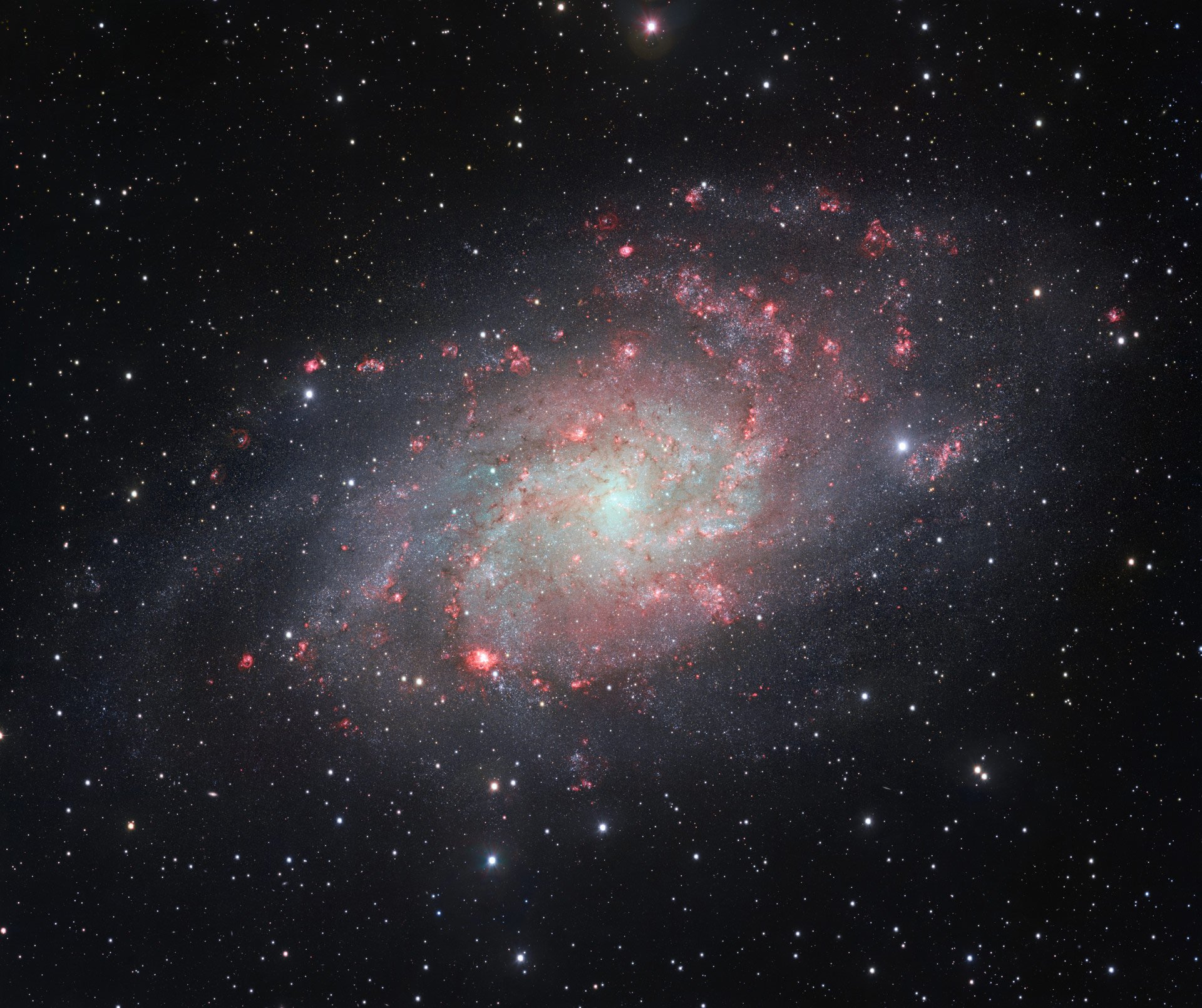
    New ESO Image of Messier 33
    Messier 33, otherwise known as NGC 598, is located about three million light-years away in the small northern constellation of Triangulum (The Triangle). It is frequently referred to as the Triangulum Galaxy. Credit: ESO

    This newly released VLT Survey Telescope image shows spiral galaxy Messier 33, which is located about three million light-years away.

    The VLT Survey Telescope (VST) at ESO’s Paranal Observatory in Chile has captured a beautifully detailed image of the galaxy Messier 33. This nearby spiral, the second closest large galaxy to our own galaxy, the Milky Way, is packed with bright star clusters, and clouds of gas and dust. The new picture is amongst the most detailed wide-field views of this object ever taken and shows the many glowing red gas clouds in the spiral arms with particular clarity.

    Messier 33, otherwise known as NGC 598, is located about three million light-years away in the small northern constellation of Triangulum (The Triangle). Often known as the Triangulum Galaxy it was observed by the French comet hunter Charles Messier in August 1764, who listed it as number 33 in his famous list of prominent nebulae and star clusters. However, he was not the first to record the spiral galaxy; it was probably first documented by the Sicilian astronomer Giovanni Battista Hodierna around 100 years earlier.

    Although the Triangulum Galaxy lies in the northern sky, it is just visible from the southern vantage point of ESO’s Paranal Observatory in Chile. However, it does not rise very high in the sky. This image was taken by the VLT Survey Telescope (VST), a state-of-the-art 2.6-meter survey telescope with a field of view that is twice as broad as the full Moon. This picture was created from many individual exposures, including some taken through a filter passing just the light from glowing hydrogen, which make the red gas clouds in the galaxies spiral arms especially prominent.

    Among the many star formation regions in Messier 33’s spiral arms, the giant nebula NGC 604 stands out. With a diameter of nearly 1500 light-years, this is one of the largest nearby emission nebulae known. It stretches over an area 40 times the size of the visible portion of the much more famous — and much closer — Orion Nebula.

    The Triangulum Galaxy is the third-largest member of the Local Group of galaxies, which includes the Milky Way, the Andromeda Galaxy, and about 50 other smaller galaxies. On an extremely clear, dark night, this galaxy is just visible with the unaided eye, and is considered to be the most distant celestial object visible without any optical help. Viewing conditions for the very patient are only set to improve in the long-term: the galaxy is approaching our own at a speed of about 100,000 kilometers per hour (62,000 mph).

    A closer look at this beautiful new picture not only allows a very detailed inspection of the star-forming spiral arms of the galaxy, but also reveals the very rich scenery of the more distant galaxies scattered behind the myriad stars and glowing clouds of NGC 598.

    Never miss a breakthrough: Join the SciTechDaily newsletter.
    Follow us on Google and Google News.

    Astronomy European Southern Observatory Popular
    Share. Facebook Twitter Pinterest LinkedIn Email Reddit

    Related Articles

    Stunning Galactic Fireworks: New ESO Images Reveal Spectacular Features of Nearby Galaxies

    Astronomers Were Puzzled by “Great Dimming” of Betelgeuse – Now the Mystery Is Solved

    “Big Surprise!” – Heavy Metal Vapors Unexpectedly Found in Comets Throughout Our Solar System – and Beyond

    Mysterious Interstellar Visitor May Be the Most Pristine Comet Ever Found

    Event Horizon Telescope Images Magnetic Fields at the Edge of M87’s Supermassive Black Hole

    “Meteorological Beast in Our Solar System” – Powerful Stratospheric Winds Measured on Jupiter for the First Time

    Astronomers Have Discovered the Most Distant Source of Radio Emission Ever Known – 13 Billion Light-Years Away

    Distant Colliding Galaxy Dying Out As It Loses the Ability to Form Stars – Ejecting 10,000 Suns-Worth of Gas a Year

    Puzzling Six-Exoplanet System Discovered With Resonant Rhythmic Movement

    Leave A Reply Cancel Reply

    • Facebook
    • Twitter
    • Pinterest
    • YouTube

    Don't Miss a Discovery

    Subscribe for the Latest in Science & Tech!

    Trending News

    Scientists Discover Mysterious Creature Living in the Great Salt Lake – and It Exists Nowhere Else on Earth

    It’s Alive? Surprising Discovery Changes What We Know About Fog

    A Tiny Bright-Blue Octopus Found in the Galápagos Is Completely New to Science

    Scientists Discover Surprising Anti-Aging Power Hidden in Aged Garlic

    Why More People in Their 30s Are Suddenly Getting Colon Cancer

    Scientists Discover Sperm Seem To Bypass a Fundamental Law of Physics

    Archaeologists Discover Mysterious Artificial Island Older Than Stonehenge in Scotland

    Massive Study Warns Marijuana Use in Teens Is Linked to Serious Mental Illness

    Follow SciTechDaily
    • Facebook
    • Twitter
    • YouTube
    • Pinterest
    • Newsletter
    • RSS
    SciTech News
    • Biology News
    • Chemistry News
    • Earth News
    • Health News
    • Physics News
    • Science News
    • Space News
    • Technology News
    Recent Posts
    • Scientists Discover Surprising Similarities Between Freud’s Ideas and Modern Neuroscience
    • New 7-Dimensional Theory May Finally Solve the Black Hole Information Paradox
    • The Missing Notebooks That Solved a 25-Year-Old Paleontology Mystery
    • Scientists Discover a Simple Writing Test That May Detect Cognitive Impairment
    • Scientists Made Older Mice Biologically Younger Using Gut Microbes
    Copyright © 1998 - 2026 SciTechDaily. All Rights Reserved.
    • Science News
    • About
    • Contact
    • Editorial Board
    • Privacy Policy
    • Terms of Use

    Type above and press Enter to search. Press Esc to cancel.