
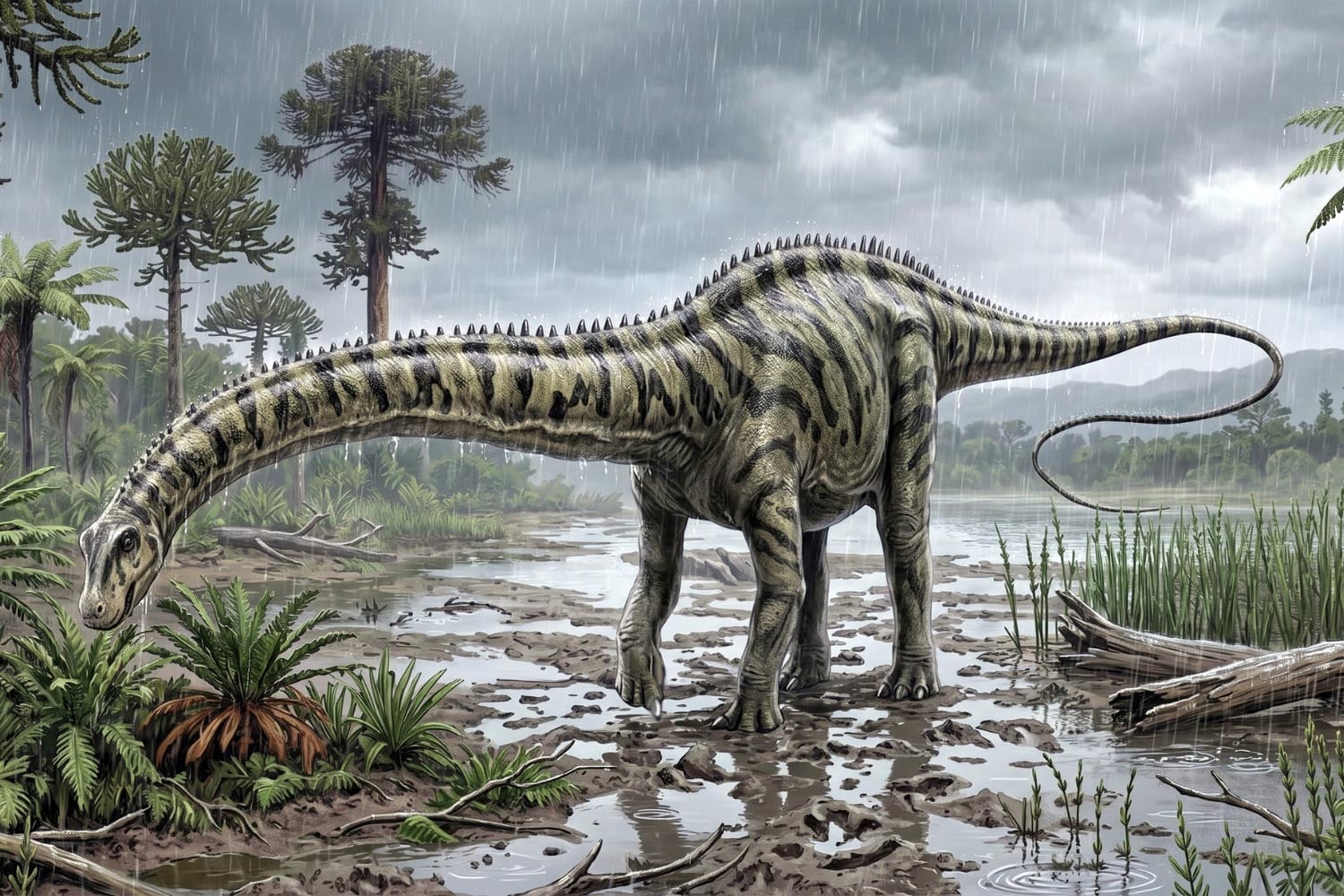
A dinosaur long thought to belong exclusively to North America has turned up in Spain, offering a 150-million-year-old clue to how giants moved between continents.
Paleontologists at the Fundación Conjunto Paleontológico de Teruel-Dinópolis have identified the first evidence of Diplodocus outside North America. Their study, published in the Journal of Vertebrate Paleontology, places the familiar long-necked dinosaur in Europe near the end of the Jurassic Period.
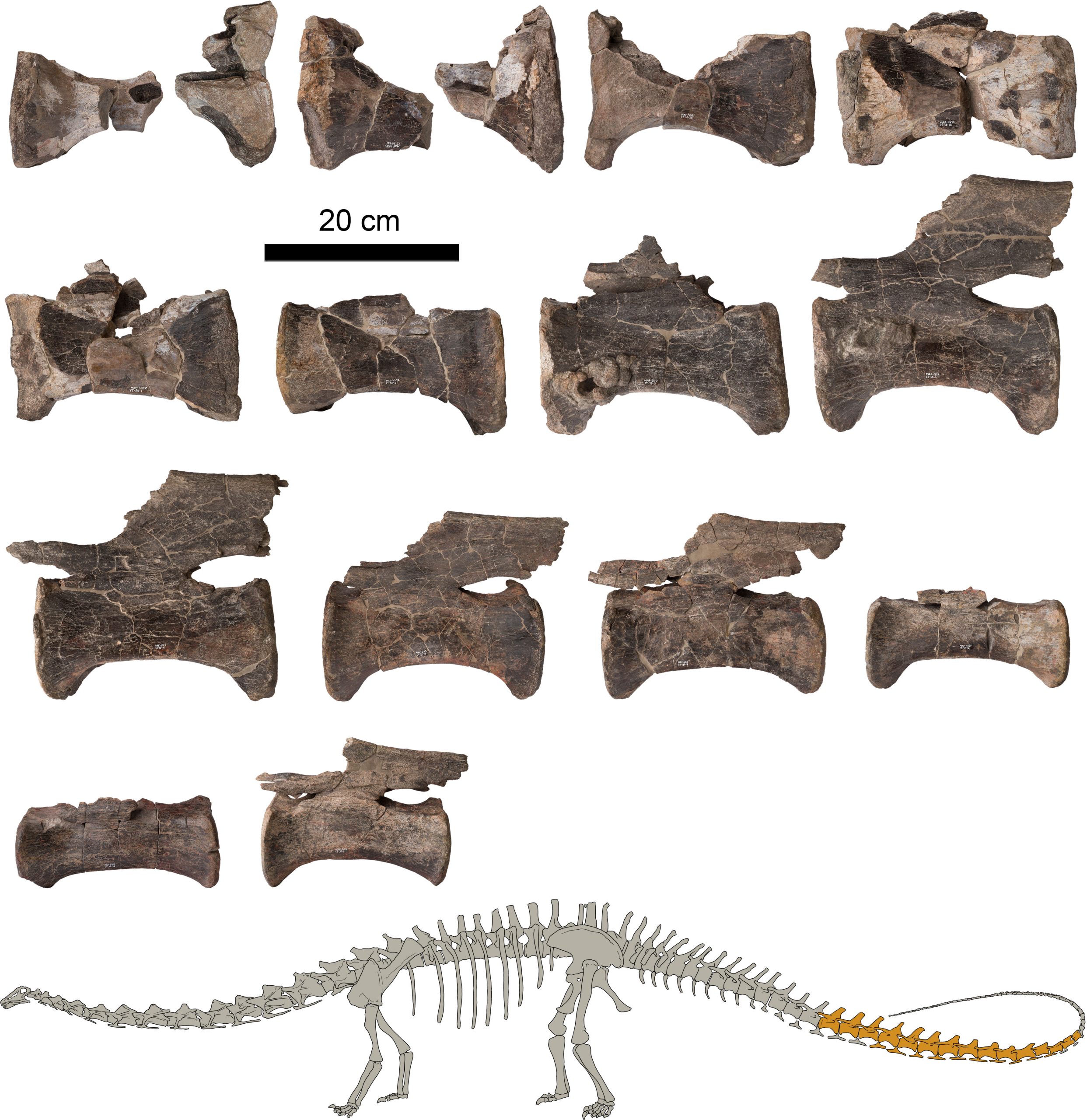
The discovery comes from La Tejería, a fossil site in El Castellar, Teruel, where researchers excavated 14 exceptionally well-preserved caudal (tail) vertebrae and several chevron bones. These bones beneath the tail, together with the vertebrae, preserved the anatomical clues needed to identify the animal.
Until this find, all confirmed Diplodocus fossils came from the Morrison Formation in the western United States. The Spanish specimen now ranks among the most complete diplodocid skeletons discovered in Europe, extending the dinosaur’s known range across an ocean.
The Tail Bones That Revealed Diplodocus
Identifying the dinosaur required more than a general resemblance. Researchers found a distinctive combination of features: large air cavities inside the vertebrae, deep grooves along the undersides of the tail bones, forked chevron bones with characteristic depressions called medial fossae, and elongated vertebral bodies without lateral ridges.
The team compared those structures with known sauropods and tested the specimen’s evolutionary relationships (including maximum parsimony and Bayesian inference methods). Both approaches placed it within the genus Diplodocus, close to the species Diplodocus hallorum.
Lead author Sergio Sánchez Fenollosa, a PhD student in biodiversity and evolutionary biology at Fundación Dinópolis, said: “We are delighted with this discovery.”
“It was an exciting and continuous process of seeing the pieces of the puzzle gradually fall into place. From the early stages of the osteological study, we noticed strong similarities with several diplodocine sauropods. As we looked more closely at the anatomy, we began to identify a combination of features characteristic of Diplodocus species. Then, as we carried out different evolutionary analyses, they kept pointing in the same direction. With each new result, the picture became clearer: we were looking at a Diplodocus.”
A Route Across The Jurassic Atlantic
The discovery also raises a larger question about the landscape these animals inhabited. Around 150 million years ago, the North Atlantic was still developing. Falling sea levels may have exposed temporary land connections, allowing dinosaurs to disperse between North America and Europe.
The Spanish fossils provide strong evidence of that exchange, although they do not reveal the precise route the animals followed. Their significance lies in showing that a dinosaur previously known only from North America also inhabited the European Jurassic.
Sánchez Fenollosa said, “And what is more, the outcome of the dig is some of the strongest paleontological evidence for episodes of dispersal and faunal exchange between the two continents across the proto-Atlantic Ocean during the Late Jurassic.”
“Essentially, this discovery allows us to better understand Iberian Mesozoic ecosystems and the diversity of sauropod dinosaurs that inhabited the European Jurassic.”
Diplodocus Joins Teruel’s Dinosaur Giants
Co-author Dr. Alberto Cobos, managing director of Fundación Dinópolis, said, “The Diplodocus from El Castellar was approximately 25 meters long (82 feet) (comparable in size to its North American relatives), making it another of the giant sauropods of the Spanish Jurassic, alongside other sauropod dinosaurs from Teruel with characteristics very different from those of diplodocids, such as Turiasaurus and Losillasaurus, among others.”
“The fossils of all these dinosaurs, including those of the new Diplodocus specimen, make Teruel a reference place for understanding this great diversity.”
Visitors can now see the fossils in the dinosaur hall of the Museo Aragonés de Paleontología at Dinópolis in Teruel, in eastern Spain, roughly between Madrid and Valencia. The specimen is available for further research as well as public education, giving scientists and visitors access to the bones that expanded the known world of Diplodocus.
Reference: “Intercontinental evidence of the iconic genus Diplodocus Marsh, 1878 (Dinosauria, Sauropoda)” by Sergio Sánchez-Fenollosa, Josué García-Cobeña and Alberto Cobos, 14 September 2026, Journal of Vertebrate Paleontology.
DOI: 10.1080/02724634.2026.2718423
Never miss a breakthrough: Join the SciTechDaily newsletter.
Follow us on Google and Google News.